Tagged: Copyleft Culture
Towards a Material Commons
 Cooperativism, Peer Production and community venture funds for the Commons. KMO from the C-Realm Podcast, interviews Michel Bauwens, Dmytri Kleiner and John Restakis
- Transcripted from the original audio by Jane Loes Lipton for Guerrilla Translation!
- Main image by Stacco Troncoso
- This transcript is also available as a Spanish translation
Can commons-oriented peer production be applied to material production? Will activists and contributors to the commons always be forced to work within capitalist structures to subsist while investing their available free time in volunteer activities? How can we create socially-oriented companies without the start-up capital to fund them? Is there a model that will allow us to make a living, produce goods and services and even compete with the dominant hegemony?
In this fascinating conversation hosted by KMO from the C-Realm Podcast, Michel Bauwens, Dmytri Kleiner and John Restakis tackle these questions, and arrive at a series of proposals combining new models of social co-ops with commons-oriented peer production and systems for collective financing.
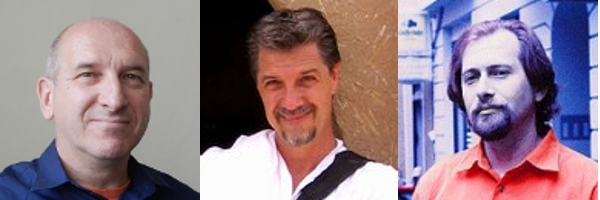
Michel Bauwens, John Restakis, Dmytri Kleiner
KMO: You are listening to the C-Realm Podcast, I am your host, KMO, and I am joined from Quito, Ecuador, by Dmytri Kleiner, Michel Bauwens, and John Restakis, so I’ll introduce you each individually. Dmytri Kleiner, this is our second conversation, although his first appearance on the C-Realm Podcast. He is a venture communist and the author of the Telekommunist Manifesto. Dmytri, welcome to the C-Realm Podcast.
Dmytri: Thank you, KMO.
KMO: Say just a little bit more about yourself. Don’t say anything about what brings you to Ecuador, though, I’ll ask you about that in a moment.
Dmytri: I’m a member of the collective called Telekommunisten. We make artworks that investigate the political economy of information, and especially the ways the Internet and social media has developed. As part of doing that, there’s a lot of writing that goes along with it, including the Telekommunist Manifesto, which looks at the history of copyright, and the history of networks and communication platforms from a materialist perspective.
KMO: And Michel Bauwens, you are back on the C-Realm Podcast, you are the founder of the P2P Foundation, and you’re working to achieve the commons-based society that can operate within a reformed market and state. Welcome back to the C-Realm Podcast.
Michel Bauwens: Thanks, it’s an honor.
KMO: And also John Restakis, the author of Humanizing the Economy, Cooperatives in the Age of Capital. John welcome to the C-Realm podcast, and please tell us a bit more about yourself.
John: Right, I have been involved with the cooperative movement, primarily in Canada, over the last 18, 19 years or so. Up until this summer I was executive director for the BC Cooperative Association, and I have been involved with writing and lecturing around cooperative economies and globalization. I’ve done a lot of work around co-op development, both in Canada and internationally, paying a lot of attention to the evolution of the cooperative model, for the creation of a new kind of market as a response to the failed neoliberal paradigm that we’re living through at the moment.
KMO: Michel, let’s start with you. You are all three in Quito, Ecuador, as invited speakers for a conference there. If you would, say a little bit about the conference, and why the conference organizers invited you in particular, what you bring to the table for this discussion.
Michel: John and I are working on something called the FLOKSociety Project. FLOK means free, libre, open knowledge society. It’s based on a speech that Pres. Rafael Correa gave some months ago where he asked young people to work and fight for open, commons knowledge-based society. Three official organisms signed an agreement, the Ministry of Knowledge, and the SENESCYT which is like an open innovation in science secretariat, and the postgraduate University of the state, called EIAN. These three asked us to provide a transition program to move Ecuador towards a commons-based model. I’m the research director and John Restakis is a research stream coordinator about institutional innovation. The other thing is the conference which you asked about, called Minga. It’s about technological sovereignty. Now that we know that everything we do is monitored and surveilled, especially by British and American intelligence, the questions are, is there anything we can do about it, is there anything we can do to preserve our privacy, protect our communications from systematic spying? And both Dmytri and I are speaking in the conference. I’m introducing the FLOK society to this public of quite committed free software activists here in Ecuador. Dmytri, do you want to add something about the conference?

FLOKSociety website
Dmytri: Sure. I’m here as a member of the free software community. I’m a developer, and have been for a long time. I introduced a critical analysis within the community which often feels that technology can solve all our problems. There is a very common attitude of the free software community that all we need to do is code better software and we can overcome things. So the reason we can’t defeat Facebook is that we simply haven’t coded a better thing. I don’t understand the problem in those ways, I understand the problem politically and economically, in that the modes of communication we use are very tightly coupled with the modes of production that finance them, so I was invited here to express that opinion in this group.
Michel: John do you want to add anything?
John: Just to say that, I’m part of the research team that Michel just outlined for the FLOK society project. I’m not actually participating in this conference, I’m not a techie by any means and I’m having a hard time just following the conversation when I go to one of those things. I’m focused on the policy formation around this transition to a new, open knowledge and commons-based economy, and that’s the research work I’m doing here. Perhaps I can pitch this back to Michel, and ask if you can provide the framework for the conversation we’re going to have, kind of an echo of what we talked about the other day.
Michel: I’d like to start with outlining the issue, the problem around the emergence of peer production within the current neoliberal capitalist form of society and economy that we have. We now have a technology which allows us to globally scale small group dynamics, and to create huge productive communities, self-organized around the collaborative production of knowledge, code, and design. But the key issue is that we are not able to live from that, right?

Michel Bauwens
The situation is that we have created communities consisting of people who are sometimes paid, sometimes volunteers, and by using open licenses, we are actually creating commonses – think about Linux, Wikipedia, Arduino, those kinds of things. But what is the problem? The problem is I can only make a living by still working for capital. So, there is an accumulation of the commons on the one side, we are effectively producing a commons, but we don’t have what Marx used to call social reproduction. We cannot create our own livelihood within that sphere. The solution that I propose is related to the work of Dmytri Kleiner – Dmytri proposed some years ago to create a peer production license. I’ll give you my interpretation of it; you can only use our commons if you reciprocate to some degree. So, instead of having a totally open commons, which allows multinationals to use our commons and reinforce the system of capital, the idea is to keep the accumulation within the sphere of the commons. Imagine that you have a community of producers, and around that you have an entrepreneurial coalition of cooperative, ethical, social, solidarity enterprise.
The idea is that you would have an immaterial commons of codes and knowledge, but then the material work, the work of working for clients and making a livelihood, would be done through co-ops. The result would be a type of open cooperative-ism, a kind of synthesis or convergence between peer production and cooperative modes of production. That’s the basic idea. I think that a number of things are happening around that, like solidarity co-ops, and other new forms of cooperative-ism. I would like John to briefly explain what that means.
John: First I should just mention that as I said earlier, I’ve been involved in the co-op movement, both in Canada and internationally for the last 17 or 18 years or so, but I’m relatively new to what I am calling the new commons movement. It’s largely through the interaction with Michel and others from that sphere that I’m becoming aware now of how extensive and vibrant this new commons movement is. So, the question for me has always been how to reimagine and reinterpret the cooperative model as a response to the current crisis, and beyond, that we’re living in at the moment.

John Restakis
Historically, the cooperative movement goes back long way, and it’s achieved enormous successes all around the world, both in the North and South. But it hasn’t had much of a direct connection to this emerging commons movement, which shares so many of the values and principles of the traditional cooperative movement. One of the issues I’m interested in addressing is how to bridge this gap between the cooperative movement internationally, and the international commons movement. There is very little dialogue between those two. I think there is a need for convergence between the traditional historical cooperative movement in this new form of commons, which is finding its voice now as a new way of thinking about social relationships, production relationships, developing new kinds of economies, as Michel just outlined.
This reinterpretation of the cooperative model as a particular form can add a lot of stability and strength and power to the commons movement. As far as I can see, it’s still largely a technology movement. There’s also a lot of peer-to-peer work going on, but it’s not very well versed around issues like cooperative organization, formal or legal forms of ownership, which are based on reciprocity and cooperation, and how to interpret the commons vision with a structure, an organizational structure and a legal structure that actually gives it economic power, market influence, and a means of connecting it to organizational forms that have durability over the long-term.
Michel: I’d like to add something. I experience this on a human level almost daily. The young people, the developers in open source or free software, the people who are in co-working centers, hacker spaces, maker spaces. When they are thinking of making a living, they think startups. They have been very influenced by this neoliberal atmosphere that has been dominant in their generation. They have a kind of generic reaction, “oh, let’s do a startup”, and then they look for venture funds. But this is a very dangerous path to take. Typically, the venture capital will ask for a controlling stake, they have the right to close down your start up whenever they feel like it, when they feel that they’re not going to make enough money. They forbid you to continue to work in the same sector after your company has failed, and you have a gag order, so you don’t even have free speech to talk about your negative experience. This is a very common experience. Don’t forget that with venture capital, only 1 out of 10 companies will actually make it, and they may be very rich, but it’s a winner-take-all system.
There is a real lack of knowledge within the young generation that there are other forms of enterprise possible. I think that the other way is also true. A lot of co-ops have been neo-liberalizing, as it were, have become competitive enterprises competing against other companies but also against other co-ops, and they don’t share their knowledge. They don’t have a commons of design or code, they privatize and patent, just like private competitive enterprise, their knowledge. They’re also not aware that there’s a new way of becoming more competitive through increased cooperation of open knowledge commons. This is the human side of it, and we need to work on the knowledge and mutual experience of these two sectors. Both are growing at the same time; after the crisis of 2008, we’ve had an explosion of the sharing economy and the peer production economy on the one side, but also a revitalization of the cooperative sector. Before Dmytri intervenes, I would like John to talk about the solidarity co-ops, and how that integrates the notion of the commons or the common good in the very structure of the co-op.
John: Historically, cooperatives have been primarily focused around providing support and service to the members. Cooperatives, which are basically a democratic and collective form of enterprise where members have control rights and democratically direct the operations of the co-op, have been the primary stakeholders in any given co-op – whether it’s a consumer co-op, or a credit union, or a worker co-op. That has been the traditional form of cooperatives for a long time now. Primarily, the co-op is in the service of its immediate members. That has changed over the last 15 years or so, particularly in the field of the provision of social care.

Cadiai Socil Coop, Bologna
Social co-ops emerged in the late 70s in Italy as a response to a market failure within public services in Italy. Groups of families or users of social services, primarily originally from within a community of people with disabilities, decided to organize cooperatives as a better way of designing and providing services to themselves. This is a very different model from the state-delivered services to these people. What was really fascinating about the social co-ops was that, although they had members, their mission was not only to serve the members but also to provide service to the broader community. And so, they were communitarian, community service organizations that had a membership base of primary users of that service, whether it was healthcare, or help for people with drug addictions, or whatever.
These social co-ops have now exploded in Italy. I think they have taken over, in a sense, the provision of social care services in many communities under contracts to local municipalities. In the city of Bologna, for example, over 87% of the social services provided in that city are provided through contract with social co-ops. These are democratically run organizations, which is a very different model, much more participatory, and a much more engaged model of designing social care than the traditional state delivered services. The idea of co-ops as being primarily of interest in serving their own immediate membership has been expanded to include a mandate for the provision of service to the community as a whole. This is an expansion of this notion of cooperatives into a more commons-based kind of mission, which overlaps with the philosophy and values of commons movement. The difference, however, is that the structure of social co-ops is still very much around control rights, in other words, members have rights of control and decision-making within how that organization operates. And it is an incorporated legal structure that has formal recognition by the legislation of government of the state, and it has the power, through this incorporated power, to negotiate with and contract with government for the provision of these public services. One of the real strengths of the cooperative form is that it not only provides a democratic structure for the enterprise – be it a commercial or social enterprise – but it also has a legal form that allows it to enter into contract and negotiate legal agreements with the state for the provision of public services. This model of co-op for social care has been growing in Europe. In Québec they’re called Solidarity co-ops, and they are generating an increasing portion of market share for the provision of services like home care and healthcare, and it’s also growing in Europe.

Sollievo social-healthcare coop, Bologna
So, the social economy, meaning organizations that have a mutual aim in their purpose, based on the principles of reciprocity, collective benefit, social benefit, is emerging as an important player for the design and delivery of public services. This, too, is in reaction to the failure of the public market for provision of services like affordable housing or health care or education services. This is a crisis in the role of the state as a provider of public services. So the question has emerged: what happens when the state fails to provide or fulfill its mandate as a provider or steward of public goods and services, and what’s the role of civil society and the social economy in response? Social co-ops have been part of this tide of reaction and reinvention, in terms of civic solutions to what were previously state-designed and delivered public goods and services. So I’ll leave it at that for the moment, but it’s just an indicator of the very interesting ways in which the co-op form is being reimagined and reinvented to respond to this crisis of public services and the changing role of the state.
Michel: Before introducing Dmytri, I’d like to reiterate one of the key problems that maybe Dmytri’s proposals will be able to solve. John has been explaining public services, but what about material production? This is where the issue arises: we have commonses of knowledge, code and design. They’re more easily created, because as a knowledge worker, if you have access to the network and some means, however meager, of subsistence, through effort and connection you can actually create knowledge. However, this is not the case if you move to direct physical production, like the open hardware movement.
What we see in the free software movement is that there are democratic foundations like the Apache foundation or the Gnu foundation, which means that the community has its own organization. In hardware, we don’t see that, because you need to buy material, machines, plastic, metal. Some people have called the open hardware community a “candy” economy, because if you’re not part of these open hardware startups, you’re basically not getting anything for your efforts. Dmytri’s offering us a vision of a commons of material means of production which I’d like him now to explain. He uses what I think is a bit provocative as a concept, the concept of “venture communism”. You think about venture, you think about venture capital, right? Dmytri, can you tell us what you mean?
Dmytri: In the 90s, I was part of the anarchist-communist, anti-globalization movement. At the same time I was also making a living as an IT consultant in a very dotcom-fueled environment. I was a really big believer in what we now call peer production. We didn’t have these terms back then, but what we now call peer production, which attempts to describe the ways that people cooperate on networks, or within free software. I envisioned this transforming our social relationships worldwide, and achieving the age-old dreams of anarchist-communism. But that all came crashing down in the early 2000s, with the dotcom bust, and the George Bush administration’s massive crackdown on protests, from Seattle, Québec City, Miami. All of a sudden, the unstoppable-ness of our movement seemed to be stopped, it seemed to be something that I couldn’t believe in anymore.
I quickly realized that this network that we were building – the Internet and the free software community – was largely enabled by our jobs for the dotcom bubble, for capitalism. It was being funded by venture capital. Realizing that venture capital wouldn’t fund the anarchist-communist social relationships that we believed were embedded in these platforms, it became clear that we needed something else. So I called that something else “venture communism”, with the intention to study what that might look like, and how we might achieve it. I originally encountered Michel after seeing some talks by Benkler and Lessig at the Wizard of OS 4, in 2006, and I wrote an essay criticizing that from a materialist perspective, it was called “The creative anti-commons and the poverty of networks”, playing on the terms that both those people used.

Lawrence Lessig y Yochai Benkler
The basis of the criticism in both cases was that they were describing peer production in a way that was very different from our conception. We didn’t have this term, this term came from Benkler, but we were talking about what we thought was the same thing. They conceive of peer production, especially Benkler, as being something inherently immaterial, a form of production that can only exist in the production of immaterial wealth. From my materialist point of view, that’s not a mode of production, because a mode of production must, in the first place, reproduce its productive inputs, its capital, its labor, and whatever natural wealth it consumes.
From a materialist point of view, it becomes obvious that the entire exchange value produced in these immaterial forms would be captured by the same old owners of materialist wealth that existed before, after, and during. This was the beginning of my dialogue with Michel. I argued for a different definition of peer production, rather than as something that is inherently immaterial, I defined it as independent producers collectively sharing a commons of productive assets. That definition of peer production is much more compatible with anarchist-communist, anarchist-syndicalist roots, and also better describes the peer-to-peer technologies that inspired the term “peer production”.
So, to try to explain what “venture communism” is, which is my own project, predating the term “peer production”, but very relevant to it. I think we’re talking about the same thing, even if I was using different terms. As a technologist, I was also inspired by the functioning of peer networks and the organization of free software projects. These were also the inspiration for venture communism. I wanted to create something like a protocol for the formation and allocation of physical goods, the same way we have TCP/IP and so forth, as a way to allocate immaterial goods. The Internet gives us a very efficient platform on which we can share and distribute and collectively create immaterial wealth, and become independent producers based on this collective commons.

Henry George
Venture communism seeks to tackle the issue of how we can do the same thing with material wealth. I drew on lots of sources in the creation of this model, not exclusively anarchist-communist sources. One was the Georgist idea of using rent, economic rent, as a fundamental mutualizing source of wealth. Mutualizing unearned income is essentially what that means in layman’s terms. The idea is that people earn income not only by producing things, but by owning the means of production, owning productive assets, and our society is unequal because the distribution of productive assets is unequal.
Even within the cooperative movement, which I’ve always admired and held up as an example, it’s clear that the distribution of productive assets is also unequal. The same with other kinds of production; for example, if you look at the social power of IT workers versus agricultural workers, it becomes very clear that the social power of a collective of IT workers is much stronger than the social power of a collective agricultural workers. There is inequality in human and capital available for these cooperatives. This protocol would seek to normalize that, but in a way that doesn’t require administration. The typical statist communist reaction to the cooperative movement is saying that cooperatives can exclude and exploit one another, and that solution is either creating giant cooperatives like Mondragon, or socialist states.

Silvio Gessell
But then, as we’ve seen in history, there’s something that develops called an administrative class, which governs over the collective of cooperatives or the socialist state, and can become just as counterproductive and often exploitive as capitalist class. So, how do we create cooperation among cooperatives, and distribution of wealth among cooperatives, without creating this administrative class? This is why I borrowed from the work of Henry George and Silvio Gesell in created this idea of rent sharing.
The idea is that the cooperatives are still very much independent just as cooperatives are now. The producers are independent, but instead of owning their productive assets themselves, each member of the cooperative owns these together with each member of every other cooperative in the Federation, and the cooperatives rent the property from the commune collectively. This is not done administratively, this is simply done as a protocol. The idea is that if a cooperative wants an asset, like, an example is if one of the communes would like to have a tractor, then essentially the central commune is like a bond market. They float a bond, they say I want a tractor, I am willing to pay $200 a month for this tractor in rent, and other members of the cooperative can say, hey, yeah, that’s a good idea,we think that’s a really good allocation of these productive assets, so we are going to buy these bonds. The bond sale clears, the person gets the tractor, the money from the rent of the tractor goes back to clear the bonds, and after that, whatever further money is collected through the rent on this tractor – and I don’t only mean tractors, same would be applied to buildings, to land, to any other productive assets – all this rent that’s collected is then distributed equally among all of the workers.
So, the unearned income, the portion of income derived from ownership of productive assets is evenly distributed among all the cooperatives and all the stakeholders among those cooperatives, and that’s the basic protocol of venture communism.
Michel: Okay, Dmytri, just to make sure I understand it right, it’s like a basic income, right? In the sense that you have your wage, because you work, and then in addition you get this rent from all the productive forces held together by all the members of this economic unified cooperative production?
Dmytri: Exactly. Whatever productive assets you consume, you pay rent for, and that rent is divided equally among all members of the commune. Not the individual cooperatives, but the commune itself. This means that if you use your exact per capita share of property, no more no less than what you pay in rent and what you received in social dividend, will be equal. So if you are a regular person, then you are kind of moving evenly, right? But if you’re not working at that time, because you’re old, or otherwise unemployed, then obviously the the productive assets that you will be using will be much less than the mean and the median, so what you’ll receive as dividend will be much more than what you pay in rent, essentially providing a basic income. And conversely, if you’re a super motivated producer, and you’re greatly expanding your productive capacity, then what you pay for productive assets will be much higher than what you get in dividend, presumably, because you’re also earning income from the application of that property to production. So, venture communism doesn’t seek to control the product of the cooperatives. The product of the cooperatives is fully theirs to dispose of as they like. It doesn’t seek to limit, control, or even tell them how they should distribute it, or under what means; what they produce is entirely theirs, it’s only the collective management of the commons of productive assets.
Michel: Dmyitri, I think your theory has three constitutive elements, one is the venture communism, what are the two others? Can you briefly recall your idea of the peer production license, which I mentioned at the beginning?
Dmytri: Yes, first part is related to my critique of Benkler, and the peer production license comes, well, it predates it, but it enters this conversation between us through my critique of Lessig. The three constituent parts of venture communism were developed in speaking to a lot of people involved in cooperatives and economists. On paper this would seem to work, but the problem is that this assumes that we have capital to allocate in this way, and that is not the case for most of the world workers. So, how do we get to that stage? And that’s where venture communism becomes an umbrella, venture communism being only one constituent element, the other two being counter politics and insurrectionary finance. The idea of counter politics is that there is a long-running feud in the communist community and socialist community and, actually, the activist community generally: do we express our activism through the state, or do we try to achieve our goals by creating the alternative society outside…
Michel: …pre-figurative politics…

Dmytri Kleiner
Dmytri: …pre-figurative politics, versus statist politics. And with the idea of counter politics, I’m trying to show that this is actually a false dilemma, because the idea of pre-figurative politics presupposes that we have the wealth in order to create these pre-figurative enterprises, these pre-figurative startups or co-ops or whatever. My materialist background tells me that when you sell your labor on the market, you have nothing more than your subsistence costs at the end of it, so where is this wealth meant to come from? I believe that the only reason that we have any extra wealth beyond subsistence is because of organized social political struggle; because we have organized in labor movements, in the co-op movement, and in other social forms. We have fought for this, so that we now have more than our subsistence. And this is the reason that we can’t even consider pre-figurative solutions. To create the space for prefiguring presupposes engagement with the state, and struggle within parliaments, and struggle within the public social forum.
What I propose in counter politics is that we don’t think of engaging in party politics, as in the sort of classic Leninist party idea, that we will take the state, that we will impose new social relationships from the top down, and we will go through an intermediary stage of socialism, and we will finally achieve communism. This is a very problematic conception, and I’m not very hopeful that that kind of solution would work. Instead, we should think that no, we must engage in the state in order to protect our ability to have alternative societies, in order to protect the benefits that we have now, in order to protect the public services and the public goods, and the public benefits. We have to acknowledge that there are certain social functions that the state provides that are socially necessary, and we cannot do without them. We can only get rid of the state in these areas once we have alternative, distributed, cooperative means to provide those same functions. Just because we can imagine that they can exist doesn’t make them exist. We can only eliminate the state from these areas once they actually exist, which means we actually have to build them. We have to create alternative ways to provision healthcare, childcare, education, to deal with human frailty and economic cycles, all these kinds of social functions the state provides that are socially necessary.
Michel: Okay, so what about insurrectionary finance, that’s your third…
Dmytri: There’s a strange corner of the activist community that’s called alternative economics, and this is almost held in the same disdain as conspiracy theory by most activist groups. Everybody thinks, oh, yes, alternative currencies and alternative kinds of things are kind of irrelevant to the social thing. What I mean by insurrectionary finance is that we have to acknowledge that it’s not only forming capital and distributing capital, it’s also important how intensively we use capital. We have to understand the role of money, the role of debt, the role of economic interactions, and how to model them in order to create a more intensive use of capital.
If you understand the capitalist economy, everybody knows that the amount of money in the economy is greatly expanded through economic things like loans, securities, and various economic means where capital, especially finance capital, is used more intensively than it otherwise would, sometimes dangerously so. I’m not proposing that the cooperative movement needs to engage in the kind of derivative speculative madness that led to the financial crisis, but at the same time we can’t… it can’t be earn a dollar, spend a dollar. We have to find ways to create liquidity, to deal with economic cycles, and so we have to look at alternative economics in order to do that. And sometimes even not-so-alternative economics, as we’ve talked about before.
Paradoxically, I’m rather inspired by Michael Milken and the corporate raiders of the 80s that are famous for making junk bonds. They were sort of the financial side of the industrialization of the West, and their mechanisms were to issue junk bonds, low rated bonds, use these funds to buy corporations that work undervalued, and then basically strip the assets - the land, the capital, just strip them down, close them, sell of the assets, repay the bonds, keep their huge profits, and rinse and repeat, as it were, over and over again.

The Junk Bond King, Michael Milken
And this to me is really interesting, because, on one hand, it’s horrible what they did, and the legacy of the damage that the corporate raiders had is pretty large. But on the other hand, it’s kind of inspiring because they did things the organized left hasn’t been able to do, which is takeover industrial means of production, right? So it seems to me that we should be inspired by that, and we should think, well, if they can take over these industrial facilities, just in order to shut them down and asset strip them, why can’t we take them over and mutualize them? It becomes even more ironic once you understand that the source of investment that Milken and his colleagues were working with were largely workers pension funds. It was actually the savings of workers - achieved through social struggle as we’ve talked about before. Unions got together and struggled against the bosses to allow workers to save, which was already struggle one, then they put these savings into pension funds - and then Milken and his followers sold their bonds to these pension funds and used this money to destroy the factories that the workers were working in.
Michel: I think it’s maybe time for John to make some comments on Dmytri’s ideas.
John: A couple of thoughts come to mind around the idea of venture communism – it’s great term by the way – and a new model for pooling, based on the capture of unearned income. It’s a very suggestive model, there are close models to this that are already being used by cooperatives to share machinery. For example, I know for example in Québec, there is a particular form of co-op that’s been developed that allows small or medium producers to pool their capital to purchase machinery and to use it jointly. It doesn’t have exactly the form that you’re talking about, which is this kind of bond issue, which is a very interesting idea, I’d love to see that applied. The other idea I liked was trying to minimize a management class, within these systems. I know this varies from co-op to co-op and federation to federation, but I do know that in these kinds of shared pool systems of both capital and equipment, that the organizations that are put in place for the management of these systems are, by comparison to other forms of control, much more lean and accountable because they are accountable to boards of directors that represent the interests of the members. But I take your point around that. So, very interesting idea.
The second point that comes to my mind is around this tension that you described within the left, and among activists. It’s a tension around their relationship to the idea of the market, and to capital for that matter. I’ve run into this repeatedly among social change activists who immediately recoil at the notion of thinking about markets and capital, as part of their change agenda.
I think what was most revelatory to me around the cooperative movement was that I used to think of the same way. The most important lesson I took from my contact with the cooperative movement was a complete rethinking of economics. I had thought previously, like so many, that economics is basically a bought discipline, and that it serves the interests of existing elites. I really had a kind of reaction against that. When I saw and understood that cooperatives were another form of economics, a popular form of economics, it completely shifted my perception around what social change entails, with respect to the market. One of the things I think we really have to do is to recapture the initiative around vocabulary, and vision, with respect to economics.
Dmytri: Absolutely.
John: And a key part of that is reimagining and reinterpreting, for a popular and common good, the notion of market and capital. And that’s what cooperatives, among other kinds of systems, do. They reclaim the market. I think that’s a fundamental task, in terms of educating and advocating for a vision of social change that isn’t just about politics, and isn’t just about protest, it has to be around how do we reimagine and reclaim economics, and how do we develop forms where markets actually belong to communities and people, not just to corporations. Traditionally markets were not just a property of corporations and companies, and capital wasn’t just an accumulated wealth for the rich. Capital can be commons capital, it can be a commons market, and we need to come up with forms and models that actually realize that in practice, and that’s what the peer-to-peer movement is, that’s what the cooperative movement is, and we need to find ways of conjoining those two.
Dmytri: I agree.

FLOKSociety invertigator, Janice Figueredo
Michel: I agree too, and I think this is a really nice way to start our conclusion, just to make another reference to the project here in Ecuador. I think in many countries now, there are ministries of the social economy, of the solidarity economy, but they’re always seen as kind of marginal add-ons. I think what we’re potentially talking about here is to make the social economy hyper-productive, hyper-competitive, hyper-cooperative. The paradox is that capital already knows this. Capital is investing in these peer production projects, and cooperatives are not yet massively turning that way, so this is what we have to achieve. Part of the proposal of the FLOK society project in Ecuador will be to get that strategic reorganization to make the social economy strategic, not just as an add-on to an existing neoliberal format. I think we’ve pretty much finished, but I just wanted to mention that the end of our discussion in the bar, I proposed that the P2P foundation, which has a co-op, would also try to create a seed form for what Dmytri proposes. I hope that they weren’t drunk when they were saying that, but John and Dmitri actually said they would cooperate (laughter). So, KMO, maybe you have a last question? I think that we’re nearly at the end of the allotted time.

KMO, host of the C-Realm Podcast
KMO: Well, we are at the end of the allotted time, I have been taking notes and I have a lot of questions (laughter). What I’ll have to do is get each of you on Skype individually in the coming weeks, and put my questions to you one-on-one, because I think that there’s at least three episodes worth of questions that I have here.
Michel: Yes, it’s very dense and I apologize to your listeners, l hope it wasn’t sleep inducing! but this is strategic, we’re talking about the DNA of the system, and I think that’s why it’s so important that we had this occasion to actually talk together and compare our perspectives.
KMO: Well, I’m very happy to of been a party to it, and I’m looking forward to re-listening, because I know I’ll be taking a lot more information from the recording that you’ve made as as I listen to it and edit it for a one-hour podcast. Dmytri Kleiner, Michel Bauwens, and John Restakis, thank you very much for all the work you’re doing, and for participating on the C-Realm Podcast.
Michel: I also want to thank Bethany Horne, for facilitating this encounter, and Clara Robayo from Radialistas.net
Guerrilla Translation/Related: Venture Communism and Technological Miscommunication: a Conversation with Dmytri Kleiner
 #GlobalP2P, The Wind that Shook the Net/ Bernardo Gutiérrez
This trancription has also been published at:
- Shareable
- Resilience.org
- The P2P Foundation blog, as three extracts: Bauwens, Restakis, Kleiner.
Hacia un procomún material
Cooperativismo, producción P2P, y financiación comunitaria en el contexto del procomún. KMO del C-Realm Podcast, entrevista a Michel Bauwens, Dmytri Kleiner y John Restakis
- Traducido por Stacco Troncoso, editado por Mamen Martín y Rosana Fernández - Guerrilla Translation!
- Imagen de Stacco Troncoso
- Artículo original, en audio, en texto.
- Descarga este artículo en PDF
¿Podemos llevar el modelo de producción P2P al terreno material? ¿Es obligatorio trabajar dentro de esquemas capitalistas para que colaboradores del procomún, activistas y demás puedan subsistir y dedicar su tiempo libre a estas actividades? ¿Cómo podemos crear empresas sociales si no tenemos capital para arrancarlas? ¿Acaso hay un modelo que nos permita ganarnos la vida, producir bienes y servicios e incluso competir con la hegemonía dominante…?
En esta fascinante conversación grabada por KMO del C-Realm Podcast, Michel Bauwens, Dmytri Kleiner y John Restakis se plantean estas preguntas y más, para hallar una serie de soluciones que combinan nuevos modelos de cooperativismo social con las dinámicas de producción entre iguales orientadas al procomún y los sistemas de financiación colectiva.
Michel Bauwens, John Restakis, Dmytri Kleiner
KMO: Estás escuchando el C-Realm Podcast y hoy hablaremos desde Quito, Ecuador, con Dmytri Kleiner, Michel Bauwens y John Restakis. Os voy a presentar a cada uno individualmente. Dmytri Kleiner es un “comunista de riesgo” 1 y el autor del “Manifiesto Telekomunista”. Dimytri bienvenido al C-Realm.
Dmytri: Gracias, KMO.
KMO: Háblanos un poco de ti mismo.
Dmytri: Formo parte de un colectivo llamado Telekommunisten. Nos dedicamos a proyectos artísticos que investigan la economía política de la información y, especialmente, la evolución de Internet y las redes sociales. Como parte de ello presentamos muchos textos, entre los que encontramos el “Manifiesto Telekomunista”, que trata sobre la historia del copyright, las redes y las plataformas de comunicación desde una perspectiva materialista.
KMO: También tenemos a Michel Bauwens creador de la Fundación P2P, cuyo objetivo es fomentar una sociedad basada en el procomún dentro de un marco estatal y económico reformado. Bienvenido de nuevo al C-Realm Podcast.
Michel: Gracias, es un honor.
KMO: Y por último, John Restakis, autor de Humanizing the Economy: Cooperatives in the Age of Capital. (Humanizar la economía: cooperativas en la era del capital). John bienvenido al C-Realm Podcast. Háblanos un poco de ti mismo.
John: Sí, llevo unos dieciocho o diecinueve años trabajando con el movimiento cooperativista canadiense. Hasta este verano he sido el director ejecutivo de la Asociación de Cooperativas de la Columbia Británica y también me dedico a escribir y dar conferencias sobre economía cooperativa y globalización. He trabajado mucho en el desarrollo del modelo cooperativo en Canadá e internacionalmente, estudiando tanto su evolución como la creación de nuevos tipos de mercados como respuesta a este paradigma neoliberal, fallido y omnipresente.
KMO: Michel, vamos a empezar contigo. Los tres estáis en Quito, Ecuador como ponentes en una conferencia. ¿Qué nos puedes contar sobre la conferencia y por qué os han invitado a vosotros específicamente? ¿Qué váis a aportar al diálogo?
Michel: John y yo estamos aquí trabajando en el proyecto FLOKSociety. “FLOK” significa “Free/Libre Open Knowledge” Society (Sociedad de conocimiento libre, abierto y común). Todo surgió a raíz de un discurso de hace unos meses en el que el presidente, Rafael Correa, planteó un reto a juventud ecuatoriana: desarrollar y defender una sociedad del conocimiento abierto, libre y basado en el procomún. Existe un acuerdo firmado por tres organismos oficiales: el Ministerio del Conocimiento y Talento Humano, el SENESCYT, que es un secretariado de innovación abierta y ciencia, y la Universidad de Posgrado Estatal en IAEN. Estas tres organizaciones nos han pedido desarrollar un programa de transición para dirigir Ecuador hacia un modelo basado en el procomún. Soy el director de investigación del proyecto y John Restakis es el coordinador de corrientes de investigación orientadas a la innovación institucional. Eso es una parte, la otra es la conferencia que has mencionado antes. Se llama “Minga por la libertad tecnológica” y trata sobre la soberanía tecnológica. Ahora que sabemos que están vigilando y monitorizando todo lo que hacemos —especialmente si se trata de la inteligencia norteamericana o británica— nos planteamos la siguiente pregunta: ¿Qué podemos hacer al respecto? ¿Qué podemos hacer para mantener nuestra privacidad y proteger nuestras comunicaciones del espionaje sistemático? Dmytri y yo somos ponentes en la conferencia. Yo, básicamente, voy a introducir el proyecto FLOKSociety ante un público compuesto por activistas comprometidos con el software libre aquí en Ecuador. Dmytri, ¿quieres decir algo más sobre la conferencia?
Web de FLOKSociety
Dmytri: Por supuesto. Estoy aquí porque soy parte de la comunidad del software libre. Tengo una larga trayectoria como desarrollador informático y he venido a presentar un análisis crítico ante una comunidad que, a menudo, cree que la tecnología es capaz de resolver todos nuestros problemas. Es una actitud bastante frecuente dentro de la comunidad de software libre, expresada en frases como “si somos capaces de programar mejor software, superaremos cualquier obstáculo” o “el motivo por el que no hemos vencido a Facebook es porque no podemos programar algo mejor”. Mi análisis del problema sigue otros cauces; lo veo como un problema tanto económico como político y creo que los modos de comunicación que empleamos tienen una relación muy estrecha con los modos de producción que los financian. Me han invitado aquí para expresar esa opinión ante este grupo.
Michel: John, ¿quieres añadir algo?
John: No, solamente expresar que soy parte del equipo de investigación del que Michel acaba de hablar para el proyecto de FLOKSociety. No soy parte de la conferencia y tampoco soy nada “tecnológico”. Es más, me resulta bastante difícil seguir la temática de estas conferencias. Mi propia investigación trata sobre la legislación pertinente a esta transición hacia una economía basada en el conocimiento abierto y el procomún. Llegados aquí, le quiero devolver la palabra a Michel. Michel, quizás puedas desarrollar un poco el marco de la conversación para reflejar los temas de los que estábamos hablando el otro día.
Michel: Quiero empezar hablando un poco sobre los problemas y las cuestiones que surgen en torno a la producción entre iguales, o P2P, en el marco de la sociedad y economía neoliberal-capitalista actual. Podríamos describirlo de la siguiente manera: contamos con la tecnología necesaria para escalar las dinámicas de grupos pequeños a nivel global y crear grandes comunidades productivas y autogestionadas en torno a la producción colaborativa de conocimiento, código y diseño. El problema es que no podemos ganarnos la vida con ello.
Michel Bauwens
La situación es que hay comunidades donde algunos perciben un salario mientras que el resto trabaja de forma voluntaria, pero todas utilizan metodologías abiertas para crear un procomún. Cosas como Linux, Arduino, Wikipedia y todo eso… Pero esto conlleva un problema, dado que solo te puedes ganar la vida trabajando para el capital. Se está produciendo un procomún, y cada vez más, pero sin disfrutar de lo que Marx denominaba como “la reproducción social”. Dado que no podemos subsistir en este ámbito, quisiera proponer una solución muy relacionada con el trabajo de Dmytri Kleiner. Hace unos años, Dmytri propuso la creación de una licencia producción entre iguales. Yo la interpreto de la siguiente manera: La licencia declara que solo puedes utilizar nuestro procomún si eres recíproco con él hasta cierto punto. Es decir, en vez de tener un procomún totalmente abierto (donde se permite que las multinacionales se lucren con nuestro esfuerzo para seguir fortaleciendo al capital) la idea es mantener la acumulación de beneficios dentro del ámbito del procomún. Imagina que tienes una comunidad de productores y, por encima de ella, una coalición empresarial de cooperativas éticas asociadas y empresas de solidaridad social.
La idea es tener un procomún inmaterial de código y conocimiento, pero el “trabajo material”, es decir, la labor de trabajar para clientes y ganarte la vida, la haces a través de cooperativas. El resultado sería una especie de “cooperativismo abierto”. Se trataría de la combinación, convergencia y síntesis de la producción entre iguales y la producción cooperativista. Esa es la idea básica y ya vemos ejemplos de ello en las cooperativas solidarias y las nuevas formas de cooperativismo. John, me gustaría que nos hablaras un poco de todo esto.
John: Sí, cómo no. En primer lugar quiero constatar, que, aunque he trabajado dentro del sector cooperativo canadiense durante los últimos dieciocho o diecinueve años, sigo siendo un novato en lo que yo llamo el “nuevo movimiento del procomún”. Y es gracias a la interacción con Michel y otra gente de este mundillo que me estoy percatando del alcance y la vitalidad que hay en este nuevo movimiento. Para mí la gran pregunta siempre ha sido cómo reimaginar y reinterpretar el modelo cooperativo para dar respuesta a la crisis actual y a lo que nos depare el futuro.
John Restakis
Históricamente, el movimiento cooperativo tiene mucha trayectoria y ha alcanzado unos logros formidables en países de todo el mundo, tanto del norte como del sur. Pero, hasta ahora, no ha habido una conexión directa con este movimiento emergente del procomún, que comparte muchos de los valores y principios del movimiento cooperativista tradicional. Uno de los temas que más me interesa es cómo forjar lazos y salvar diferencias entre el movimiento cooperativista global y las iniciativas orientadas hacia el procomún, también a nivel internacional. Existe una carencia de diálogo entre ambos y creo que hay una gran necesidad de convergencia entre el movimiento cooperativista internacional e histórico y este nuevo prototipo del procomún, que está hallando su voz como nuevo paradigma para las relaciones sociales, las relaciones de producción y los nuevos modelos económicos, tal y como ha descrito Michel.
Esta reinterpretación del modelo cooperativo posee unas características muy peculiares que pueden dotar al movimiento del procomún de más fuerza, estabilidad e influencia. Este último, por lo que veo, sigue principalmente enfocado en el ámbito tecnológico. Es cierto que tiene un componente entre iguales o P2P muy importante pero, aun así, hay escasez de conocimientos en cuanto a estructuras cooperativas o a protocolos formales de propiedad legal basados en la reciprocidad y la cooperación. Quiero plantear una visión del procomún dotada de las estructuras organizativas y legales necesarias para conferirle más poder económico, influencia de mercado y mayor fluidez a la hora de conectar con modos de organización más duraderos a largo plazo.
Michel: Quiero añadir que, a nivel personal, veo ejemplos de esto casi a diario. Los jóvenes, los desarrolladores del software libre o código abierto, toda la gente que está en espacios de co-working, hackerspaces o makerspaces… siempre que se plantean cómo ganarse la vida, piensan en “Start ups” o empresas incipientes. Están muy influidos por la atmósfera neoliberal dominante que ha caracterizado a su generación y tienen una especie de impulso genérico. Dicen: “vamos a empezar un start-up” y se ponen a buscar capital riesgo. Es un camino muy peligroso, el capital riesgo típicamente exige una serie de controles y garantías: tienen derecho a cerrar toda empresa cuando les dé la gana o si creen que no van a ganar suficiente dinero. Te prohíben seguir trabajando en el mismo sector después de que la compañía haya fracasado y te imponen cláusulas de confidencialidad, con lo que ni siquiera tienes libertad de expresión para hablar de tus experiencias negativas. Es una situación muy común. Tengamos en cuenta que, de todas las empresas financiadas con capital riesgo, solo sale adelante una de cada diez. Estas compañías se vuelven multimillonarias, pero es un sistema en el que los que triunfan arrasan con todo.
Esta generación de jóvenes desconoce la existencia de otras fórmulas para crear y gestionar una empresa. Creo que también ocurre lo mismo a la inversa. Hay muchas cooperativas que se están “neoliberalizando”, por decirlo de alguna manera. Se han convertido en empresas competitivas que contienden con otras cooperativas y empresas normales y ni comparten sus conocimientos, ni fomentan un procomún de diseño o de código. Privatizan y patentan el conocimiento que han generado, igual que cualquier empresa competitiva privada. Aún no se han dado cuenta de que hay una nueva forma de ser más competitivo: mediante la cooperación dentro de un procomún de conocimiento abierto. Este es el lado humano de este problema y podríamos solucionarlo beneficiándonos del conocimiento y la experiencia mutua de ambos sectores. Los dos están creciendo paralelamente; después de la crisis de 2008 hemos visto la consolidación de la economía colaborativa, junto a una explosión en la economía de producción entre iguales, pero también hay una revitalización en el sector cooperativo. John, antes de que hable Dmytri me gustaría que hablarás sobre las cooperativas de solidaridad y cómo integran la noción del procomún y el bien común dentro de la propia estructura cooperativa.
John: Históricamente hablando, las cooperativas normalmente se han dedicado a proveer servicios y apoyar a sus propios miembros. Si por “cooperativa” entendemos “empresas colectivas, democráticas y bajo control de sus miembros”, los miembros son los mayores beneficiarios de la cooperativa; ya sean cooperativas de consumo, de trabajadores o de ahorro y crédito. Ésa sido la tradición: la cooperativa está al servicio de sus miembros inmediatos. Esto ha cambiado en estos últimos 15 años y, en particular, en el sector de la asistencia social.
Cooperativa social Cadiai, Bolonia
Las cooperativas de asistencia social surgieron en Italia a finales de los 70 como respuesta al fracaso del modelo de mercado que sustentaba los servicios públicos del país. Por eso las familias y los usuarios de los servicios sociales —primordialmente dentro de la comunidad de personas con discapacidad— empezaron a crear cooperativas para seguir beneficiándose de estos servicios. Es un modelo muy distinto a la asistencia social estatal. Lo más fascinante de estas cooperativas sociales es que, aunque tienen membresía propia, su misión no es sólo atender a las necesidades de sus miembros, sino proveer un servicio a toda la comunidad. Por tanto, son organizaciones de servicios comunitarios compuestas por los principales usuarios de tales servicios, ya sea asistencia médica, asistencia a drogodependientes, etc. Estas cooperativas sociales han tenido un auge explosivo en Italia. Creo que, en cierto sentido, se han apropiado del sector de la asistencia social en muchas comunidades y todo esto mediante contratos con los ayuntamientos. En Bolonia, por ejemplo, más del 87% de los servicios sociales de la ciudad se proporcionan a través de cooperativas sociales.
Estas cooperativas son organizaciones de gestión democrática y pertenecen a un modelo muy diferente, mucho más participativo y que está mucho más involucrado en el diseño de esa asistencia social que el modelo habitual gestionado por el Estado. El concepto tradicional de las cooperativas como algo primordialmente dirigido al beneficio y los intereses de sus propios socios se ha expandido para incluir una provisión de servicios a toda la comunidad. Esto expande la definición tradicional de “cooperativa” para incluir una serie de objetivos más acordes con el bien común, algo que, por supuesto, tiene mucho que ver con la filosofía y los valores del movimiento del procomún. La diferencia es que las cooperativas sociales siguen estructuradas en torno a los derechos de gestión (qué miembros tienen derechos de decisión, qué controlan dentro de la cooperativa, etc.) y sobre la propia operatividad de la organización. Se trata de una estructura legal incorporada y con el reconocimiento formal de las autonomías y del gobierno central. Gracias a ello, las cooperativas pueden negociar y forjar contratos con el gobierno para la provisión de estos servicios públicos. Una de las mayores ventajas del modelo cooperativo es que —aparte de disfrutar de una estructura de empresa democrática, independientemente de tratarse de cooperativas sociales o comerciales— también tiene una estructura legal que le permite firmar contratos y establecer acuerdos legales con el Estado en materia de servicios públicos. Este modelo de cooperativa de servicios sociales ha Estado creciendo en Europa. En Quebec se llaman cooperativas de solidaridad y están generando cada vez más cuota de mercado en servicios tales como la asistencia doméstica o la sanidad. También está creciendo en otras partes de Europa.
Cooperativa social-sanitaria Sollievo, Bolonia
En conclusión, la economía social —es decir organizaciones con objetivos basados en unos principios de reciprocidad y de beneficios colectivos y sociales— está emergiendo como un agente muy importante en el diseño de suministro de servicios públicos. Esto surge como reacción al fracaso de los mercados públicos a la hora de gestionar servicios sociales, como el derecho a la vivienda, a la sanidad y a la educación a precios asequibles. El papel del Estado como proveedor de servicios públicos está en crisis y, por tanto, surge la pregunta: ¿qué pasa cuando el Estado no puede cumplir con su mandato como proveedor y gestor de servicios públicos y cuál es el rol de la sociedad civil y de la economía social ante esto? Las cooperativas sociales son parte de la respuesta y, en términos de soluciones cívicas, suponen una reinvención ante lo que otrora eran las responsabilidades del Estado en el sector público. De momento lo dejó ahí, pero es representativo de la cantidad de iniciativas interesantísimas que están reinventando el modelo cooperativo y respondiendo a esta crisis de servicios públicos y al rol cambiante del Estado.
Michel: Antes de dar paso a Dmytri me gustaría reiterar uno de los problemas clave que quizás pueda solucionarse mediante sus propuestas. John acaba de hablar de servicios públicos, pero ¿qué pasa con la producción material? Aquí surge el siguiente problema: tenemos un procomún de información, relacionado con el código de software y el diseño, que es cada vez más accesible. Por tanto, si trabajas en algunos de estos sectores y tienes acceso a redes, te puedes costear tu subsistencia, aunque sea de mala manera, y podrás seguir creando conocimiento gracias a tus esfuerzos y tus conexiones. Pero la situación cambia cuando hablamos de la producción directa de objetos físicos como, por ejemplo, dentro del movimiento de hardware abierto.
En el movimiento de software libre nos topamos con entidades democráticas, como la Apache Foundation o la GNU Foundation, que son organizaciones que protegen a la comunidad. Pero en el ámbito del hardware no hay nada parecido porque ahí hay que comprar material, máquinas, plástico o metal. Hay gente que dice que la economía del hardware abierto es una “economía de caramelo” porque jamás obtendrás nada a cambio de tus esfuerzos —a menos que estés trabajando para alguna de estas empresas incipientes de hardware abierto. Dmytri tiene una visión del procomún que incorpora la producción material y me gustaría que nos explicará en qué consiste. También utiliza un concepto que me resulta algo provocativo: el “comunismo riesgo”. Cuando hablamos de “riesgo” o de “inversión” en este contexto, suele ser dentro del contexto del capital ¿no es así? Dmytri, háblanos más sobre tu proyecto.
Dmytri: En los 90 fui parte del movimiento anti-globalizador anarco-comunista, pero también me ganaba la vida como asesor tecnológico en un entorno principalmente impulsado por el desmadre puntocom. Creía apasionadamente en lo que ahora llamamos “producción entre iguales” aunque, por entonces, ese término no existía. Lo que llamamos “producción entre iguales” o “producción P2P” describe las dinámicas de cooperación interpersonal en el ámbito de la red o del software libre. Creí que esto transformaría las relaciones sociales de todo el planeta y que por fin se cumplirían todos los sueños de la tradición anarco-comunista. Pero todo eso se vino abajo en los primeros años del nuevo milenio con el estallido de la burbuja puntocom y la represión masiva de la administración de George Bush en contra de las protestas. Estoy hablando de Seattle, Quebec City, Miami etc. De repente, nuestro “movimiento imparable” se vio detenido y dejé de creer en ese idealismo tan al pie de la letra.
Me di cuenta de que esta red que estábamos construyendo —es decir, Internet y la comunidad del software libre— se construyó gracias a nuestro trabajo asalariado para la burbuja, gracias al capitalismo. Todo fue financiado por el capital riesgo. Tras darme cuenta de que el capital riesgo no financiaría las relaciones sociales artísticas y anarco-comunistas que veíamos como parte inherente de estas plataformas, supe que necesitábamos algo distinto. Y ese “algo” lo bauticé como “Comunismo riesgo”, con la intención de desarrollarlo y ver cómo llegar hasta ahí. Conocí a Michel tras atender a unas charlas de Benkler y Lessig en la conferencia de Wizard of OS 4, allá por el 2006 y escribí un ensayo criticando sus perspectivas llamada “The creative anti-commons and the poverty of networks,” 2 jugando un poco con los términos que utilizaban.
Lawrence Lessig y Yochai Benkler
Mi crítica se basa en que ambos describen la producción entre iguales de manera muy distinta a nuestro concepto de lo que, en esencia, es el mismo ideal. Aunque no lo describíamos con esos términos, “producción entre iguales” es un término de Benkler, pero estábamos hablando de lo mismo. Su concepto de producción entre iguales, especialmente el de Benkler, es de algo inherentemente inmaterial. Se trata de un modo de producción que sólo puede compaginarse con la producción de riqueza inmaterial. Eso, desde mi punto de vista materialista, no es un modo de producción, porque un modo de producción debe, en primer lugar, reproducir sus insumos productivos y tiene que reproducir su capital, su trabajo y la riqueza natural que produce.
Desde un punto de vista materialista, es evidente que todo el valor de cambio derivado de estos bienes inmateriales acabará en manos de los mismos dueños de riqueza material que han existido a lo largo de la historia. Así comenzó mi diálogo con Michel para llegar a otra definición de “producción entre iguales”. En vez de definirla como algo inherentemente inmaterial, la defino como una red de productores independientes compartiendo un procomún colectivo de bienes productivos. Es una definición de producción entre iguales mucho más compatible con la tradiciones anarco-sindicalistas y anarco-comunistas. También es una descripción más acertada de las tecnologías P2P que inspiraron el término “producción entre iguales”.
Asimismo quise explicar en qué consistía el comunismo riesgo, mi propio proyecto que precede a la acuñación del término “producción entre iguales” pero que pueda aportarle muchos beneficios, dado que estamos hablando de lo mismo, aunque utilicemos términos distintos para describirlo. Como tecnólogo, siempre me he inspirado en las dinámicas de las redes entre iguales y en los proyectos de software libre. Todo esto influyó en la creación del comunismo riesgo. Dado que ya teníamos TCP/IP y demás para distribuir bienes inmateriales, me propuse crear un protocolo apto para la producción y distribución de bienes físicos. Internet es una plataforma muy eficaz para compartir, distribuir y crear riqueza inmaterial colectiva y para ayudarnos en nuestro afán de ser productores independientes basados en este procomún colectivo.
Henry George
El objetivo del comunismo riesgo es seguir el mismo patrón con la riqueza material. Tiene influencia de muchas tradiciones, y no sólo de la tradición anarco-comunista. Uno es el ideal georgita de utilizar las rentas económicas como base fundamental de la distribución mutua de riquezas. En términos sencillos, esto significa que podemos distribuir las rentas pasivas. Bajo esto concepto, los trabajadores, además de obtener ingresos mediante la producción de bienes, agregan rentas por ser dueños de los medios de producción, por ser dueños de activos productivos.
Vivimos en una sociedad desigual porque tenemos una distribución desigual de activos productivos. Incluso si hablamos del movimiento cooperativo —que siempre he admirado y que siempre he utilizado como ejemplo a seguir— es evidente que la distribución de activos productivos también es desigual. Lo mismo pasa en otros tipos de producción; si nos fijamos en la influencia social de los trabajadores del sector de la tecnología en contraposición a la de los trabajadores del sector agrícola, es evidente que el colectivo de trabajadores del sector tecnológico tiene mucho más peso e influencia que el de los trabajadores agrónomos. Hay desigualdad en el capital y en los recursos humanos de estas cooperativas. Este protocolo busca normalizar estas desigualdades sin necesidad de administración externa.
Silvio Gesell
La reacción típica del comunismo de Estado ante el movimiento cooperativo es decir que las cooperativas se explotarían y se excluirían mutuamente. La solución pasa por crear cooperativas gigantes, como Mondragón, o Estados socialistas; pero entonces, como hemos visto a lo largo de la historia, surge algo llamado la clase administrativa, y esa clase administrativa que gobierna el conjunto de cooperativas de un Estado socialista se puede convertir en algo tan contraproducente y explotador como la propia clase capitalista. ¿Cómo creamos reciprocidad entre cooperativas y distribuimos sus ganancias sin engendrar una clase administrativa? Para esto me he inspirado en las teorías de Henry George y Silvio Gesell respecto a la idea de compartir las rentas.
El concepto es que las cooperativas seguirían siendo independientes, igual que las cooperativas de hoy en día. Serían productores independientes pero, en vez de ser dueños de sus propios bienes productivos, cada miembro de la cooperativa sería copropietario de estos bienes, junto a todos los demás miembros de todas las demás cooperativas enmarcadas dentro de Federación. Las cooperativas arrendan la propiedad de la comuna colectivamente. Esto se lleva a cabo a través de un protocolo, que no una estructura administrativa. Si la cooperativa requiere un activo como, por ejemplo, un tractor, la comuna central entra en funcionamiento como una especie de mercado de bonos. El planteamiento del bono sería: “Necesitamos un tractor y estamos dispuestos a pagar 200 dólares al mes por él en concepto de rentas”, y los demás miembros de la cooperativa pueden decir: “Sí, nos parece buena idea, es una buena distribución de estos bienes productivos y vamos a comprar estos bonos.” La comuna aprueba la venta de bonos, la cooperativa se lleva el tractor y el dinero generado por las rentas de éste se reinvierte en saldar los bonos.
Una vez recuperada la inversión, cualquier otro ingreso percibido por la renta del tractor, junto a todas las demás rentas acumuladas, se distribuye de manera equitativa entre todos los trabajadores, no sólo los trabajadores la cooperativa que lo ha pedido. Esto no se limita a tractores, podríamos decir lo mismo sobre edificios, tierras o cualquier otro activo productivo. Esto supone que todos los ingresos pasivos, es decir aquella porción de ganancias derivada de la propiedad de bienes productivos, se distribuyen proporcionalmente entre todas las partes interesadas dentro de todas las cooperativas. Y ese es el protocolo básico del comunismo riesgo.
Michel: Dmytri, quiero asegurarme de haberte entendido bien, y que también te hayan entendido los oyentes. Es como una renta básica ¿no? Tienes un salario por estar trabajando pero, adicionalmente, obtienes rentas de todas las fuerzas productivas que son propiedad común de todos los miembros de esta cooperativa productiva unificada.
Dmytri: Exacto, pagas una renta sobre los activos productivos que utilizas, esa renta se divide equitativamente entre todos los miembros de la comuna, no entre las cooperativas independientes sino entre toda la comuna. Esto supone que si utilizas la cantidad exacta per cápita de tu acción en estas propiedades, ni más ni menos, la cantidad que pagas en concepto de renta y lo que recibes como dividendo social será exactamente igual. Si eres un trabajador normal esto tendrá un funcionamiento previsible y constante pero, si ya no trabajas tanto —o bien por la edad o porque estás desempleado— utilizarás muchos menos bienes productivos que la persona media. En este último caso, recibirás mucho más en concepto de dividendos que lo que pagas por renta y, en ese sentido, sí es una especie de renta básica. Por el contrario, si eres un productor súper motivado y estás expandiendo tu capacidad productiva, entonces la cantidad que pagas por los activos productivos será mucho más alta de lo que recibes como dividendos, aunque, como has apuntado, también obtienes ingresos de la aplicación productiva de esa propiedad. El comunismo riesgo no busca controlar el producto de las cooperativas. El producto de las cooperativas es totalmente suyo para utilizar como quieran. No busca limitar el control o contabilizar o ni siquiera decirles cómo tienen que distribuir el producto o bajo qué condiciones. Lo que producen es totalmente suyo, se limita exclusivamente a la gestión colectiva del procomún de activos productivos.
Michel: Dmytri, según recuerdo tu teoría consta de tres elementos constitutivos. Uno es el comunismo riesgo, ¿cuáles son los otros dos? Y, quizás, puedas hablarnos un poco sobre la licencia de producción entre iguales que he mencionado al principio.
Dmytri: Cómo no. Esta primera parte, la del comunismo riesgo, surge como reacción a las teorías de Benkler, mientras que la licencia de producción entre iguales se basa… bueno no es que se base en ello, ya data de antes, pero dentro de los parámetros de esta conversación se basa en mi crítica de Lessig. Las tres partes constituyentes del comunismo riesgo se han desarrollado mediante muchas conversaciones con gente que trabaja en cooperativas, economistas y demás. Como concepto creemos que funcionaría, el problema es que asume que ya poseemos el capital que queremos distribuir, pero esto no se corresponde con la realidad de la mayoría de los trabajadores del mundo. ¿Cómo cambiar esto? Llegados aquí, el comunismo riesgo se convierte en un paraguas donde el propio comunismo riesgo solo es uno de los tres elementos constituyentes. Los otros dos serían la contra-política y las finanzas insurreccionalistas.
El concepto de “contra-política” proviene de un conflicto omnipresente en las comunidades socialistas y comunistas, y también dentro de cualquier comunidad activista: ¿Expresamos nuestro activismo través del Estado o intentamos lograr nuestros objetivos a través de una sociedad alternativa?
Michel: Política prefigurativa…
Dmytri Kleiner
Dmytri: Política prefigurativa en contraposición a la política estatal. La contra-política pretende demostrar que esto es un dilema falso ya que el concepto de política pre figurativa presupone la posesión de un capital con el que crear estas empresas prefigurativas o cooperativistas, start-ups, etc. Como materialista opino que, si vendes tu labor en el mercado, lo único que obtendrás a cambio será suficiente para subsistir y poco más. Por tanto ¿de dónde vas a sacar el capital para crear una empresa? Creo que el único motivo por el que disfrutamos de un excedente salarial que sobrepasa la mera subsistencia es gracias a la lucha social organizada y la lucha política. Nos hemos organizado en el movimiento laborista, en el movimiento cooperativo y en otros foros sociales para luchar por estos derechos. Gracias a esto disfrutamos de ingresos que van más allá de la subsistencia y nos dan la opción de plantear alternativas prefigurativas. Crear un espacio para la política prefigurativa presupone lidiar con el Estado y luchar tanto en el parlamento como en los foros públicos y sociales.
Mi propuesta contra-política no tiene que ver con el ideal clásico leninista de apropiarse del Estado para imponer nuevas relaciones sociales desde arriba y pasar por un Estado intermediario de socialismo hasta, finalmente, lograr el comunismo. Es un concepto muy problemático y creo que ese tipo de soluciones no funcionan. Pero si nos planteamos nuestra mediación con el Estado como una forma de proteger la posibilidad de tener sociedades alternativas y proteger los beneficios que hemos logrado hasta ahora; es decir, los servicios, bienes y beneficios públicos; tenemos que admitir que el Estado provee una serie de funciones sociales que son necesarias y no podemos librarnos de ellas. En lo que a estos servicios se refiere, sólo nos libraremos del Estado cuando tengamos nuevas cooperativas distribuidas y nuevas formas de proveer estos servicios. La capacidad de concebir la existencia de estas cooperativas no las convierte automáticamente en realidad. Sólo podremos librarnos del Estado cuando estas alternativas ya estén funcionando. Por tanto, necesitamos alternativas para proporcionar cosas como la educación, el cuidado infantil, la sanidad y estar prevenidos ante los errores humanos y los ciclos económicos; todas esas funciones sociales de las que ahora se encarga el Estado y que son socialmente necesarias.
Michel: ¿Qué nos dices de las finanzas insurreccionalistas, tu tercera propuesta?
Dmytri: En la comunidad activista existe una especialización un poco extraña llamada “economía alternativa” que, según qué grupo de activistas, merece el mismo respeto que las teorías conspiratorias. Son muchos los que opinan que las monedas sociales y otras alternativas son irrelevantes en el contexto de la problemática social. Las finanzas insurreccionalistas van más allá del análisis de la creación y distribución del capital para incluir un aspecto esencial: la intensidad con la que lo empleamos. Tenemos que estudiar el papel del dinero, el papel de la deuda, el papel de las interacciones económicas y modelarlos para utilizar el capital de forma más intensiva. Cualquiera que tenga nociones básicas de economía capitalista sabe que la cantidad de dinero que hay en la economía se expande a través de instrumentos financieros como los préstamos, las valores y otros estratagemas con los que el capital y, en concreto, el capital financiero, aumenta su rendimiento mercantil por encima de la norma y, a menudo, con consecuencias desastrosas.
No estoy proponiendo que el momento cooperativo se adhiera a ese desenfreno especulador y de derivados que desencadenó la crisis financiera, pero tenemos que ir más allá de esta situación de “gasto lo que gano”. Tenemos que encontrar formas de crear liquidez, de superar los ciclos económicos y, para lograrlo, tendremos que usar la economía alternativa. A veces ni siquiera se trata de economía alternativa en la acepción típica de la palabra; paradójicamente me he inspirado mucho en gente como Michael Milken y los magnates ladrones de los 80, que son famosos por sus…
Michel: Bonos basura.
Dmytri: [Risas] Por los bonos basura, exacto. También fueron el espejo financiero de la desindustrialización de occidente. El procedimiento consistía en emitir bonos basura, es decir bonos de baja calificación crediticia, y utilizarlos para comprar empresas infravaloradas y, en esencia, despojarles de los activos, ya fueran tierras o capital. Las arrasaban por completo y las cerraban; entonces vendían los activos, repagaban las acciones y se quedaban con unos beneficios desmesurados. Acto seguido, repetían el procedimiento.
Michael Milken,el rey de los bonos basura
Me parece fascinante… por una parte hicieron algo horrible con consecuencias muy graves. Pero, por otra parte es inspirador, porque lograron los objetivos que la izquierda organizada jamás ha alcanzado: apropiarse de los medios de producción industrial. Me parece que deberíamos tomarlo como inspiración y plantearnos que, bueno, si ellos fueron capaces de apropiarse de estas instalaciones industriales para desplumarlas y quedarse con sus bienes, ¿por qué no podemos apropiarnos nosotros de ellas y mutualizarlas? La gran ironía es que Milken y su estirpe se financiaron echando mano de los fondos de pensión de los trabajadores, esos mismos ahorros que obtuvieron gracias a la lucha social. Los sindicatos se enfrentaron a los patrones para que los trabajadores pudieran ahorrar —toda una reivindicación en sí misma— y guardar esos ahorros en fondos de pensión… para que Milken y los suyos vendieran sus fondos de pensiones y utilizasen ese dinero para desguazar las fábricas donde estaban trabajando.
Michel: Pasamos la palabra John por si quiere aportar algo en relación a las ideas de Dmytri.
John: Sí, se me ocurren varias cosas. Creo que el comunismo riesgo, o cualquier modelo para agregar fondos basado en la captura de rentas, es un proyecto muy sugerente. Ya se están empleando modelos muy similares en algunas cooperativas que comparten maquinaria. Por ejemplo, en Quebec existe un tipo de cooperativa que permite que los productores pequeños y medianos agreguen capital para comprar maquinaría y utilizarla mutuamente. No sigue el mismo procedimiento descrito por Dmytri y creo que todo el apartado de emisión de bonos es muy interesante y me encantaría verlo en acción. No se trata solo de compartir maquinaria, sino también de compartir servicios y crear fondos de crédito agregados para prestarse mutuamente e invertir en sus granjas y negocios. Sería muy interesante introducirlo dentro de ese contexto para ver cómo lo pondrían en práctica. Dmytri también ha hablado de minimizar la preponderancia de la clase gestora en estos sistemas. Esto varía según qué cooperativa y qué federación pero, en general, los modelos de organización con los que se gestionan estos fondos de capital y material común son, comparativamente, bastante más líquidos de lo normal. También exigen más responsabilidades a la junta directiva que representa los intereses de los miembros de la cooperativa.
La segunda observación tiene que ver con la tensión que hay en la izquierda, o dentro del activismo en general, entorno a cómo relacionarse con el mercado y con el capital. Me he topado con esto en numerosas ocasiones dentro del activismo social y hay gente que se echa atrás de inmediato en cuanto les propones plantear una estrategia para el capital y los mercados. Creo que es una de las cosas más importantes que he aprendido del cooperativismo, porque yo antes pensaba igual. Fui activista y educador social durante muchos años hasta que, poco antes de llegar a la cuarentena, empecé a comprender qué eran las cooperativas y por qué eran tan importantes. Esta toma de contacto con el cooperativismo me hizo replantear por completo todos mis conceptos sobre economía, el capital y el mercado.
Antes, y al igual que mucha gente, creía que la economía era básicamente una disciplina “vendida” que solo servía a los intereses de las élites existentes. Más adelante, al comprender que las cooperativas representaban un modelo económico más acorde con las necesidades del pueblo, cambié de opinión por completo en lo que al mercado se refiere dentro del contexto del cambio social.
Una de las cosas más importantes que podemos hacer es recapturar y reinterpretar el concepto de capital y mercado para enfocarlos hacia el bien común. A eso se dedican las cooperativas y otros sistemas similares: reclaman el mercado y me parece una tarea fundamental en la educación y propugnación de un ideario social que va más allá de la política y la mera protesta. Debemos replantearnos y reclamar la economía para crear modelos de mercado que pertenezcan a la comunidad y al pueblo, y no solo a las corporaciones. Históricamente, el mercado siempre ha sido mucho más que una propiedad corporativa y el concepto de capital iba más allá de la acumulación de riquezas para las grandes fortunas. El capital puede ser capital para el bien común, y lo mismo podría decirse de los mercados. Necesitamos encontrar formas y modelos para llevar ese ideal a la práctica. Eso es lo que propone el movimiento P2P, es lo que propone el movimiento cooperativista, ahora tenemos que encontrar formas de conjugar a ambos.
Dmytri: Totalmente de acuerdo.
Janice Figueredo, investigadora de FLOKSociety
Michel: Yo también, y creo esto nos da pie a expresar ciertas conclusiones. Querría hacer referencia al proyecto aquí en Ecuador. Hay muchos países que cuentan con ministerios de economía social o de economía de solidaria que sólo actúan como agentes marginales. Lo que estamos planteando es convertir la economía social en algo super-productivo, super-competitivo super-cooperativo. Paradójicamente, y como ya sabéis, el gran capital está invirtiendo grandes cantidades de dinero en iniciativas de producción P2P, mientras que las cooperativas se quedan cruzadas de brazos, esto es lo que queremos cambiar. El proyecto FLOKSociety, aquí en Ecuador, propone una reorganización estratégica para que que la economía social juegue un papel fundamental, en vez de funcionar como un mero añadido al paradigma neoliberal existente. Para finalizar, quiero decir que la Fundación P2P tiene una cooperativa propia que podría funcionar como incubadora para las propuestas de Dmytri. Espero que no estuvieran borrachos al decirlo, pero tanto John como Dmytri se han comprometido a colaborar con este proyecto. KMO no sé si tendrás alguna pregunta creo que estamos llegando al final de nuestro tiempo.
KMO, presentador del C-Realm Podcast
KMO: [Risas] Efectivamente, hemos llegado a final del tiempo establecido. He estado tomando apuntes y tengo muchas preguntas. Pero creo que lo mejor será entrevistaros individualmente en el futuro cercano para continuar el diálogo.
Michel: Sé que ha sido una charla muy densa y pido disculpas a tus oyentes. ¡Esperemos que no se hayan dormido! …Pero estamos hablando del ADN de un sistema estratégico, por eso creo que es importante haber tenido ocasión de conversar juntos y comparar nuestras perspectivas.
KMO: Ha sido un placer poder formar parte de ello y tengo muchas ganas de volver a escucharlo, porque esto es una mina de información. Dmytri Kleiner, Michel Bauwens, John Restakis, gracias por vuestra labor y por haber participado en el C-Realm Podcast.
Michel: También quiero dar las gracias a Bethany Horne, por facilitar este encuentro y a Clara Robayo de Radialistas.net
Agradecimientos a Gregorio Abascal y Juan Domingo Sánchez Estop por su ayuda en esta traducción.
Guerrilla Translation/Relacionado: ¿Qué es el P2P?/ Michel Bauwens
 ¿Qué es el procomún?/ Helene Finidori Gemeingüeter Germany“La misión de la Web 2.0 es destruir el aspecto P2P de Internet”/ Dmytri Kleiner
N.de.T.
1. [Venture Communism en el original, juego de palabras (y por admisión del propio Kleiner, como explica más adelante en la entrevista) sobre Venture Capitalism o “Capital Riesgo”]↩
2. [“Creative Anti-procomún” juego de palabras con el nombre de la licencia Creative Commons.]↩
Venture Communism and Technological Miscommunication: a Conversation with Dmytri Kleiner
 KMO, from the C-Realm Podcast, interviews Dmytri Kleiner
This interview with Dmytri Kleiner, conducted by KMO for his C-Realm Podcast, was transcripted by Guerrilla Translation at KMO’s request. The audio was, unfortunately, unusable for the podcast because of background noise, but the resulting interview was too good to not to share. The following is re-posted from the C-Realm blog.
KMO: You are listening to the C-Realm Podcast, I am your host, KMO, and I’m speaking with Dmytri Kleiner, venture capitalist and miscommunications technologist. Dmytri, welcome to the C-Realm Podcast.
Dmytri: Thank you, but that’s “venture communist.”
KMO: Did I say “capitalist?”
Dmytri: [chuckles] It’s an easy mistake.
KMO: You know, I’ve read the phrase “venture communist” several times in the past few hours in preparing for this interview, and yeah… it just rolled out “venture capitalist,” didn’t it?
Dmytri: [chuckles]
KMO: So, Dmytri Kleiner, “Venture Communist” – what does that mean?
Dmytri: Well, it’s sort of the name of a research project I started awhile ago. My background comes from the social justice movement of the 90s. I was part of some of the kinds of hacker groups that eventually became things like Indymedia, and stuff that we called technology affinity groups. At that time there was something going on called the dotcom boom, that you probably remember. A lot of us who were part of these hacker affinity groups supporting activist projects were working for these dotcoms.

Dmytri Kleiner
As the social justice movement began to fade, along with the dotcom boom itself going into bust, it became very clear to me that this was very problematic. These truly liberating and revolutionary communication platforms were not going to be funded by capital. And so, if venture capital wasn’t going to fund them, then we needed some other way to fund them. This is where the term originates from. It originates from the simple aversion to venture capital. If venture capital won’t fund what we need to do, then we have to create venture communism. And so, venture communism itself began as a research project. And over time, there has been some development of the concept, but I usually mean the term in the very broad sense. I have my own proposals that you’ll find in the manifesto and other texts for what approaches to venture communism might look like, or what a venture communism may be like, but I also use the term in a very broad sense that could include other ways of collectively forming the communication capital that we need.
KMO: I’ll just tell you a little bit about my relationship to capitalism and the dotcom period. I worked in customer service for Amazon.com from 1996 to 1998 and got some pretty decent stock options. When I sold them, I made more money with one phone call than I did in all the rest of my life selling my labor by the hour. I made that one call to the brokerage and said, “Exercise all of my options and sell the shares,” and I got about $660,000 with that call.
Dmytri: Wow…
KMO: Had I waited and made the call six weeks later, I would have made about $3 million.
Dmytri: Oh, wow.
KMO: And in hindsight, I’m so glad I didn’t wait. The money let me do what I wanted to do for many years, but then it ran out. By then I had moved to Arkansas where I was trying to start a homestead farm. That’s where I was living when I ran out of money and had to go back to work in my mid-30s, with a nearly decade-sized gap in my resume. There was not a lot of opportunity, really, in Berryville, Arkansas, in the early aughts. Well, I had a big change of heart, because, before that, I had been very much libertarian, politically. I had been a techno-utopian, a trans-humanist, and a Singularitarian. Those are meme complexes that tend to attract one another.
Dmytri: Sure.

KMO
KMO: Rarely are trans-humanists particularly critical of capitalism, or even cognizant that there might be something to criticize. And so, having to basically start again in my mid-30s, working really horrible jobs in sales – I started selling cell phones, and then I got into insurance, which is a really, really ugly business – my political views changed, and eventually my techno-utopian views gave way as well.
Now, I’m actively critical of capitalism. But I’m trying to articulate that criticism in such a way that it does not trigger an automatic ideological, reflexive rejection of what I have to say. Because, for so many people in this country, particularly in the middle of the country, the word “capitalism” just means “our side.” It represents everything that is right and good. Capitalism is synonymous with prosperity, and communism means totalitarian, evil dictatorship that brings austerity, and slavery. So, I’m trying to be very careful with my terms, but let me encourage you to say as much good as you can about the concepts of communism and peer to peer networks.
Dmytri: Well, I never imagined myself to be speaking to the masses or making an argument to the masses. From the beginning, I always considered myself to be an artist and to be somebody who had technological skills that could be of use to activist movements. So, I was never particularly concerned with the words that I used, and actually, I’ve always been rather attracted to strong or provocative language from “pirate” to “hacker” to “communist.” But, actually, now that I have, over the years, taken on a more “contributing to theory” kind of a role, I think that it’s quite important to continue using the word “communism”.
When I had my post-social justice, post-dotcom disillusionment, I started really engaging on a lot of forums where actual economists and political theorists participate. A little bit outside of the hacker community, in this sort of infoshop politics of “reclaim the streets,” and one thing that really frustrated the people that I was communicating with was that I wasn’t using any kind of language they recognized.
When you work in any kind of technical field, whether it’s computers, whether it’s politics, whether it’s economics, there is an established dialogue going on, and if you use the language that everybody else is using, that makes it a lot easier to communicate, to share ideas, and to really be very precise about what arguments you’re making. And so, I learned that I should understand the classical language, and that I should be able to use it.
A lot of people who like my work over the years that come from similar backgrounds as yourself, and they were reluctant to use the word “communism.” They would say, “Ah, this sounds really interesting, I like what you’re saying, but do we have to use that word? That word is so horrible and off-putting”. But, actually, that word connects you to hundreds of years of research and struggle and theory that goes far deeper and far broader than my own work does. So, by not just making up some random word – like what was it, “venture community-ism” was one of them, and other kinds of things – and by sticking to the word “communism,” it might connect you to that theory as well.
Another thing I think is really important is to understand that anything can go wrong. Anything can go badly. So even if we make up new words, it doesn’t mean that we will somehow protect ourselves from possible negative outcomes. By using the word “communism,” it is implicitly understood that negative outcomes are possible, because we have actually seen them. In using that word, we do it without naïveté. We use it with the understanding that it’s not necessarily problem-free.
KMO: I heard you say in a presentation, that when you use the word “communism,” you are talking about a theoretical society; one that has no historical example.
Dmytri: That’s true, but there are historical examples of people who tried to achieve it.
KMO: But there has never been a nation-state that embodied communism in the way that you’re describing it.
Dmytri: Well, there’s never been a nation-state that claimed to have achieved communism.
KMO: I think that’s an important point that American audiences in particular would find unfamiliar. Here, the Soviet Union is held up as the archetypal example of communism.
Dmytri: Right, but not a single leader of the Soviet Union would ever have claimed to have achieved communism.
KMO: I have been reading your “Telekommunist Manifesto,” and there’s one sentence from early in the manifesto that I think we could probably spend the rest of our time together just unpacking. So, let me read that, I’ll even read it twice, and then I’ll ask that you explain it piece by piece. You wrote, “The Internet started as a network that embodied the relations of peer-to-peer communism. However, it has been reshaped by capitalist finance into an inefficient and unfree client-server topology”.
So, let’s start with just the first part. “The Internet started as a network that embodied the relations of peer to peer communism”. Say more about that.
Dmytri: Well, for many of us in activist circles, in hacker circles in the 90s and some even before (that had access), the Internet didn’t just represent a new technology. It represented something that could have very broad social and political implications, in that, when you use the technology, especially the classic platforms of the Internet, – email, IRC, USENET, and the original classic platforms of the Internet – they didn’t mediate between users. All communication between users was based on mutual configurations. So therefore, if your computer and my computer agreed to exchange information with each other, we could do that without the mediation. Every intermediary node operated under the end-to-end principle, and just allowed us to communicate as if we were talking directly to each other. So this was very much a society of equals.
The “classic Internet” had this kind of ethos of sharing, like we really believed at that time that the Internet was uncensorable. We had this idea because of the topology, and because of the peer-to-peer nature of the communication tools we were using. But of course, what we didn’t fully realize back then, is that this Internet was very tiny.
The “classic Internet” had this kind of ethos of sharing, like we really believed at that time that the Internet was uncensorable. We had this idea because of the topology, and because of the peer-to-peer nature of the communication tools we were using. But of course, what we didn’t fully realize back then, is that this Internet was very tiny. It felt big to us, but it was really very tiny. It was mostly developed by universities, by NGOs, by the military, and other organizations, and the people developing it were developing it for use value, which is an important distinction in economics.
The people who were making things like email, make USENET, like IRC and Finger, were not making them so they could sell them for exchange. They were making them in order to use them. So it really embodied a communist ethic of “from each to each.” The people creating technology wanted to use and share it with everyone that needed it.
But of course, this can’t scale very much, in order for a communication system to be used by the billions of people on the planet, it can’t be entirely made by university students, NGOs and some military contractors. When the Internet became commercialized, it became commercialized by venture capital, and venture capital invests money not for use value but for exchange value. This means that when a venture capitalist provides money, he or she does so under the pretext that they will make more money in return. This is different from a use value Internet. It becomes an exchange value Internet. In order to capture exchange value, the network had to become less free. An internet that allows users to do whatever they want presents very limited opportunities for capitalists to earn profit.
In order to charge prices, communications could be centralized through areas where prices can be charged. And so, there you have the re-architecture of the Internet from what it was back then, based on peer-to-peer software like e-mail, IRC, USENET, Finger, and so forth, to what eventually became called social media, or, briefly, Web 2.0, which is where web applications were developed to mimic the kinds of interactions people were having on the real peer-topeer social media platforms of the early Internet, but in a client-server fashion reminiscent of the original capitalist online platforms like CompuServe, and the original AOL, where all users connected through a central point. Platforms like Facebook, Twitter, and other sorts of things used this same model, and by doing so, they were able to make a profit model based on the capture of user data and control of user interaction.

Dmytri Kleiner
KMO: This will be a little bit of an aside, but just for my own personal curiosity, when I first started using the Internet, I was a graduate student at the University of Missouri in the early 1990s, and I used IRC, email and USENET, and I also got into listserv discussion groups, but I’m not familiar with Finger, what is Finger?
Dmytri: Finger is like status updates, you have a text file in your home directory, two text files actually, .project and .plan, and you could put your status updates in there, like you might do on Twitter now and then people could check what you are doing.
KMO: Hm, I wonder how I missed it?
Dmytri: You probably had one. People could Finger you.
KMO: Would you say what you mean when you describe the current state of the Internet as being, “an unfree, client-server topology”?
 Dmytri: Yes. That is because the current state of the Internet is based on big, centralized services like Facebook, but that’s not all that’s possible. You can still use Finger on the modern Internet as long as you still have TCP/IP to the house, which is, of course, not guaranteed. For one of Telekommunisten’s artworks in 2010 we made a clone of Twitter. It was a microblog based on Finger to show that these ideas have been around since the beginning of the Internet and that the kinds of things being made by modern social media platforms aren’t new in the sense of what kind of use of media they are proposing. The only thing that’s new about them is how they want to capture profits. Finger has existed since the 70s in a distributed fashion that nobody could make a profit on because nobody could control it. Twitter is, of course, very central. It requires millions and millions of dollars in funding. Because it can capture lots of data it can make a business model around monetizing that data and selling it to advertisers and other parties.
KMO: And later in your manifesto, you wrote, “No social order, no matter how entrenched and ruthlessly imposed, can resist transformation when new ways of producing and sharing emerge”.
Dmytri: Right.
KMO: And yet, new ways of producing and sharing did emerge with the early Internet, tools which you described as being very peer-to-peer and communist in structure. And yet it was resisted. That transformation was seemingly hijacked and redirected toward things that are very favorable to the preservation of inequality, a class system and commoditized art, and all the distasteful aspects of the modern Internet.
Dmytri: Well, that’s because, as I elaborate more in the section that talks about peer production, Benkler and stuff like that, is that we haven’t actually achieved peer production on any kind of massive level. If you look at what happens with the early Internet and free software, you see that what was going on was not a new mode of production, but just a very unique kind of distribution of an existing form of production at its core. The problem with free software and free networks is that they can’t capture any exchange value as we discussed already. And so because they can’t capture any exchange value, they cannot finance their own material cost of the upkeep of the people that take care of them. The networks and the programmers and the engineers, and all the people that contribute to the development of free software and free networks need sustenance. And that sustenance, then and now, still comes from capitalism. That, I think, is the point. A true mode of production can’t be resisted, but we haven’t actually seen peer production emerge as a real, significant form of production. For that to happen, we have to have material assets in the commons as well as immaterial assets. So long as the composition of the commons is entirely immaterial, they will not be able to sustain its material upkeep.
The networks and the programmers and the engineers, and all the people that contribute to the development of free software and free networks need sustenance. And that sustenance, then and now, still comes from capitalism. That, I think, is the point. A true mode of production can’t be resisted, but we haven’t actually seen peer production emerge as a real, significant form of production.
KMO: Is there any point in trying to request that the state serve the ends of a peer-to-peer society, or is the state completely at odds with that by definition?
Dmytri: There are a number of threads in the overall strategy that I think are necessary. On one hand, we need venture communism, which means independent, federated entrepreneurship along communist principles. But on the other hand, the state does exist, and I believe that we can’t just imagine that we live in a future state-less society. We have to understand what the state provides now, and we have to struggle within the state as a theater of struggle as well, to get what we can out of it. So I would say yes, but that it really depends on where you are.
In principle, if you look at public funding for other kinds of media, like film, television, and movies, in many cases there’s been quite significant public involvement in the development of those media. So, do I think that there is the prospect for public involvement in funding of social media for a positive impact? Certainly, but, in an era where we’re still not out of the neoliberal phase of history, in an era where governments don’t even want to pay for schools and housing and education and roads, the idea that they will suddenly become interested in paying for social media seems unlikely. So, it doesn’t seem to be a prospect that I have a lot of confidence will actually come about, though it could come about, and if it did, it could be positive. Perhaps, especially in areas that are trying to assert their independence from global neoliberalism, like South and Central America for instance, perhaps they will understand the public need to finance social media in the same way that they finance their broadcast media and their film media.
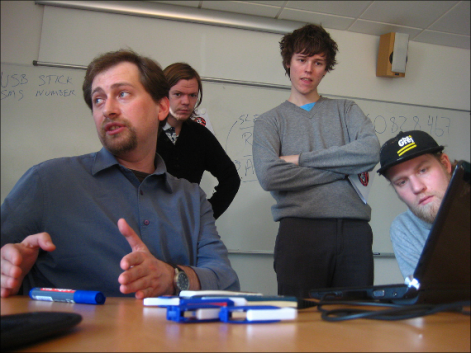
Sousveillance. The Art of Inverse Surveillance February 8th – 9th, 2009, Aarhus University, Denmark.
KMO: Just last night, I was reading an essay by David Byrne, of the Talking Heads, about Spotify, streaming music, and the emerging situation in which all the money changing hands for streaming music is basically going to record labels. Not only are they selling the songs of their artists to the streaming services, but they are also in exchange, for the listing the music companies catalogs, they are getting a stake in services like Spotify, but that artists get very little, even though it is the creativity and passion of the artists whih create value of the end users. The contribution of the artists is absolutely vital and integral, but they get very little of the proceeds.
For example, this past summer, Daft Punk had a song that was so popular that even people who don’t pay follow the music business or make any effort to seek out new music would recognize it – “Get Lucky” is the song – and their Spotify revenues for this, which had been downloaded or streamed hundreds of millions of times, was $13,000 each. They are the megastars of streaming media right now, and the amount of money that they received was less than one would make flipping burgers at McDonald’s. And so, we’ve got this emerging structure where the assumption is that the artists themselves are expected to work a day job somewhere, and then, in their spare time, struggle and produce art which enriches corporations. I’m just wondering what way forward you can envision, and what’s actually worth the time and effort trying to bring it about, because I’m largely of the opinion that trying to request that corporations and governments stop their current collusion and help artists is probably a silly way to invest one’s energy, and I’m wondering about a viable way forward.
Dmytri: I think, in most places, I would agree. Though, as I said, I think in some places it’s more viable than others, but here in the Western world, I think that it wouldn’t be the best use of energy. You had John McChesney on the program, and I’m sure that my view is not so different than his.
The answer, as it’s always been, has been the organization of workers towards ownership of the means of production. It’s no surprise to me that artists are being squeezed out of the profits made by Spotify and other online streaming corporations, because, you understand that artists are paid for their labor value, not the value of what they produce. The value of what is produced is captured by the people that own the means of production and distribution. They are the ones who are going to capture the value, so, unless artists own their own means of distribution and production, they can’t hope to capture the value that is so produced. So the only real way forward is to have not Spotify and iTunes, but organizations made up of the people who actually make the music involved in the production and distribution of media, and to have those owned by the workers themselves.
KMO: I understand that, but I find it an unsatisfying answer. (laughter)
Dmytri: Yeah, I know, it’s the same answer we’ve had for a couple of hundred years.
KMO: Yeah…
Dmytri: It’s not a sexy new answer, but, unfortunately the basic economics makes it so.
KMO: Well, the very central point of McChesney’s message is that we are approaching or perhaps in the midst of what he calls a “critical juncture,” which is a convergence of crises in which a disruptive new technology, a legitimacy crisis around current institutions and economic turmoil all come together. When that happens, we get a moment where there is a possibility to make institutional changes which are sweeping and long-lasting, and it seems that our side, so to speak, is not as focused on capturing the opportunity of that moment, that critical juncture, as the capitalists are. They seem quite poised to take advantage whenever these opportunities open up.
Dmytri: Of course. And, you know, that’s very difficult to combat, because they have the accumulated wealth to be able to weather the storms. So, in a way, crisis serves a role in capitalism as well. It allows the stronger capitalists to squeeze out the weaker capitalists, because capitalism is competition even among the capitalists. The capitalists aren’t only struggling against us, but also struggling against each other.
KMO: And so, it’s no good to try to become a sort of minor, beneficent capitalist, because the larger and sociopathic capitalists will just outcompete you and reduce you back to the worker who is paid not for the value of what he creates before his time, basically.
Dmytri: Absolutely, that’s right. And I think it’s important to understand that capitalism is not a choice for capitalists either, because if you’re capitalist and you invest your capital in such a way that it fails to create more capital, you cease to be a capitalist, right? So, capitalists are just as much trapped within the capitalist system as everybody else.
KMO: But it’s a much more well-appointed cage that they inhabit than most everybody else inhabits (laughter).
Dmytri: Certainly, but it’s not that even if any individual or bunch of individual capitalists suddenly had an epiphany and decided to abandon their exploitive ways, that that would be a threat to the system itself. That would only be the opportunity for other capitalists to squeeze them out.
KMO: Although it seems that the capitalists who had this emerging sense of consciousness and esprit de corps and identification with people and other classes of society, if they had this awakening moment, but they also realized what will happen if they act on it overtly, they might, if they were clever (and they must be clever to be where they are), continue to use the language which pacifies the other capitalists, while working subtly and behind the scenes to implement improvements and some movement toward social justice.
Dmytri: I don’t think language actually has much to do with it. I think the only people that are queasy about radical language are people who position themselves on the left, because they feel that being portrayed as a radical will weaken their position. I think that the people in power are not particularly concerned with language, and you can see that very often if you look at media campaigns. We’ve seen all kinds of revolutionary language, and even revolutionary figures from historical events used in advertising, used to promote and describe capitalist products. So, of course the film industry uses these themes and figures quite liberally, and it’s funded by capitalists.
I don’t think that the capitalist has to make a semantic argument to his peers, I think they have to be successful. I think, in the end, they have to capture profit. And it doesn’t matter how they capture the profit. If they do capture it, they become successful. And that’s also very interesting.
I don’t know if you’ve read any of the work that I’ve done on macroeconomics, which is much more recent than the manifesto. It still consists of just random blog articles rather than a more substantial text, but there are a couple of ideas that I’m fleshing out, and they don’t have names as catchy as “venture communism,” but I think that they’re interesting ideas. The great Polish economist, Michał Kalecki, created an equation to separate profit and consumption by class, which is to say, by workers profit and by capitalist profit. This equation allows you to see the relationship between capital and labor within the profit model. Using Kalecki’s equation as inspiration, I tried to take an approach where I look at modes.
 One major problem that I have with a lot of progressive theories that you hear casually within the anarchist community and the communist community is this idea that communism is something that happens in the future, that it suddenly happens as an epiphany, where societies are transformed magically from the old society to the new society, and everything is completely different. I don’t think that this is the case. I think we have communism right now, as well as capitalism right now. If you look at the kinds of relationships we have in our day-to-day lives, we have relationships that are ruled or dominated by exchange value, but we also have relationships that approach the communist relationships of “from each according to his ability, to each according to his need.” “From each, to each”, as I like to summarize it. And we experience these relationships among our friends, within our families, within intentional communities, and also within some of the emerging peer-production forms, like free software and information sharing, and things like that.
What we have is multimodal environment, and I think we need to look at the economy as having multiple modes of production happening at all given times. I don’t think it should be our objective to try to figure out how we can flip from one to the other, but how we can increase the kinds of producing and sharing that we think are beneficial and want more of and decrease the amount of producing and sharing that happens at ways that we think are destructive and not beneficial, and that we want less of. We need value to flow from one mode to another, this is what I’m thinking of, inter-modal value flows.
What we have is multimodal environment, and I think we need to look at the economy as having multiple modes of production happening at all given times. I don’t think it should be our objective to try to figure out how we can flip from one to the other, but how we can increase the kinds of producing and sharing that we think are beneficial and want more of and decrease the amount of producing and sharing that happens at ways that we think are destructive and not beneficial, and that we want less of.
One kind of these flows is something that I’m calling “substantiation”, which I’ve already been told is a horrible term. The idea of “substantiation” is that there are certain forms of investment that benefit individual members of a class, while hurting the class as a whole.
One example of substantiation is workers supporting capitalists when they buy capitalist securities in their pension funds. Individual workers that buy the securities could very well benefit, but the class doesn’t, because, overall, it cedes more power to capital. The capitalists take that investment and use it to expand capitalist control of the means of production and their own political strength. So, even though funds may benefit the individual workers who invested in them, they hurt workers as a class.
Now, I think that we can also find examples of things that are going the other way. I think free software for instance is a good example of that. If you are capitalist whose business depends on software as an input — in other words, you don’t sell software but you need software in order to produce whatever it is you produce — and you capture your profit elsewhere in the circulation of that final product, so capital is an input to your production, you therefore invest in free software, and by doing so you may yourself benefit, because you get help from the community and cheaper and better software to use in your own production. But, the capitalist class loses, because the sale of software licenses is broadly damaged, is lost as a way to make profit for the capitalist class. So, even though in both cases the individual members of the class are benefiting, this kind of value flow hurts the class in general. These are just a couple of examples of the kind of thinking we need to develop further. We need to figure out how value flows between the different modes that are existing at the same time within the contemporary economy, and what kinds of methods and institutions and practices can we introduce and promote that will cause value to flow from exploitive means to liberating means.
KMO: I think I follow you, but would you summarize your last line of reasoning?
Dmytri: I think that it’s helpful to think of the society that we live in as not being either capitalist or communist, in essence, that it’s helpful to think that within our society we have many modes of production going on at the same time. We have capitalism. We have communism. We have all kinds of hybrid and alternative forms going on. But we have a lot of different kinds of social relations. So, what we need to do is think about that in a compositional way. We need to think about what kinds of ways of producing and sharing are already going on right now, that we could develop more broadly, and how can we move and make value flow from the more exploitive modes to the more liberating modes.
This is what I was trying to get at with the idea of substantiation. These modes are coexisting and drawing off each other, and so just as much as we are benefiting the capitalists with our production, because everything that happens within commons-based production right now as being captured by capital, because the commons is still largely an immaterial commons. But likewise, by contributing to that immaterial commons, the capitalists are also helping us. So, value is flowing. We need to think strategically and ask how can we reduce the loss and maximize the gain. We need to conceptualize how to structure the kinds of productive forms which enable a sustained and positive long-term exchange away from capitalism.
KMO: Well, Dmytri Kleiner, it has been a pleasure talking to you, I look forward to future conversations, and thank you very much for participating on the C-Realm Podcast.
Dmytri: Very nice talking to you as well.
12 Inspired Actions to Outsmart Repressive Situations and Laws
 Amador Fernández-Savater & Leónidas Martín
- Translated by Stacco Troncoso, edited by Jane Loes Lipton– Guerrilla Translation!
- Main Image by Colectivo Enmedio
- Original article at eldiario.es
The Spanish government’s latest round of anti-protest laws are as worrying as they are laughably predictable. On top of criminalizing passive resistance, the new regulation considers actions such as uploading images of police violence to YouTube, or even Tweeting about a protest, to be punishable by fines as high a 600,000€, if you decide to protest in front of any so-called “Democratic Institutions”. As George Orwell argued, “A society becomes totalitarian when its structure becomes flagrantly artificial”.
Given that this trend is growing internationally, and rather than play a cat and mouse game where normal people have the losing hand, we can turn the tables and ridicule these sorts of reactionary, short sighted, desperate measures with our greatest assets: imagination, humor and the fact that we’re the good guys. The following article, written by Spanish art-ivists Amador Fernández-Savater and Leónidas Martín, offers 12 examples drawn from the last five decades poised to inspire and provoke. And check this out: so many people are eager to learn more about the how-to and history of this approach, that this has been the single most widely Facebook-shared article in eldiario.es’s history! We’ve also included some English hyperlinks to follow up on some of these leads and subtitled the one video in Spanish. Although written in reaction to the passage of the new law in Spain, we believe that their application and appeal is universal. Read on…
The objective of Spain’s new Citizen Security Law is very simple: to proscribe politics by criminalizing it, and withdrawing anything other than politics by politicians from circulation. This stunted, meager concept of democracy declares that decision-making is the exclusive right of political parties, public opinion the monopoly of experts, and that the sole role of the citizenry is to vote every four years.
The law was immediately dubbed the “Anti 15-M” law in social networks. In effect, these measures don’t hold up to the general and abstract character of a proper “law”. Instead, they’re very specifically directed against the new forms of on-the-ground citizen politics we’ve seen emerge in these last two and a half years: 15-M, Mareas (Citizen’s Tides), PAH, for example 1. While critics of the 15-M movement dismissed it as something meek and inoffensive, it’s now evident that its open, creative, and inclusive modes of action have posed a challenge to the powers that be.
It is certainly not the first time in the history of politics – and by this we mean, the surging increase of debate and decision-making by the people on issues of common life – that politics have come under threat: dictatorships, authoritative regimes and repressive laws, police management of public space, and so on. What then can we do when open, frontal confrontation is neither possible, nor the best of all options (because it’s useless, because it makes us feel despondent and crushes our voices, because it only leads to a trail of wounded, imprisoned protesters, etc.)?
In other, infinitely harsher situations than ours, the people managed to come up with subtle, intelligent and imaginative strategies to bypass repressive situations and laws. Below we present 12 stories of actions that can inspire us today to disobey the new law with humor, beauty, mobility, and a bit of camouflage.
Humour (or How to say it without saying it)
1: Fuck Communism in the USA
In the United States in the 60s, two words were absolutely forbidden. One, literally, was the word “fuck”. Writing it or saying it aloud could carry fines, or even prison sentences. The other was, both culturally and symbolically, “communism”. It was the great taboo, the evil spirit which the House Committee on Un-American Activities had decided to eradicate (and magnify, in considering anyone and everyone to be a suspect).
The Yippies, which was the creative activist group led by Abbie Hoffman and Jerry Rubin, decided to take matters into their own hands by organizing a citywide sticker and billboard campaign with the following slogan: “fuck communism”. There was a poster designed by Paul Krassner.
They were saying the forbidden (sometimes as a feint or while saying it without saying it), dodging censorship and criminalization, seeking complicity with intelligent observers able read between the lines and appreciate the genius of this operation.
For further investigation: Read Kurt Vonnegut’s thoughts on this poster.

2: The Orange Alternative in Poland
In the 80s, you needed guts and killer smarts if you wanted to go up against the Communist regime of Poland. Without them, you’d almost surely end up in prison for the rest of your life – or worse. Members of Pomaranczowa Alternatywa (Orange Alternative) stood out for their whimsical approach to protest and their creative use of the absurd.
They kicked off their career by painting dwarves over the regime’s attempts to whitewash all antigovernment graffiti away. These omnipresent dwarves soon took on lives of their own as symbols of Polish dissent. Hundreds of people dressed up as orange dwarves started to protest in the streets, demanding things such as the overthrow of Gargamel (!)
By using metaphor and allegory, saying without saying, they carried out dozens of protests without running the risk of being arrested – that is, without those arrests making the authorities look pretty ridiculous in the process. Really, how can anyone take a police officer seriously after seeing him arrest a protester for “participating in an illegal gathering of dwarves”?
For further investigation: Join “The Orange Alternative Revolution of Dwarves”
3: The Tighty-whitey Block in New York City
A few days before the protests against the World Economic Forum in February 2002, the Major of New York City digs up an old law (drafted in 1847, no less!) prohibiting the use of masks in the course of any public event. The restoration of the law has a very clear objective: to allow the police to compile a thorough photo archive of protesters.
The New Kids on the Black Block, a group of anti-globalization activists wise in the ways of guerrilla communication, scrutinize the law with the utmost attention. What the law literally says is that the “use of any kind of mask” is strictly prohibited. But, with a bit of creativity, many things can be pressed into service…and thus, the Tighty-whitey Block is born.
“Tighty-whities” is US slang for old school underpants. In a matter of hours, the New Kids acquired a truckload of more than a thousand of these underpants, had them printed with subversive messages and distributed among the protesters. What’s more, they produced a gigantic underpants-shaped banner as a rallying point for all who wanted – or needed – to protest in anonymity, even if it was with a pair of underpants covering their mugs.
Tighty-whities: underpants though they may be, masks they most definitely are not. So, the police are left impotent as hundreds of protesters march by with underpants over their faces. They can’t make arrests, much less build that photo archive – certainly not the kind of mugshots they were expecting!

Camouflage (or, how to break the rules of the game from inside)
4: Argentina’s 501 Movement
Voting is compulsory in Argentina, but the National Electoral Code exempts anyone who’s 500 kilometers or more away from their home. On election day 1999 a group of young people invited anyone feeling dissatisfied with the electoral routine to make their way to a location 501 km away from their place of residence, as a way of expressing that the true meaning of democracy can’t be reduced to choosing from among what are, essentially, identical options every four years.
All the participants certified before police that, on election day, they would be 501 km away from their place of residence. Free, collective travel arrangements were provided from Buenos Aires to Sierra de la Ventana, where a festival was held. Unsurprisingly, they were accused of being “anti-political”, “anti-democratic”, and blah, blah, blah. But they countered, in their “Open Letter to Voters”, that right there at kilometer 501 they had reclaimed the true meaning of democracy, not as a perfunctory formality of the Necessary and Inevitable, but rather as a transformation of the extant, by everyone and for everyone.
For further investigation: “El movimiento 501, la “Carta a los votantes” y la spanish revolution” (in Spanish).
 5: The Sex Pistols on the Thames
It’s mid-1977, Queen Elizabeth’s Jubilee is drawing near and the Government and the Royal House are desperate to avoid any critical actions. Following this logic, the Sex Pistols, authors of the song “God Save the Queen”, are expressly forbidden from playing on the British mainland.
The Pistols’ reaction to the ban is legendary. Instead of throwing in the towel, the band rent a boat for the occasion (aptly named the “Queen Elizabeth”), and on the 7th of June, the same day as the Royal March, they play a gig smack in the middle of the River Thames. Lest we forget, while the official order expressly prohibits them from playing on British mainland, it doesn’t say anything about rivers and waterways.
The stunt was so successful that it sent shockwaves through the media. That same week, their single “God Save the Queen” reached number one in the British charts. But, given that the song was banned, their chart-topping success could neither be announced on television, nor played on the radio. It was the only time in history that there has been no number one song.
6: Belarus’ Revolution Through Social Networks
Belarus, July 2011. Frustration over the economic crisis reaches its peak. President Alezander Lukashenko’s authoritative regime forbids all types of protest, while police repress all dissent. In response, the “Revolution Through Social Networks” appeared, a public call to gather in the streets to applaud, or to synch all mobile phones and make them ring at the same time. In this (apparently inoffensive) manner, thousands of people managed to turn a handful of everyday gestures into powerful expressions of dissent.
Mobility (or how to not become a target for your adversaries)
7. Lavapiés 15, Madrid
Located at its namesake address in the Lavapies district of Madrid, Lavapies 15 was a squat back in 1996. An official eviction order was drawn up within six months of its existence. The dwellers of Lavapies 15 sealed the door and pretended to hole up inside, the standard procedure for squats at that time (very heroic perhaps, but both useless and frustrating in the end).
So, as a hundred police agents and a helicopter searched the house, the squatters made their escape over rooftops, making obvious the disproportionate, unjustified and repressive deployment. It’s even rumored that some squatters actually stood by the door, mingling with the rest of the onlookers, to witness their own eviction.
“Resistance doesn’t have to equal suffering, taking the piss is another form of struggle”, they explained in regards to their action.
For further investigation: Read a short excerpt from “The Exteriority Crisis: From the City Limits and Beyond” on “The Ghosts” of Lavapies 15.
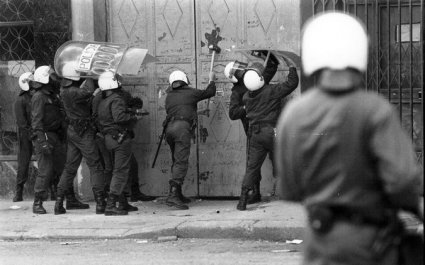
8: Chile’s National day of Protest
Chile, July 1983. Pinochet’s dictatorship is 10 years old, and the copper mine workers celebrate the anniversary by holding a national strike. The copper mines were the backbone of the country’s economy at the time, so the dictator’s response was swift. Hundreds of troops and various police forces surround the mines, with orders to shoot anyone supporting the strike. Bloodshed seems inevitable. However, it didn’t turn out that way.
Barely a day before the beginning of the strike, the leaders and spokespersons of the worker’s movement decide to change strategies. Rather than having the miners work stoppage be the only means of protest, they called for the first National Day of Protest, with many decentralized actions throughout the country. For example, people were encouraged to drive their cars at a snail´s pace through the main highways and thoroughfares of Chile, creating epic traffic jams all over the country; or to turn the lights on and off in their houses; or to incessantly bang pans and pots at nightfall. This was the birth of the cacerolazo, a mode of protest still very much in use nowadays.
9: The (non) Battle of Puerta del Sol, Madrid
Tuesday, August 2nd 2011, the police unceremoniously clear out the remains of the recent occupation of Puerta del Sol, Madrid’s famous main square. Specifically, the info booth left there by the 15-M Movement. They tear down the beautiful plaque that read “We slept, we awoke. The square is taken”, and dump it in the trashbin. Thousands of citizens, feeling suddenly erased from the map, spontaneously gather to reconquer the square.
Lines of police blocked all entry points, while armored police vans stood guard over an empty square. Suddenly someone shouts, “Ciao, ciao, ciao, nos vamos a Callao” (“Ciao, ciao, we’re moving to Callao” – one of the neighboring squares). The slogan is quickly picked up. Rather than confront the police, protesters decide to turn their backs on them. Change of perspective, change of scenery, change in the dialogue, change of interlocutors, and change of emotions. Instead of uselessly screaming in the face of impassive policemen, 15-M decides to branch out all over the city. A seemingly helpless situation turns into one of empowerment. A joyous evasion.
The police garrison at Sol remains entrenched in position, protecting nothing. A day goes by, then two, three…such a level of police presence is unwarranted, and on the fourth day, they are told to stand down. Then, on the night of August 5th, the people happily re-enter the now liberated square in a great march.
For further investigation: a text Amador wrote describing the events (translation not ours)
The (Non) Battle of Sol as seen by Enrique Flores. The bubble reads “We Reserve the Right to Refuse Admission”
Beauty (or how art disarms brute force)
10: The pianist at Gezi Park (Istanbul)
During the June 2013 protests and prior to the final eviction of Gezi Park in Istanbul, president Erdogan had given an ultimatum to the demonstrators.
7 P.M. on the 12th of June was the chosen hour. Everything was primed for a police charge: emergency crews, gas masks, media, barricades…but just as the clashes began and the teargas exploded, there came a sound – neither war cry nor firearms, but music: The Beatles’ “Let It Be”. A piano had appeared from nowhere, and a hooked-nosed skinny kid with a hat was playing “Imagine” by John Lennon and “Bella Ciao”. Just then, everyone stopped what they were doing and gathered: they sat, applauded and sang together.
The pianist was a German of Italian origin, who’d been travelling throughout Europe carrying a message of peace. He had made the piano himself, asserting that his music calmed the police and, somehow, protected the demonstrators. Erdogan didn’t dare crush this community sprung around music. It would have been too brutal an image to expose to the world.
(Here you can see the Solfónica, Madrid’s own protest-march classical ensemble and choir, producing the same effect during the Spanish general strike of November 14, 2012)
What you have just read is a fragment of a chronicle of those days in Istanbul written by our friend José Fernández-Layos. You can read the full account here in Spanish
11: “Standing Man” in Istanbul
When Erdogan finally – without warning – attacked Gezi Park and evicted the occupiers, he issued a threat: anyone trying to enter Taksim Square (adjacent to the park) would be accused of terrorism. Thousands of people tried to enter forcibly or via the barricades, but it was all in vain. Until one man waltzed through, posing as any other tourist, with no gasmask or bandanna covering his face, and simply stood in front of the Atatürk building, just standing there quietly for hours. It soon became a trending topic on Twitter and the police arrested him, but it was too late: many other “standing men” or “still persons” like him replicated the action in an incessant dribble on squares throughout the country. Bit by bit, Taksim was reclaimed. It was practically impossible to steer public opinion that these people were terrorists, when it was plain to see that they were simply people standing there…although, in fact, everyone knew that they were defying the government.
What you have just read is a fragment of another chronicle written by our friend José Fernández-Layos about those days in Istanbul. You can read the full account here in Spanish
12: The Reflectors in Barcelona
Around the time of the first anniversary of the 15-M protests, the powers that be had flipped the switch on their repressive countermeasures to criminalize street protest. Playing into this dynamic robs the streets of plurality, “de-democratizing” protest and reducing it to small groups, very homogenous and easy to identify and codify. Enter The Reflectors with the slogan, “We won’t play that game, let’s break the codes”.
The Reflectors look like superheroes out of a Marvel comic book, but they are in fact normal people with two or three very un-normal characteristics: their brilliant costumes made out of aluminum foil, the Reflecto-Ray and the Reflecto-Cube.
Used correctly, the Reflecto-Ray reflects sunlight over police cameras recording protesters. The Reflecto-Cube can be used in two different ways: as a festive prop when any protest starts getting boring, and as an antidote to police charges.
This second application of the Reflecto-Cube was put to the test for the first time in Barcelona, during the last general strike on November 14th, 2012. The populist protests of the morning had finished, and police entered the Plaza de Cataluña square in full force, striking everyone in their path with their batons. People panicked. Terrified protesters started running towards neighboring Paseo de Gracia and, at that exact moment, the Reflecto-Cube erupted onto the scene. After a good while trying to get to grips with it, the riot police decided to dispose of it by pushing it back towards The Reflectors, who proceeded to send it back to the police, starting a game of absurd beach volleyball that radically transformed the atmosphere in the square from sheer panic to all-out party in less than a minute.
For further investigation: Find out more about The Reflectors’ adventures here.
Do you know of any other similar actions? Tell us your story in the comments, and we will try and update this article with them.
This first compilation was written by Leónidas Martín Saura (Enmedio Collective) and Amador Fernández-Savater, with the indispensable help of Sabino Ormazábal and his horseflies, Juan Gutiérrez, Frauke Schultz, Lawrence of Arabia, Nuria Campabadal, Beautiful Trouble, José Fernández-Layos, Margarita Padilla and Franco Ingrassia.
The principles of the Guerrilla Movement are, ultimately, two: mobility as the best defensive weapon; and thought, as the best kind of attack. Neutralizing the enemy’s targets and the conversion of each individual into a sympathizer and friend are the keys to victory.
BONUS! Here’s a coda of sorts to this compilation, written by the co-author Leónidas Martín and published in our Metablog: A call for the World Record of people shouting, “You’ll never own a house in your whole fucking life”
Guerrilla Translation/Related: Overcoming the Shock Doctrine/Soy Pública
 Strength and Power: Reimagining Revolution/ Amador Fernández-Savater
 The Interruption of the Dominant Narrative, an interview with Colectivo Enmedio/ Amador Fernández-Savater interviews colectivo Enmedio
1. [These are all groups and collectives enmeshed within the 15 -M network. Briefly]:
- Las Mareas or “Citizen Tides” are Spain’s post-syndical defense network for Education, Public Health, Feminism, Labour rights and more.
- PAH (Plataformas de los Afectados por la Hipoteca) is Spain’s anti-foreclosure network.
To read about these, and many other, initiatives taking place in Spain right now, read our translation of Bernardo Guitérrez’s “Spain’s Micro-Utopias: The 15M Movement and its Prototypes”]↩
¿Qué es el procomún?
 Helene Finidori/ Gemeingüeter Germany
- Texto traducido por Carmen Lozano Bright; vídeo traducido y subtitulado por Stacco Troncoso. Editado por Arianne Sved - Guerrilla Translation!
- Ilustración de Enrique Flores
- Artículo original. Vídeo original
El procomún (o los comunes) se puede explicar como un sistema social que relaciona íntimamente a las personas o partes interesadas con sus recursos y con las formas participativas en las que los gestionan/producen y cuidan de ellos.
Si hace poco nos preguntábamos “¿Qué es el P2P?” hoy nos centramos en otro término importante que mucha gente no acaba de entender: el “procomún”. Para explicarlo, cedemos la palabra a Helene Finidori, coordinadora de Commons Abundance Network, un colectivo de investigación y colaboración con la noble misión de crear una nueva economía de la abundancia basada en el procomún. A modo de aperitivo, incluimos un video de animación creado por Gemeingüeter Germany, un colectivo alemán dedicado a la difusión y defensa del procomún.
(Para activar la pista de subtítulos, pulsad el botón rectangular de la parte inferior derecha y elegir “Spanish – (Spain) -Guerrilla Translation!”)
La lógica del procomún para construir una ciudadanía y una justicia globales a múltiples niveles y escalas.
El procomún (o los comunes) se puede explicar como un sistema social que relaciona íntimamente a las personas o partes interesadas con sus recursos y con las formas participativas en las que los gestionan/producen y cuidan de ellos.
El procomún puede ser descrito de varias maneras y a través de diversas dimensiones. Las tres que se explican a continuación funcionan conjuntamente, como un todo:
- Como objeto, el procomún es la riqueza común, el conjunto de bienes que heredamos o creamos, utilizamos y modificamos, que sirven para nuestro sustento (recursos naturales, sociales y culturales, la diversidad genética y biológica, el conocimiento, etc.) y que transmitimos a las generaciones futuras. Estos bienes deben ser cuidados y (re)generados, y deben ser indiscriminadamente accesibles para el mayor número de personas posible. Por eso mismo, deben ser protegidos de las apropiaciones, la sobreexplotación, el agotamiento y el abuso.
- Como práctica, el procomún es la escala común de valores de la cual formamos todos parte integral; la cultura y las relaciones que construimos entre nosotros así como con los recursos y con la tierra; las maneras de estar y hacer en común (los cuidados, el reparto, la preservación y la reposición de nuestros bienes comunes con discernimiento, transparencia, empatía, equidad, justicia, conciencia del otro…). Esta práctica depende de manera crucial de unas habilidades adaptables y mantenidas en el tiempo, de flujos de conocimientos incrementados y de una colaboración y un aprendizaje continuos que incluyan métodos de trabajo conjunto en la resolución de problemas. Esta práctica toma múltiples formas y nombres. Vida y desarrollo sostenibles es uno de ellos.
- Como resultado, el procomún es el bien común, la consecuencia de la práctica (acceso, capacidad, bienestar, calidad de vida, prosperidad, abundancia). Se trata de la savia del proceso, lo que hace que el mundo prospere y que, a su vez, se convierta en bienes a cuidar.
Gracias a las relaciones e interacciones entre estos elementos, los sistemas generativos del procomún proporcionan condiciones tangibles que empoderan y activan a las comunidades, a varios niveles y escalas, en relación con sus propósitos y con el contexto ecológico en el que se encuentran.
Desde esta perspectiva, el procomún puede servir como medio para acelerar la adopción de prácticas sostenibles que aborden las dimensiones sociales, medioambientales y económicas de forma sustentable, cohesiva e interconectada. De igual manera, puede funcionar como sistema de veto que evalúe el impacto de las políticas y prácticas de sostenibilidad.
Así pues, nutrir y cultivar el procomún en todas sus dimensiones y manifestaciones puede servir de referente para una ciudadanía global y una justicia global.
Guerrilla Translation/Relacionado:¿Qué es el P2P?/ Michel Bauwens Introducción a “Sacred Economics”/ Charles Eisenstein
 Reclamando el crédito como bien común/ Thomas H Greco
¿Qué es el P2P?
 Julie Tran de MakeChangeTV entrevista a Michel Bauwens

- Traductores: Vídeo: Stacco Troncoso. Texto: Andrés Delgado. Editado por Carmen Lozano Bright - Guerrilla Translation!
- Imagenes de Open Source Embroidery
- Vídeo original. Texto original: 1ª parte. 2ª parte
“No podemos seguir con un sistema que crea riqueza pero que también está destruyendo el planeta y creando semejante desigualdad social. Creo que, tras 400 años de esto, ya sabemos que no funciona. Necesitamos un nuevo sistema que recupere todos estos valores comunales.”
¿Cómo sería una economía post-capitalista? En esta entrevista con Michel Bauwens, Julie Tran de Makechange TV indaga en las peculiaridades de la filosofía P2P o “entre iguales”. Bauwens responde de manera clara y directa a preguntas como: ¿Qué es la economía P2P? ¿En qué se diferencia del capitalismo y el comunismo? ¿Es lo mismo que el consumo colaborativo o el crowdsourcing? ¿Se convertirá en la tendencia principal del futuro?
Como material adicional incluimos dos esquemas escritos por Bauwens para Flok Society, un nuevo proyecto ecuatoriano para propagar la filosofía del buen conocimiento y el buen vivir. Los esquemas desglosan tres escenarios para la filosofía P2P, junto a los pasos necesarios para hacer la transición hacia una verdadera sociedad post capitalista.
(Para activar la pista de subtítulos, pulsad el botón rectangular de la parte inferior derecha y elegir “Spanish – (Spain) -Guerrilla Translation!”)
Tres modelos de creación de valor, redistribución y desarrollo económico

Contexto
Esta pieza ha sido escrita como un marco de referencia para el proyecto FLOKSociety.org en Ecuador, para describir una transición hacia una sociedad basada en el conocimiento abierto y compartido.
Será mejorada continuamente entorno a la siguiente estructura:
- Modelos de extracción de valor, tanto materiales como inmateriales
- Estructura de clase dominante
- Lógicas de conocimiento
- Modelos de solidaridad
- Movimientos sociales y el equilibrio de poder
- El modelo dominante del capitalismo / alternativas dominantes
- Formas de democracia / participación
La idea clave es distinguir la condición de las prácticas en torno a compartir/p2p/procomún bajo el predominio del capitalismo cognitivo financiarizado y un modelo cívico/ético más genuino centrado en los bienes comunes
Análisis de los tres modelos
1: Bajo las condiciones del capitalismo propietario
- Los trabajadores crean valor a título privado como proveedores de mano de obra
- Desprofesionalización de la producción de conocimiento de los trabajadores; creación de capas de gestión y de ingeniería que gestionan la producción colectiva en nombre de los propietarios del capital
- El conocimiento codificado es de propiedad exclusiva y el valor se captura como alquiler de propiedad intelectual
- Los dueños del capital capturan y toman posesión del valor de mercado; redistribución parcial en la forma de salarios
- En condiciones de equilibrio entre capital y trabajo, el Estado redistribuye la riqueza a los trabajadores como consumidores y ciudadanos
- En las condiciones contemporáneas de debilidad del trabajo, el Estado redistribuye la riqueza al sector financiero, y crea condiciones de dependencia de la deuda a la mayoría de la población
2: Bajo las condiciones de una producción entre iguales emergente bajo la dominación del capitalismo financiero
-
Contribuciones ciudadanas voluntarias, trabajo pagado y empresarios independientes crean valor codificado en repositorios comunes de conocimiento, código y diseño
-
Los dueños del capital capturan y toman posesión tanto de los contribuyentes como del trabajo; las redes propietarias y las plataformas de colaboración capturan y toman posesión del valor de la atención de los participantes/contribuyentes
-
Los dueños del capital obtienen ganancias de los beneficios del trabajo distribuido desagregado (crowdsourcing)
-
El capital se co-crea a través de la financiación del trabajo y de las plataformas; crece la acumulación continua de repositorios comunes de conocimiento, código y diseño; en condiciones de precariedad para los contribuyentes voluntarios y emprendedores orientados sin apoyo al procomún
-
Los bienes comunes son administrados por instituciones con fines de beneficencia que reflejan el equilibrio de influencia entre los contribuyentes, los trabajadores y los propietarios de capital, pero continuan expandiendo los repositorios comunes; el sector de bienes comunes carece de mecanismos de solidaridad para hacer frente a la precariedad, la sociedad civil está aún siendo derivada hacia el mercado y sectores estatales
-
El Estado debilita su función pública y las funciones de solidaridad, en favor de funciones represivas y subvenciona al capital financiero; el Estado co-crea las condiciones mínimas para la producción entre pares orientadas al procomún y la redistribución hacia el capital financiero continúa.
3: En condiciones de producción entre iguales robusta, bajo dominio ciudadano
-
Los contribuyentes voluntarios y el trabajo autónomo cooperativo crean valor codificado a través de repositorios comunes; la recalificación ciudadana y del trabajo se produce a través de la fabricación distribuida orientada al procomún que sitúa a los creadores de valor en el timón de la fabricación distribuida y otras formas de creación de valor
-
Los contribuyentes del procomún crean entidades mercantiles cooperativas orientadas al procomún que las sostienen, así como a las comunidades de contribuyentes
-
Las cooperativas y otras entidades mercantiles afines al procomún, co-crean repositorios comunes y se dedican a la acumulación cooperativa en nombre de sus miembros; las contribuciones al procomún están codificadas en sus estructuras legales y de gobernanza; las coaliciones empresariales y filés (empresas estructuradas en red que trabajan en torno a unos grupos comunes para mantener comunidades productoras de bienes comunes).
-
La coordinación social mutua de producción a través de cadenas abiertas de aprovisionamiento dirige las actividades del mercado
-
Los bienes comunes permiten que las instituciones benéficas se conviertan en una formación ciudadana central para la gobernanza de los repositorios comunes; las entidades del mercado asociadas crean mecanismos de solidaridad y de ingresos para los productores y procomuneros con el apoyo del Estado asociado.
-
El Estado, dominado por los sectores ciudadanos/del procomún se vuelve un Estado Socio, que crea y sostiene la infraestructura ciudadana necesaria para permitir y empoderar la producción social autónoma
-
El mercado se vuelve una economía moral y ética, orientada en torno al producción procomún y a la coordinación mutua, apoyada por las funciones del Estado Socio
-
El sector mercantil está dominado por cooperativas, leyes, formas de gobierno y propiedad orientadas al procomún; las entidades restantes que maximizan los beneficios se reforman para respetar las externalidades ambientales y sociales, incluyendo la redistribución de la extracción de ‘beneficios-procomunes’.
-
Los mecanismos de gobernanza se reforman hacia modelos de gobernanza multisectoriales con orientación al procomún, los modelos de propiedad se reforman desde la extracción hacia modelos generativos
-
El modelo de Estado Socio renueva la prestación de servicios públicos, los mecanismos de solidaridad y asistencia social a través de la comunalización de los servicios públicos y asociaciones públicas-procomún
-
La redistribución social tiene lugar a través de provisiones de salario básico y mediante la reducción de la participación laboral, necesaria para crear condiciones de participación ciudadana y una economía contributiva
Propuestas de transición

Describiendo el rol de: 1) El estado 2) La economía ética 3) El sector del procomún
1:El Estado
-
El Estado se convierte en un Estado asociado, cuyo objetivo es facilitar y potenciar la producción social autónoma, que regula también en el contexto del bien común
-
El Estado se esfuerza por brindar apertura y transparencia máximas
-
El Estado sistematiza la participación, la deliberación y la consulta en tiempo real con los ciudadanos
-
La lógica social se mueve de estar centradada en la propiedad a estar centrada en la ciudadanía
-
El Estado desburocratiza a través de la procomunización de los servicios públicos y las asociaciones público-procomún
-
Los puestos de trabajo de servicio público son considerados como un recurso de repositorios del procomún y la participación se extiende a toda la población
-
La democracia representativa se extiende a través de mecanismos participativos (legislación participativa, elaboración de presupuestos participativa, etc.)
-
La democracia representativa se extiende a través de mecanismos de deliberación tanto tradicionales como en redes digitales.
-
La democracia representativa se extiende a través de votación directa y/o líquida (consultas y procedimientos democráticos en tiempo real, junto con los mecanismos de delegación de voto)
-
La tributación del trabajo productivo, el espíritu empresarial y la inversión ética se reducen al mínimo; la imposición de la producción de bienes sociales y ambientales se reduce al mínimo; la tributación de las inversiones especulativas improductivas se ve aumentada, los impuestos sobre los ingresos por alquiler improductivo aumentan; la fiscalidad de las externalidades sociales y ambientales negativas se ve aumentada
-
El Estado sostiene infraestructuras ciudadanas orientadas al procomún y agentes del mercado éticos orientados al procomún
-
El Estado reforma el sector empresarial tradicional para minimizar las externalidades sociales y ambientales
-
El Estado se dedica a la creación monetaria pública libre de deuda y apoya una estructura de monedas complementarias especializadas
2: La Economía Ética
-
Creación de una economía social/ética/ciudadana/solidaria orientada al procomún y al bien común
-
Los agentes del mercado ético se fusionan en torno al procomún del conocimiento productivo. Con el tiempo utilizan licencias orientadas al procomún y de producción entre iguales para apoyar al sector socio-económico
-
Los agentes del mercado ético integran requerimientos del bien común y de varios sectores impulsados por usuarios y trabajadores en su modelo de gobierno
-
Los agentes del mercado ético se desplazan de formas de propiedad extractivas a modelos de propiedad generativos; se privilegian formatos de compañías abiertas, éticas, orientadas al procomún
-
Los agentes del mercado ético practican contabilidad abierta y cadenas de suministro abiertas para aumentar la coordinación de mercado de la producción
-
Los agentes del mercado ético crean una red territorial y sectorial de asociaciones de la Cámara del Procomún para definir sus necesidades y metas comunes e interactuar con la sociedad civil, los comuneros y el estado socio
-
Con ayuda del Estado Socio, los agentes del mercado ético crean estructuras de soporte para una comercialización abierta, que mantenga y dé soporte al procomún
-
Los agentes del mercado ético se interconectan con comunidades productivas globales del procomún (comunidades de diseño abierto) y con asociaciones globales de producción (filés) que proyectan poder de mercado ético a nivel mundial
-
Los agentes del mercado ético adoptan un diferencial de salarios 1-8 y se establecen los niveles de salario mínimo y máximo
-
El sector comercial principal es reformado para minimizar las externalidades sociales y ambientales negativas; se proveen incentivos que buscan una convergencia entre las economías corporativa y solidaria
-
Con miras a obtener dicha convergencia, se alientan formas de economía híbrida, como el comercio justo, el emprendimiento social o las corporaciones de beneficencia
-
Se crean y apoyan microfábricas distribuidas para fabricación (g)localizada bajo demanda con el objetivo de satisfacer las necesidades locales de los bienes básicos y maquinaria
-
Se crean institutos para el apoyo del conocimiento productivo sobre una base territorial y sectorial
-
La educación está alineada a la co-creación de conocimiento productivo en apoyo a la economía social y el procomún abierto de conocimiento productivo
3: El sector del procomún
-
Creación de infraestructuras del procomún tanto inmaterial como de los bienes materiales. La sociedad es vista como un conjunto de bienes comunes entrelazados, que son compatibles con una economía de mercado ético y un Estado asociado que protege el bien común y crea infraestructuras ciudadanas de apoyo
-
Los procomunes locales y sectoriales crean alianzas civiles para interactuar con la Cámara del Procomún y el Estado Socio
-
La conexión de asociaciones con ánimo de lucro (Fundaciones del Conocimiento Común y Abierto) permite y protege los diversos bienes comunes
-
Cooperativas de Solidaridad forman asociaciones público-procomún en alianza con el Estado Socio y el sector de economía ética es representado por la Cámara de los Comunes
-
Los comunes naturales son gestionados por asociaciones público-procomún y se basan en la pertenencia ciudadana en Fideicomisos del Procomún
Guerrilla Translation/Relacionado: Cuatro escenarios futuros para la economía colaborativa/ Michel Bauwens¿Qué es el procomún?/ Helene Finidori Gemeingüeter Germany
 Ciencia P2P: El desafío del siglo es responder a Fukushima/ Layne Hartsell &Emanuel Pastreich
Ciencia P2P: El desafío del siglo es responder a Fukushima
 Layne Hartsell y Emanuel Pastreich
- Traducido por Joyce MacNeg, editado por Miki Decrece - Guerrilla Translation!
- Imagen de Ian MacKenzie, de su documental “Reactor”
- Artículo original
Resolver la crisis nuclear de Fukushima exigirá considerar de nuevo nuestra manera de abordar la ciencia, los medios de comunicación social y la diplomacia pública.
Hace ya más de dos años y medio que un terremoto, y el posterior tsunami, causaron graves daños en una central nuclear japonesa. El desastre de Fukushima se ha convertido en una de las amenazas más graves para la salud pública en la región Asia-Pacífico, y el peor caso de contaminación nuclear que se haya visto jamás. Hoy día la radiación sigue escapándose de la planta Fukushima Daiichi hacia las aguas subterráneas, amenazando con contaminar todo el océano Pacífico. La limpieza necesitará de un esfuerzo global sin precedentes.
Al principio, los elementos radiactivos vertidos consistían en Cesio-137 y Cesio-134 y, en menor medida, Iodo-131. De estos elementos, el más peligroso a largo plazo es sin duda el Cesio-137, ya que es altamente bioasimilable y tiene una vida media de 30 años, lo que implica que la amenaza persistirá durante varias décadas. En los últimos vertidos el nivel de Estroncio-90, un elemento radiactivo mucho más peligroso, está aumentando. El Estroncio-90 es un análogo funcional del Calcio, por lo que se absorbe y acumula fácilmente en los huesos de humanos y animales.
La Compañía Eléctrica de Tokyo (TEPCO), ha admitido recientemente, que carece de los conocimientos necesarios para controlar de manera efectiva el flujo de radiación hacia las aguas subterráneas y al mar; y ha pedido ayuda al gobierno japonés. TEPCO ha propuesto la creación de una barrera subterránea congelando el suelo de los alrededores de la planta para evitar que el vertido radiactivo siga escapando hacia el mar, un enfoque que jamás se ha intentado en un caso de fuga de radiación masiva. TEPCO también ha propuesto levantar muros adicionales, dado que el muro existente ha sido rebasado por las, aproximadamente, 400 toneladas diarias de agua que fluyen hacia la planta nuclear.
Pero aunque estas propuestas tuvieran éxito, no constituirían una solución a largo plazo.
Una nueva carrera espacial
Resolver la crisis de Fukushima Daiichi debería plantearse como un desafío similar al de poner a una persona en la Luna en la década de 1960. Un reto tecnológico tan complejo requeriría mucha atención y el gasto de cantidades enormes de recursos durante varias décadas. Pero esta vez, el esfuerzo debe ser internacional, ya que esta crisis pone en riesgo la salud de cientos de millones de personas. La solución definitiva de esta crisis merece tanta atención por parte de gobiernos e industria como la que se presta a las armas nucleares, el terrorismo, la economía o la delincuencia.
Resolver el problema de Fukushima Daiichi precisará reclutar a las mejores y más brillantes mentes que se puedan encontrar para llegar a una estrategia que se lleve a cabo durante el próximo siglo. Gente experta de todo el mundo deberán de aportar su inteligencia e ideas. Deberán provenir de diversas disciplinas como la ingeniería, la biología, la demografía, la agricultura, la filosofía, la historia, el arte, el urbanismo y algunas más. Tendrán que trabajar juntos a distintos niveles para desarrollar un plan amplio sobre cómo reconstruir las comunidades, re-alojar a las personas, controlar la fuga de radiación, eliminar de forma segura el agua y el suelo contaminados, y contener la radiación. También tendrán que encontrar la manera de desarmar completamente el reactor dañado, aunque ese desafío puede necesitar de una tecnología que no estará disponible hasta dentro de unas décadas.
Dicho plan requerirá el desarrollo de tecnologías aún no disponibles, como robots que puedan funcionar en ambientes altamente radiactivos. Este proyecto podría cautivar la imaginación de desarrolladores del mundo de la robótica y dar una aplicación civil a la tecnología militar actual. Mejorar la robótica evitaría escenas trágicas, como la de personas mayores y otros voluntarios adentrándose en los reactores, pese a los evidentes riesgos.
El desastre de Fukushima es una crisis para toda la humanidad, pero es una crisis que puede servir como una oportunidad para construir redes globales de colaboración sin precedentes. Los grupos o equipos asistidos por tecnología informática sofisticada pueden comenzar a dividir en partes manejables los inmensos problemas derivados del vertido. Después, los expertos podrán volver con las mejores recomendaciones y un plan de acción concreto. El esfuerzo puede inspirarse en el trabajo previo del Grupo Intergubernamental de Expertos sobre el Cambio Climático, pero debe ir mucho más allá.
En su libro Reinventing Discovery: The New Era of Networked Science (“Reinventando el descubrimiento: La nueva era de la ciencia en Red), Michael Nielsen describe los principios de la ciencia en Red, que se pueden aplicar a una escala sin precedentes. Los avances que conlleva esta aproximación también se pueden aplicar a otros proyectos a largo plazo, tales como la limpieza del vertido de petróleo de la plataforma Deepwater Horizon de BP en el Golfo de México o la respuesta global al cambio climático. La investigación colaborativa sobre Fukushima debería llevarse a cabo a escala masiva, mayor que la secuenciación del genoma humano o el mantenimiento del gran colisionador de hadrones (LHC).
Por último, en la respuesta a esta crisis existe una oportunidad de reinventar por completo el campo de la Diplomacia Pública. Ésta puede cambiar, desde el esfuerzo, un tanto débil, de los gobiernos nacionales, que sólo pretende maquillar su discurso, hacia foros serios de discusión y acción de problemáticas internacionales. Tan pronto como la Diplomacia Pública madure a través de la experiencia de Fukushima, podremos idear nuevas estrategias para unir a cientos de miles de personas en todo el mundo para dar respuesta a las amenazas comunes.
Tomando nota de la ciencia en Red, la diplomacia pública podría funcionar como una plataforma para la colaboración internacional honesta y definitiva en temas cruciales como la pobreza, las energías renovables y el control de la contaminación.
Del mismo modo, esta crisis podría servir de impulso para que las redes sociales hagan lo que se supone que deben hacer: ayudar a las personas a combinar sus conocimientos para resolver problemas comunes. Las redes sociales pueden utilizarse no como un medio de intercambio de fotografías de cafés con leche y gatos sobrealimentados, sino más bien como un medio eficaz para evaluar la veracidad de la información, fomentar el intercambio de opiniones entre expertos, llegar a consensos, y permitir que la sociedad civil participe directamente en la toma de decisiones.
Un sistema de revisión entre iguales, a través de las redes sociales, puede desempeñar un papel crucial a la hora de plantear nuevas propuestas frente a la crisis de Fukushima. Como figura destacada del movimiento P2P, Michel Bauwens, apunta en un correo electrónico: “Las redes entre iguales ya están propagando un modelo de conocimiento común y a nivel mundial, incluso en la producción de ordenadores, automóviles y maquinaria pesada.”
Puede que aquí esté la clave para resolver el problema de Fukushima: abrirlo para que pueda resolverlo el mundo entero.
Ciencia entre iguales
Hacer de Fukushima un proyecto global, que verdaderamente involucre a expertos y a millones o decenas de millones de ciudadanos corrientes, podría devolver un poco de esperanza al mundo después de dos años y medio de mentiras, medias verdades y esfuerzos conjuntos del gobierno japonés y las instituciones internacionales para eludir cualquier responsabilidad. Si los ciudadanos concienciados de todos los países estudiasen a fondo los datos y realizasen sus sugerencias por Internet, podría haber un nuevo nivel de transparencia en el proceso de toma de decisiones y una abundancia de observaciones valiosísimas.
No hay ninguna razón para que la información sobre las emisiones de radiación y el estado de los reactores no esté disponible públicamente y con suficiente detalle como para satisfacer la curiosidad de un ingeniero nuclear. Si la hoja de ruta viene del consenso de los millones de ciudadanos dedicados a tratar de resolver el problema, tendremos una fuerte alternativa al secretismo actual. ¿Cabe la posibilidad de que nuestra cooperación para resolver la crisis de Fukushima marque un antes y un después para superar las barreras que contra la inteligencia colectiva son impuestas por las fronteras nacionales, las patentes de las empresas y las preocupaciones por la propiedad intelectual?
Existe un proyecto para clasificar todas las estrellas del firmamento que ha demostrado que, si las tareas se dividen con rigor, la contribución voluntaria de individuos no acreditados puede jugar un papel fundamental en la solución de problemas técnicos. En el proyecto Galaxy Zoo, cualquier persona que lo desee puede meterse en Internet y clasificar los diferentes tipos de estrellas situadas en galaxias distantes e introducir la información en una base de datos. Todo esto forma parte de un esfuerzo monumental para ampliar nuestro conocimiento del Universo que ha tenido un éxito enorme y ha demostrado que hay partes del análisis científico que no necesitan un doctorado. En el caso de Fukushima, una persona corriente, si examina fotografías de satélite por Internet todos los días, puede ser más experta que un profesor a la hora de identificar flujos inusuales que transporten elementos radiactivos. Hay una enorme cantidad de información sobre Fukushima que necesita ser analizada y ahora la mayor parte de ella queda prácticamente sin analizar.
Para dar una respuesta eficaz a Fukushima se necesita adoptar tanto una perspectiva general como una específica. Al principio será necesario establecer las prioridades de forma cuidadosa y sofisticada. A continuación, se pueden crear grupos de convergencia que podrían responder a las crisis y desafíos con gran eficacia gracias a la computación avanzada y a un trabajo metódico de integración interdisciplinar. Estos grupos de convergencia también pueden funcionar como un puente entre expertos y colaboradores amateur, fomentando una educación continua crucial sobre la ciencia y la sociedad.
Dar respuesta a la crisis de Fukushima consiste tanto en educar a la gente común acerca de la ciencia como en reunir a expertos bien remunerados. Es inútil que los expertos planteen nuevas soluciones si no pueden aplicarlas. Sin embargo, la aplicación sólo puede lograrse si la población en su conjunto tiene una comprensión más profunda de los temas. Los esfuerzos de una ciencia inclusiva en red y a gran escala garantizarán que ningún segmento de la sociedad quede fuera.
Si los actores conocidos (ONG, gobiernos centrales, corporaciones e instituciones financieras) son incapaces de hacer frente al conjunto de crisis sin precedentes que afronta la humanidad, debemos encontrar maneras de crear redes sociales, no sólo para idear conceptos innovadores, sino también para promover y aplicar las soluciones que se deriven de ellos. Ese proceso incluye presionar a las instituciones para que actúen. Necesitamos algo realmente nuevo para orientar la ciencia y la tecnología a satisfacer las necesidades de la sociedad civil. No hay mejor lugar para empezar que Internet y no hay mejor tema que dar una solución definitiva a la catástrofe de Fukushima.
- Agradecimientos a Manuel Troncoso Cabeza por su ayuda en esta traducción.
Guerrilla Translation/Relacionado:¿Qué es el P2P?/ Michel BauwensCuatro escenarios futuros para la economía colaborativa/ Michel Bauwens Vivir sin crecimiento económico/ Charles Eisenstein
Medialab Prado: 10 Years of Social Innovation
The following article, written by our good friend Bernardo Gutiérrez, looks at MediaLab Prado, a very special hybrid space in our hometown, Madrid. This translation features additional original content by the author (not originally published in the Spanish media article), citing MediaLab as one of the spaces where the initial gestalt of the early 15M movement was collaboratively created. It has subsequently been republished in Shareable magazine, and the website for The 2013 Economics and the Commons Conference.
 Image adapted from an original at Nómada Blog
It seems that “lab” is the word making the rounds amongst innovation buffs these days . Maybe the term “laboratory” isn’t the most appropriate analog, given that its dictionary definition, “a facility that provides controlled conditions in which scientific research, experiments, and measurement may be performed”, falls short in describing the present day use of “lab”, and what these spaces are about.
This divergence of terms originated with the foundation of the first Media Lab at the Massachusetts Institute of Technology (MIT), in 1985, a space characterized by its convergence of technology, multimedia art and design. However, in recent years, MIT’s model seems obsolete and at a standstill, especially when compared to a newer and more relevant generations of labs. Madrid’s MediaLab Prado, currently celebrating its tenth anniversary at a new location -la Serrería Belga- stands out as the premier reference points for labs worldwide.
So, what is a lab, exactly? A technical laboratory? A multidisciplinary space open to the public? Rather than nailing down one definition, it may be better to observe some of these labs worldwide, and notice the local idiosyncrasies. Any city eager to reinvent itself and adapt to the networked society invests in an urban lab, such as the Laboratorio Procomún in Rosario, Argentina. Cultural centers like, for example, Ljudmila Media Lab (Liubliana, Slovenia) are currently mutating into places where the artistic paradigm goes beyond art objects. Digital art spaces, such as the prestigious Eyebeam in New York, are recycling themselves following collaborative models. All of the above share a common source of inspiration: Medialab Prado Madrid.
This could likely be said about many other institutions, labs, universities and cultural centres around the world. Any city would be proud to host something like a Medialab Prado. What is it about this media lab’s DNA that makes it so desirable in areas as diverse as technological innovation, culture and civic participation?
 The key to MediaLab Prado’s success may be held in a definition first proposed by José Luis de Vicente: “it’s a community incubator”. In fact, both words, “community” and “incubator”, have been the trend amongst Silicon Valley circles and community managers alike. It’s also worth noting that, as terms, they are seldom seen together. And, as Juan Freire and Antoni Gutiérrez Rubí express in their book “Manifiesto Crowd”, in the age of networks, innovation walks a different path. “The factories that were churning out companies in the 20th century are dead. The 21st century is witness to the birth of spaces for collective innovation”. An incubator lacking a community will never be enough. This is the reason why a lab – both in its physical and digital realms – needs to be an open platform. And that is precisely why MediaLab Prado has become such a a relevant space for coexistence, innovation and mutual co-creation.
MediaLab Prado is both a physical and a digital platform. Physically, it’s a space where anyone can walk in, while online it functions as a laboratory for connecting ideas. MediaLab Prado is an interdisciplinary workspace for creation and innovation. And here’s an important detail: its strength doesn’t reside in its own programming, put together by stewards and specialists. It lies instead in the various working groups, projects and encounters collectively cooked up by the citizen communities who frequent Medialab’s headquarters, or participate in its digital channels. Every Friday, for example, there’s an open lab where anyone can collaborate with anyone else in the creation of new projects.
Another defining feature is its focus on prototyping – another digital culture and IT term. Prototyping culture doesn’t seek definitive or finished products; instead, it prefers to function in a transparent and collective manner, employing open projects in a constant, citizen-fueled process of improvement. All in all, MediaLab Prado has become a catalyst for culture, technology, networks, science, education, and innovation.
Evidently, MediaLab Prado’s official areas of competence are both necessary and relevant. Interactivos? (a laboratory for creative and educative technological applications) Visualizar (data and citizenship visualization) or its Commons Lab (transversal investigation centered on the Commons) are clear international reference points. Additionally, self managed working groups, such as “Funcionamientos: Diseños abiertos y remezcla social” (Functioning: Open design and social remixes) or “Género y Tecnología” (Genre and Tech) are just as influential. MediaLab Prado cannot simply be described as a “Cultural Centre”, as it is so much more than a building populated with works of art or technological infrastructures. It’s a connector, a hub, a platform for the collective intelligence that is transforming industry, economics, technology, education and art throughout the whole planet.
In fact, it’s been one of the citizen hubs where civic activism slowly forged the 15-M/ Indignado movement that heralded Occupy Wall Street and the global revolution. To give an example, in early 2011, while Spanish mass-media ignored collectives such as Democracia Real Ya or Juventud sin Futuro, the Redada Encounters in MediaLab Prado transformed an incumbent and collective -as opposed to hierarchical- form of web activism into a palpable phenomenon. Open code practices, now essential to modern activism, have always been central to MediaLab Prado.

The challenges in this new chapter in MediaLab Prado’s history are undoubtedly many. One of the most important will be channeling corporate innovation and navigating new economic paradigms. At a time in which The Economist, no less, dedicates its front page to the sharing economy, MediaLab Prado is in a better position than many. By developing its own trajectory, it could well become a great catalyst for the future networks of innovation, open culture and citizen intelligence that will soon be needed in Europe. In fact, connections established within MediaLab Prado in these last few years have given rise to projects and citizen start-ups such as MLP, Play the Magic, Open Materials, Hackteria, Lummo, Muimota, Máster DIWO, Ultralab and Data Citizen Driven City, amongst many others. Certain working groups, like IoT Madrid (Internet de las Cosas) or exhibitory projects such as Impresoras 3D: Makerbot y Reprap clearly lead the way to the future.
Living at a time when most of the world’s population is concentrated in cities, urban innovation may well be MediaLab Prado’s greatest challenge. It’s no coincidence that some of the most influential labs in the world, such as CityLab in Cornellà, Barcelona or the BMW Guggenheimlab in New York, are focusing their efforts on urban innovation. This is the reason why Medialab Prado’s new location at the heart of historic Madrid is so essential. Its urban vocation is most evident in working groups such as Ciudad y Procomún, the new Ciencia Ciudadana (Citizen Science) station or projects like Hacer barrio or Quality Eggs.
The history of Barrio de las Letras -or “writer’s district”- where Medialab Prado is currently located, is another key facet. The scientific institutions of the 18th Century were responsible for the first major developmental push in Madrid, which then led to the expansion of Barrio de las Letras. During this time, the city witnessed the construction of the Botanical Garden, the Astronomical Observatory, the Academy of the Sciences (which now houses the Prado Museum) and the General Hospital (currently housing the Reina Sofía Museum) and the “Gabinet de Máquinas” a demolished Industrial Engineering museum from that era and situated quite close to the old Army Museum. All of this frantic building activity took place in less than 3 decades. MediaLab Prado´s new location in the Serrería Belga, an old abandoned industrial building, is another telling metaphor of an industrial era that left so many urban carcasses in its wake.
In summary, the conversion of an old, abandoned, industrial space into an citizen innovation lab in the same area where literature and science flourished in centuries past, is a promising metaphor indeed. MediaLab Prado is one of the closest examples of the new Partner State proposed by Michel Bauwens, founder of the P2P Foundation. A State which guarantees the necessary space and resources to activate a P2P society’s collective intelligence for the improvement of the Commons.
“La misión de la Web 2.0 es destruir el aspecto P2P de Internet”
Marc Garrett entrevista a Dmytri Kleiner
- Traducido por Stacco Troncoso, editado por Carmen Lozano Bright – Guerrilla Translation! Imagen de Studio Leon & Lóes
- Artículo original en Furtherfield
“En los albores del nuevo milenio, los usuarios de la Red están desarrollando un modo de colaboración mucho más eficaz y ameno: el ciber-comunismo.” Richard Barbrook, “El Manifiesto CyberComunista”
Dmytri Kleiner, autor del Manifiesto Telekomunista, es un desarrollador de software involucrado en proyectos que “investigan la economía política de Internet, junto al ideal de la autoorganización obrera de los medios de producción, como una forma de lucha de clases.” Nacido en la URSS, Kleiner se crió en Toronto y actualmente reside en Berlín. Es el fundador del Telekommunisten Collective (Colectivo Telekomunista), un proveedor de servicios de telefonía e Internet que también se dedica a proyectos artísticos como deadSwap (2009) y Thimbl (2010) a fin de explorar cómo las relaciones sociales están esquematizadas dentro de las tecnologías de la comunicación.
“Recientemente, recibimos una copia física del Manifiesto Telekomunista en la redacción de Furtherfield. Tras leer el manifiesto, es patente que supone un revulsivo en el debate sobre iniciativas colaborativas basadas en el procomún. Es una llamada a la acción que pone en entredicho nuestro comportamiento social y nuestra relación con la propiedad y los métodos de producción. El manifiesto propone alternativas a Creative Commons y a las manifestaciones jerárquicas del capitalismo (tanto en red como en espacios físicos) mediante una actitud Copyfarleft, así como las estrategias colectivas del Telekomunismo y su “Comunismo de Riesgo”.a Son muchos los colectivos de arte digital que intentan salvaguardar sus principios éticos en un mundo en el que es casi inevitable verse absorbido por el poder institucional. Esperamos que esta conversación ofrezca alternativas para proceder con cierta dignidad recíproca dentro de este torbellino al que llamamos vida…”
Que empiece la discusión…
Marc Garrett: ¿Por qué decidiste crear una copia en papel del Manifiesto republicada por el Institute of Networked Cultures (Instituto de Culturas en Red), de Amsterdam?
Dmytri Kleiner: Geert Lovink se puso en contacto conmigo ofreciéndose a publicarlo y acepté la oferta. Con textos largos, me parece más práctico poder leer copias físicas.
MG: ¿A quién va dirigido el Manifiesto?
DK: Me siento identificado con hackers y artistas con conciencia política, especialmente artistas cuya obra está relacionada con la tecnología y la cultura en red. Gran parte de la temática y la ideología expuesta en el Manifiesto proviene de una conversación continua con estas comunidades y el Manifiesto es una contribución más a ese diálogo.
MG: Desde la llegada de Internet, hemos vivido el auge de varias comunidades en red que han explorado una expresividad tanto individual como colectiva. Muchas coinciden en su oposición a los sistemas masivos desplegados por corporaciones como Facebook y MySpace. Evidentemente, vuestro proyecto critica toda esa hegemonía que influye en nuestro comportamiento mediante la esquematización en red, la apropiación neoliberal y un aparato de vigilancia cada vez más expandido. En el manifiesto dices “Para poder cambiar la sociedad debemos expandir activamente el alcance de nuestros bienes comunes, para que nuestras comunidades independientes, entre iguales, sean materialmente sostenibles y capaces de resistir los avances del capitalismo.” ¿Puedes dar algún ejemplo de alternativas “materialmente sostenibles”?
DK: Ahora mismo no hay ninguna. Para ser preciso, lo único que poseemos en común es la riqueza inmaterial, por lo que cualquier plusvalía derivada de estas nuevas plataformas y relaciones siempre acabará en manos de quien gestiona recursos escasos, bien porque son físicamente escasos, o porque se les ha impuesto la escasez mediante leyes que protegen patentes y marcas registradas. La sostenibilidad de las comunidades en red depende del acceso a unos bienes comunes capaces de sustentar a estas mismas comunidades. Tenemos que expandir el ámbito del procomún para incluir estos bienes.
 Dmytri Kleiner en la presentación del ‘Manifiesto Telekomunista” en “Economies of the Commons 2”, noviembre de 2010, De Balie, Amsterdam.
MG: El Manifiesto reabre el debate en torno a la importancia de las clases, y dice “La condición de la clase obrera en la sociedad se ve esencialmente asociada a la falta de poder y a la pobreza; la condición de la clase obrera en Internet no dista mucho.” ¿Puedes darnos algunos ejemplos de esta clase obrera en el contexto de Internet?
DK: Mi concepto de clase obrera es muy clásico: cualquiera cuya subsistencia dependa de estar trabajando continuamente. El sistema de clase describe una serie de relaciones. El proletariado es aquella clase que carece de los medios de producción independientes necesarios para garantizar su propia subsistencia y, por tanto, necesita de un salario, de mecenazgo o de caridad para sobrevivir.
MG: Por una serie de motivos personales y sociales, me gustaría que la clase obrera no fuera exclusivamente percibida como marginada o económicamente desaventajada, sino verla también como una clase involucrada en situaciones de empoderamiento individual y colectivo.
DK: Claro, la clase obrera comprende a una gama muy amplia de personas. Lo que les une es que, por lo general, no son propietarios de bienes productivos. Como clase, no tienen capacidad de acumulación de plusvalía. Como verás, mi concepto de clase no tiene nada de novedoso.
MG: Tras las muerte de Marx, Engels le recordó a los estudiosos de éste que “Toda la historia ha de ser estudiada de nuevo”.1 Dentro de la clase obrera de la cultura contemporánea y la cultura en red ¿quiénes son los individuos o colectivos que ves con más posibilidad de escapar de su clase social?
DK: Siempre ha habido individuos capaces de superar su clase social. Muchos empresarios de la burbuja puntoCom le sacaron partido a las “ventas” multimillonarias de sus plataformas, al igual que otros individuos desprovistos de propiedad en otros ámbitos. Ahora mismo, la movilidad entre clases y a gran escala se ha vuelto mucho más improbable. Si naces pobre hoy en día, tendrás menos oportunidades de no morir siendo pobre o de evitar que tus hijos queden sumidos en la misma pobreza. Es la condición global.
No nos veo trascendiendo estas condiciones de clase hasta que haya una abolición de las clases. Aunque ahora, y a base de equivocación, se puede convencer a la gente de que el concepto de clase social ha dejado de ser aplicable. De hecho, es una táctica muy extendida entre la derecha para degradar la conciencia de clase. Aún así, las condiciones de clase son relacionales. El poder de las clases varía según la época y dependiendo de la condiciones históricas.
La condición de una clase reside en el equilibrio de su lucha contra las demás clases. Este equilibrio viene determinado por su capacidad de lucha. El procomún es uno de los componentes que afectan nuestra capacidad, especialmente al reemplazar bienes por los que, en otras circunstancias, hubiéramos tenido que comprar a dueños capitalistas. Si lograramos traspasar la producción desde bienes productivos propietarios hasta bienes comunes, habría un desplazamiento en este equilibrio de poder entre clases y, así, más que escapar de nuestra condición de clase, la transformaremos. Pero este traspaso es proporcional al valor económico de los bienes, por lo que requiere de una expansión del procomún para incluir bienes con valor económico o, lo que es lo mismo, bienes escasos capaces de producir rentas.
MG: El Manifiesto Telekomunista propone un “Comunismo de Riesgo” como nuevo modelo operativo para la producción entre iguales, alegando que “el comunismo de riesgo provee una estructura para que los productores independientes compartan un patrimonio común de activos productivos, permitiendo que las formas de producción antes asociadas exclusivamente con la creación de valor inmaterial, como el software libre, se extiendan a la esfera material”. Aparte de vuestra evidente apropiación lingüística del término “Capitalismo de Riesgo” para convertirlo en “Comunismo de Riesgo”, ¿cómo surgió la idea?
DK: Empezó con la apropiación del término.
La idea surgió de la comprensión de que todo lo que estábamos haciendo dentro de las comunidades de la cultura libre, el software libre y las redes libres, sólo era sostenible cuando servía a los intereses del capital y que, por tanto, no tenía la capacidad emancipadora que yo y otros veíamos en ellas. La financiación capitalista implica que, en el fondo, lo único que permanece libre es el capital en sí. El software libre estaba en su época de crecimiento, mientras que la cultura libre se vio sumida en una guerra en torno al derecho a compartir y reutilizar, con el resultante desplazamiento desde las redes libres hacia las plataformas centralizadas, la censura y la vigilancia. Al darme cuenta de que esto se debía a la lógica de captura de ingresos y la precondición del capital, supe que necesitábamos una alternativa y unos modos de financiación compatibles con los ideales emancipatorios que, para mí, van implícitos dentro de la comunicación libre, junto a una manera de construir infraestructuras comunicativas concebidas como libres y con la capacidad de permanecer como tal. Bauticé todo este concepto como “Comunismo de Riesgo” y me puse manos a la obra para entender cómo podría llevarse a cabo.
MG: Es un vehículo eficaz para la lucha revolucionaria de la clase obrera. También hay una propuesta para una “Comuna de Riesgo”, a modo de empresa. ¿Cómo funcionaría?
DK: La comuna de riesgo funcionaría de la misma manera que un fondo de inversión de capital de riesgo, pero financiando empresas basadas en torno al procomún. El papel de la comuna sería distribuir propiedades escasas de la misma forma que una red distribuye propiedades inmateriales. Adquiere sus fondos emitiendo titulización de créditos — por ejemplo, en forma de bonos — y adueñándose de bienes productivos para ponerlos en venta, beneficiando así a las empresas que están bajo su tutela. Los trabajadores de la empresas son también dueños de la comuna, y las rentas obtenidas se dividen equitativamente entre todos. Esto, como complemento a cualquier remuneración que puedan recibir por su trabajo dentro de las empresas.
Esto es sólo un boceto y en ningún momento digo que el modelo del comunismo de riesgo esté acabado, o que las ideas que expreso en torno a él sean definitivas. Se trata de un proyecto continuo y, en tanto que tenga un futuro, no me cabe duda de que evolucionará según se vaya topando con la realidad, por no mencionar las ideas de los demás y sus innovaciones.
Lo principal es que necesitamos un modelo como este, su implementación y los detalles que propongo son… pues eso, propuestas.
MG: Entonces, con esta combinación de software libre, licencias Copyleft y Copyfarleft y los medios de producción entre iguales, ¿habría propiedades a título del colectivo o cooperativa, igual que ocurre con las acciones de una empresa?
DK: El modelo que apoyo ahora mismo es el de comuna que agrupa muchas empresas, cada una de ellas independiente y de tal manera que la comuna sería la propietaria del 100% de las acciones de cada empresa. Los trabajadores de las empresas serían también propietarios de la comuna. La comuna tendría acciones que se distribuirán entre los propietarios y tocarían a una por cabeza.
MG: En el Manifiesto hay una sección titulada “CREATIVE ANTI-COMMONS” b en la que se habla de Creative Commons como algo contrario al procomún, vendiendo “la lógica de la privatización capitalista bajo un nombre deliberadamente engañoso”. Esto para muchos, ya sean liberales o con una mentalidad más radical, es un tema controvertido, dado que cuestiona la propia naturaleza de muchos comportamientos en red. Me siento intrigado por la elección de la palabra “privatización”. Muchos, y me incluyo a mí mismo, asumimos que describe un proceso en el que una organización sin ánimo de lucro pasa a ser un negocio privado, normalmente a instancias del gobierno y con el objetivo de añadir más ingresos a los presupuestos nacionales a través del desmantelamiento de servicios públicos generalizados. ¿Estás diciendo que Creative Commons actúa de la misma manera, pero dentro de su rol de corporación distribuida y basada en Internet?
DK: Hay partes significativas del Manifiesto que son remezclas de textos anteriores y esa frase originalmente proviene de un artículo más largo llamado “COPYRIGHT, COPYLEFTYCREATIVEANTI-COMMONS,” escrito por mí y Joanne Richardson bajo el seudónimo de “Ana Nimus”.
Con esto queremos expresar que el “común de “Creative Commons” está privatizado porque el autor sigue reteniendo su copyright mientras que, en la mayoría de los casos, lo único que se ofrece a la comunidad está bajo cláusulas no comerciales. El autor original disfruta de privilegios especiales, mientras que los usuarios del procomún tienen derechos limitados, específicamente limitados y de tal manera que se elimina cualquier posibilidad de que se ganen la vida por medio de esa obra. Por tanto, estas obras no pertenecen al procomún, sino que son obras privadas. El autor original es el único con derecho a rentabilizar la obra.
Toda concepción previa de un procomún intelectual o cultural — incluyendo la cultura pre copyright y anti copyright, y los principios del movimiento del software libre — estaba basada sobre el concepto de no conceder privilegios especiales al autor original, prefiriendo insistir en el derecho de todos a utilizar y reutilizar este material en común. Las licencias no comerciales representan una privatización de la idea del procomún y la reintroducción del concepto de un artista original y único con derechos privados y exclusivos.
Es más, dado que considero toda expresión como una extensión de percepciones previas, las ideas “originales” sobre las cuales se derivan esta serie de derechos no son realmente originales, sino una apropiación ejecutada mediante los derechos auto-otorgados de los licenciadores de Creative Commons. Más allá de la mera privatización del concepto y composición del procomún moderno cultural, al determinar un autor único, Creative Commons coloniza nuestra cultura común, otorga una autoría exclusiva a un cuerpo de trabajo en crecimiento constante y, en efecto, expande el alcance de la cultura privada en detrimento de la cultura del procomún.
MG: Esto nos lleva a Thimbl, una platafroma de microblogging distribuida, de código abierto y gratuita que, según tus palabras, es “…similar a Twitter o identi.ca. Pero Thimbl es una aplicación web especializada basada en un protocolo de información de usuario llamado Finger. El protocolo Finger se desarrolló en los 70 y, como tal, es compatible con todas las plataformas de servidor actuales.” ¿Por qué creaste Thimbl y qué tipos de individuos y grupos crees que lo van a utilizar y cómo?

DK: En primer lugar, y por encima de todo, Thimbl es un concepto artístico.
Una de las corrientes base del Telekomunismo es que el capital no financia a plataformas distribuidas y libres, sino que prefiere financiar plataformas centralizadas y de propiedad privada. Thimbl es, en parte, una parodia de tecnologías supuestamente innovadoras como Twitter. Al crear una plataforma similar a Twitter pero utilizando el protocolo Finger, Thimbl demuestra que “el micro-blogging” ya era parte de la cultura en red de los 70 y que, por consiguiente, ni la inversión de capital multimillonario, ni los centros de datos centralizados masivos son realmente necesarios para ejecutar estas formas de comunicación, sino que más bien se utilizan para tener un control centralizado y obtener rentas de las propias plataformas.
MG: En InfoEnclosure-2.0 ,c un ensayo colaborativo con Brian Wyrick publicado en Mute Magazine, decís que “La misión de la Web 2.0 es destruir el aspecto P2P de Internet. Ahora tú, tu ordenador y tu conexión a Internet dependéis de un servicio centralizado que controla tu capacidad de comunicación. La Web 2.0 supone la ruina de los sistemas libres entre iguales y el regreso de los ‘servicios online’ monolíticos.”2 ¿Crees que Thimbl es un ejemplo del tipo de plataforma que nos liberará de la dominación de las corporaciones Web 2.0?
DK: Claro. Thimbl, aparte de ser una parodia, propone una visión de futuro viable, dado que extiende la utilización de las plataformas de Internet clásicas como alternativa a la implementación de plataformas “full-stack” hipercomplejas. De todas formas, explicamos por qué estas opciones se han ido dejando de lado y que “…el reto más significativo no es técnico sino político”. Nuestra subsistencia como desarrolladores de software nos obliga a trabajar para unos patrones que, la gran mayoría de las veces están financiados por el capital y, por tanto, tienen un interés primordial en el control de los datos de usuario y sus interacciones, dado que la comercialización de estos datos es un prerrequisito para recibir el capital.
Thimbl tendría que verse adoptado por una comunidad muy amplia antes de convertirse en una plataforma viable. Un colectivo pequeño como el nuestro sólo puede llevar el proyecto hasta cierto punto. Estamos encantados de ayudar a cualquiera que quiera unirse a través de nuestro servidor de Thimbl. Creo que “conoce” a la mayoría de los usuarios, dado que yo personalmente sigo a todos los usuarios existentes de Thimbl, o eso creo, y así es como puedes ver el estado de la “Thimbl-esfera” dentro de una línea temporal global.
Pero incluso si el desarrollo de una plataforma como Thimbl no es terriblemente significativo (porque hay mucho que lograr, muy rápidamente), el valor de una plataforma social se deriva del tamaño de su base de usuarios, por eso organizaciones con más alcance que Telekommunisten tendrán que adoptar la plataforma y contribuir a ella para que vaya más allá de ser un concepto gráfico y que funcione como plataforma.
Por otra parte, y como dice la propia página web, “la idea de Thimbl es más importante que el propio Thimbl”, y nos parecería genial ver la creación de otra plataforma libre y gratuita que extendiera los protocolos de Internet clásicos. Hay quien ha sugerido utilizar smtp/nntp, xmmp o incluso http/WebDav en vez de Thimbl, y cada uno de estos tiene sus ventajas e inconvenientes. Nuestro objetivo es desarrollar una plataforma abierta y libre, funcione como funcione, y Thimbl es una contribución artística técnica y conceptual en torno a este objetivo.
MG: Otro proyecto es la página de Facebook de Telekommunisten, donde ya tenéis más de 3000 fans. Es un buen ejemplo de la complejidad y las contradicciones que afectan a muchas iniciativas independientes. Tenemos la impresión de que Internet, en estos momentos, está controlado por una serie de nodos centrales; es como cuando un vecindario se ve dominado por grandes espacios comerciales, mientras que las tiendas más pequeñas e independientes se ven desplazadas. Con esto en cuenta, ¿cómo sorteas estas contradicciones?
DK: No quise utilizar Facebook ni otras plataformas similares durante mucho tiempo. Prefería utilizar el correo electrónico, Usenet y IRC, tal y como vengo haciendo desde los 90. Cuando escribí InfoEnclosure 2.0 aún no era usuario de estas plataformas. Aún así, cada vez era más evidente que la gente no sólo estaba adoptándolas, sino que prefería recibir información a través de ellas; prefiere que se le contacte por redes sociales antes que a través del correo electrónico. Compartir cosas en Facebook les interesa, mientras que recibir correos electrónicos resulta cansino para ciertas personas. Creo que esto se debe a una serie de motivos que, de por sí, son interesantes y comienzan con el hecho de que el capital ha invertido millones para mejorar la utilidad de estas plataformas, mientras que las plataformas de Internet “clásicas” se han quedado más o menos como estaban en los 90. Además, hay mucha gente utilizando las redes sociales que jamás fue partícipe del tipo de listas de correos o grupos de Usenet, etc que yo empleaba antes para compartir información.

Me di cuenta que, para alcanzar a más gente y compartir información, tendría que hacerlo a través de las tecnologías que empleaban los demás, que no son necesariamente las que yo preferiría utilizar.
Mi crítica de Facebook y de otras plataformas similares no es que no sean útiles, sino que son plataformas privadas, centralizadas y patentadas. Además, abstenerme de utilizar Facebook en nombre de mi propio ascetismo mediático no me interesa. No veo el capitalismo como una elección de consumo, estoy más interesado en la condición de las masas, que en mi propia corrección consumista. Al final está claro que criticar a plataformas como Facebook hoy en día supone una utilización de estas plataformas. Por todo esto me hice usuario y lancé la página de Telekommunisten en Facebook. No es sorprendente que haya tenido tanto éxito y que gracias a ella lleguemos a mucha más gente que a través de nuestros otros canales como páginas web, listas de correo, etc. La esperanza es que nos ayude a promover nuevos canales descentralizados, según se vayan implementando.
MG: Me he descargado deadSwap y quiero utilizarlo y explorarlo. En la página dice “Internet está muerto. Para evadir a la fanfarria del control capitalista, la comunicación entre iguales ha de abandonar Internet para asentarse en los callejones oscuros de las operaciones secretas. La cooperación entre iguales ha abandonado la Red y sólo puede sobrevivir en células clandestinas”. ¿Qué me puedes contar de este proyecto? ¿Hay gente utilizándolo ahora mismo?

DK: No tengo ni idea si hay gente utilizándolo, en estos momentos no estoy llevando ninguna red.
Al igual que Thimbl, deadSwap es un concepto artístico. Pero a diferencia de Thimbl, que tiene el potencial de convertirse en una plataforma utilizable, deadSwap es parodia pura y dura.
Se desarrolló para la conferencia Sousveillance de 2009, “El arte de la vigilancia inversa”, celebrada en la Universidad de Aarhus. deadSwap es un juego urbano distópico en el que los participantes hacen las veces de agentes secretos, comparten información en memorias USB, las esconden en localizaciones secretas o, de forma alternativa, las intercambian clandestinamente y se comunican a través de un portal anonimizador de SMS. Es una parodia de la “cúpula hacker” y su reacción al cerco de Internet: esa convicción de que las nuevas tecnologías encubiertas vencerán todo intento de censurar Internet y que, gracias a todo este aparato clandestino, siempre seremos más listos y andaremos un paso por delante de los propietarios y controladores de nuestros sistemas de comunicación. Esta actitud rechaza desde un principio cualquier análisis de clase, con una creencia inamovible en la habilidad que tenemos los hackers para superar la represión estatal y corporativa. Aunque es un concepto muy simple, deadSwap sería muy difícil de poner en práctica. El propio manual dice: “el éxito de la red depende de la competencia y diligencia de los participantes” y “convertirse en un superespía no es nada fácil.”
 Sousveillance. “El arte de la vigilancia a inversa”. Universidad de Aarhus, Dinamarca, 8-9 de febrero, 2009
MG: ¿Qué otros servicios/plataformas/proyectos ofrece el Colectivo Telekommunisten a los hackers imaginativos, aventureros y con conciencia social?
DK: Ofrecemos servicios de hosting para individuos, pequeñas organizaciones y, especialmente, para artistas. Tenemos hosting para newsletters, y un servicio de llamadas a larga distancia. Nos puedes encontrar en IRC en in#telnik, dentro de freenode. Vamos a estar especialmente enfocados en Thimbl y damos la bienvenida a todo aquel que quiera participar en el proyecto. También tenemos un foro para la comunidad con el que coordinar todo esto que podéis encontrar aquí.
Quien quiera seguir mis actualizaciones personales, pero prefiere mantenerse apartado de redes sociales, casi todas mis actualizaciones también se publican aquí.
MG: Gracias por esta conversación fascinante, Dmytri.
DK: Gracias a ti, Marc. :-)
Fin de la entrevista.
=============================<snip>
Referencias:
1. [Marx/Engels. Archivo de Internet(marxist.org/espanol) Correspondencia Marx-Engels: Engels a Conrad Schmidt, Londres, 5 de agosto de 1890. VersiónOnline.]↩
2. [InfoEnclosure-2.0. Dmytri Kleiner & Brian Wyrick. Lunes, 29 de enero, 2007.]↩
N.de.T.
a. [Venture Communism en el original, juego de palabras (y por admisión del propio Kleiner, como explica más adelante en la entrevista) sobre Venture Capitalism o “Capital de Riesgo”]↩
b. [“Creative Anti-procomún” juego de palabras con el nombre de la licencia Creative Commons.]↩
c. [InfoCercamiento 2.0.]↩
Guerrilla Translation/Relacionado:Cuatro escenarios futuros para la economía colaborativa/ Michel Bauwens “El objetivo del juego no es tener un juego con objetivo”/ Douglas Rushkoff
 ¡El capitalismo me funciona! Verdadero/Falso/ Steve Lambert
The Path to the RealWorld™
 @Ciudadano_Zer0
- Translated by Stacco Troncoso, edited by Jane Loes Lipton– Guerrilla Translation! Images by Seb Perez-Duarte & DatAnalysis15m
- Original article at Informa’t! BCN
“World War III will be a global information war with no division between civilian and military participation.” (Marshall McLuhan, 1970)
My associates at Informa’t! BCN have proposed that I write about the War and the Internet. How online communication is changing offline politics and, specifically, how social media is structuring new forms of social conflict in the wake of the #15M Movement. In other words, they’re asking me how these “get-a-job you dirty hippie!” types go about waging their digital war. How, lacking any means, you can conquer, hold and make use of the political hegemony these social movements, the opponents to the Spanish regime and pro-democracy activists, have on the Internet.
Enthusiasts of the Internet as both political tool and battlefield, and I count myself among them, are fond of making grand statements such as: “this will change everything”, “it’s tyranny’s greatest nightmare”, or “the Internet is not just a tool, it is an epoch in history”, convinced that it’s the greatest weapon that we — those at the bottom — have ever had to defend democracy and defeat the enemy. The Internet is what Lawrence of Arabia must have been dreaming about all along. But observing the effects, day after day, isn’t enough. There’s a parallel struggle wherein we, day after day, have yet to convince our analogue colleagues and sceptics alike that these effects are not only real, but that what happens on the Internet doesn’t just stay on the Internet.
In daily practice, or at least in my daily practice, this is the digital divide that worries activists to no end, and this is what the debate is all about. There are two spaces: Internet and the RealWorld™, and many perceive them as discrete, separate compartments. Dividing them, they must imagine an unbridgeable chasm “while not everyone has Internet access”. In my opinion, this argument is the equivalent of what, in an old-style conflict, would have been expressed as: “stop using radio communications, not everyone has a radio receiver”.
I suspect that “Taking our fight to the streets and away from the keyboard” or “Forget about Twitter, come out to the streets” are just slogans. Are you telling me these people don’t know that there’s Internet on the streets too? How do they think anyone’s going to know about what’s going on at street level if there’s no one to tweet about it?
Then there’s those who say that people tend to stay at home because they can watch the protests streamed directly to the comfort of their living rooms. Do you think they’ve noticed that their argument is suspiciously similar to the one often repeated by the musical industry? That every time you download a song, that’s a song you haven’t paid for?
Me, I think that the Internet is an unbeatable way to get to people who don’t have Internet. That’s the way it’s always been, from the origins of marketing and in two-step flow of communication theory, and that’s how it should be in guerrilla marketing. Fashion campaigns aren’t geared to influence boys and girls, but to influence boys and girls who influence boys and girls. Political marketing campaigns don’t seek to convince voters, but to convince voters who convince voters.
Pizarro 1 didn’t know how to read. But Cortés’ strategy was read to him, he cloned it and that was his grand tactical advantage. In the same manner, parents keeping their offspring away from the influence of television by disallowing them to watch television don’t realise that TV’s influence on the child originates with his peers, not the TV set. That’s how culture and human social behaviour work, and that’s how they’ve always worked. We live within networks because we’ve evolved within networks. Regardless of whether you’re connected to the Internet or not, the culture you live in is connected to the Internet, as a fish is connected to water.
Ideas change the world. I know this because I’m monitoring it in real time, day in, day out: Some ideas are born on a Saturday at 5 a.m. in that seedy, but authentic, dive that is 4chan. The following day, a few discuss the idea in the skyscrapers of Reddit as they work in their offices. Someone who’s seen it hoists it up to the cover of Menéame 2. Once past the bottleneck of Menéame’s shantytown filters, it automatically spreads over the vast fields of Twitter. That same night, it will be all over the walls of the suburbs of Facebook, where more people will see it than in any of the previous stops. Staying there is not the objective, though. If you only make it up to here, you’re not achieving true virility, just a very broad type of endogamy, but endogamy all the same. You still have to get to the RealWorld™, because that’s where the rest of the world is.
When you see the idea has spread to WhatsApp 3 groups, you’ll know it’s just about made it. There’s one last stop: the old and eternal email chain letters that serve as the gateway to the Internet. Everybody who’s on the Internet has an email account. Congratulations! You’ve now arrived at the RealWorld™ by making the reverse journey from the Internet. The idea you’ve fought for has triumphed over its enemies. People are talking about it in the street and down at the bar.
There’s shortcuts. For example, we can take an aspect of our agenda via Twitter (whether its healthcare, education, housing, rights, democracy…) and make it leap from the Internet to paper media in one step. We’re obviously not using Twitter just to spread memes amongst Twitter users. Getting a Trending Topic has never been the objective, the objective is to rewrite the agenda. That’s a shortcut we take every day. There’s another shortcut between Menéame and TV newsrooms. I’d like to write about all of this in another occasion.
Depending on the idea and the strategy, traversing this route can take anywhere from a couple of hours to a few years, but I’ve always observed a marked constancy along the way. If there’s a divide between the Internet and RealWorld™ it isn’t more insurmountable than the divide between Twitter or Facebook, or the English speaking or Latino blogospheres, to give a couple of examples.
It was all over in Barcelona on the #15J, 2011, at 1600 hours 4. We had fallen into the trap. Mass media had criminalised the protest in Parlament and public opinion had shunned our action. By 1500 we had been wiped from the streets and were at the keyboards, desperately deploying for a last ditch computer counterattack. By 1900, this video was out. Just minutes after making the front page of Menéame, it spread over Twitter and, within the hour, started getting plastered all over the walls of Facebook. The next morning I overheard two old people talking about the video at the entrance to the supermarket. I don’t know how it happened, but I can guess: Not every person in the world is on the Internet, but every person on the Internet is out in the world. Simply put, those pensioners live with people who are connected, and that’s more than enough. Not only did we make it through that day but, since then, and going through #QueSoyCompañeroCoño 5, the concept of the provocateur has gone beyond protest circles and is now part of global political culture. It’s an example of an idea that made it.
In my opinion, the RealWorld™ is just another layer. But, out of all the interfaces, it’s the one with most users, more bandwidth, better graphics, and it’s the only one in which you can have a beer.
 Map of the descent to the RealWorld™ as imagined by @toret Source: DatAnalysis15m
1. [Francisco Pizarro, 16th century Spanish conquistador best known for his conquest of Perú, and for initiating the decline of Inca culture. See here for more.]↩
2. [Basically, a Spanish take on Reddit’s system of upvoting stories and links. Here’s their site.]↩
3. [Whatsapp is an instant messaging smartphone application that’s insanely popular in Spain. See here for more.]↩
4. [On June 15th, 2011, thousands of protesters in Barcelona physically blocked access to the Catalonian Parliament where a series of austerity cuts were about to be voted on. See here for more.
]↩
5. [Hashtag which, translated, means, “I’m one of yours”. It refers to a viral video of an infiltrating policeman, dressed up as a violent protestor and getting arrested during the 25th September 2012 protests in Madrid while he pleads his allegiance. See this article for more.]↩
