Tagged: Venture Communism
Towards a Material Commons
 Cooperativism, Peer Production and community venture funds for the Commons. KMO from the C-Realm Podcast, interviews Michel Bauwens, Dmytri Kleiner and John Restakis
- Transcripted from the original audio by Jane Loes Lipton for Guerrilla Translation!
- Main image by Stacco Troncoso
- This transcript is also available as a Spanish translation
Can commons-oriented peer production be applied to material production? Will activists and contributors to the commons always be forced to work within capitalist structures to subsist while investing their available free time in volunteer activities? How can we create socially-oriented companies without the start-up capital to fund them? Is there a model that will allow us to make a living, produce goods and services and even compete with the dominant hegemony?
In this fascinating conversation hosted by KMO from the C-Realm Podcast, Michel Bauwens, Dmytri Kleiner and John Restakis tackle these questions, and arrive at a series of proposals combining new models of social co-ops with commons-oriented peer production and systems for collective financing.

Michel Bauwens, John Restakis, Dmytri Kleiner
KMO: You are listening to the C-Realm Podcast, I am your host, KMO, and I am joined from Quito, Ecuador, by Dmytri Kleiner, Michel Bauwens, and John Restakis, so I’ll introduce you each individually. Dmytri Kleiner, this is our second conversation, although his first appearance on the C-Realm Podcast. He is a venture communist and the author of the Telekommunist Manifesto. Dmytri, welcome to the C-Realm Podcast.
Dmytri: Thank you, KMO.
KMO: Say just a little bit more about yourself. Don’t say anything about what brings you to Ecuador, though, I’ll ask you about that in a moment.
Dmytri: I’m a member of the collective called Telekommunisten. We make artworks that investigate the political economy of information, and especially the ways the Internet and social media has developed. As part of doing that, there’s a lot of writing that goes along with it, including the Telekommunist Manifesto, which looks at the history of copyright, and the history of networks and communication platforms from a materialist perspective.
KMO: And Michel Bauwens, you are back on the C-Realm Podcast, you are the founder of the P2P Foundation, and you’re working to achieve the commons-based society that can operate within a reformed market and state. Welcome back to the C-Realm Podcast.
Michel Bauwens: Thanks, it’s an honor.
KMO: And also John Restakis, the author of Humanizing the Economy, Cooperatives in the Age of Capital. John welcome to the C-Realm podcast, and please tell us a bit more about yourself.
John: Right, I have been involved with the cooperative movement, primarily in Canada, over the last 18, 19 years or so. Up until this summer I was executive director for the BC Cooperative Association, and I have been involved with writing and lecturing around cooperative economies and globalization. I’ve done a lot of work around co-op development, both in Canada and internationally, paying a lot of attention to the evolution of the cooperative model, for the creation of a new kind of market as a response to the failed neoliberal paradigm that we’re living through at the moment.
KMO: Michel, let’s start with you. You are all three in Quito, Ecuador, as invited speakers for a conference there. If you would, say a little bit about the conference, and why the conference organizers invited you in particular, what you bring to the table for this discussion.
Michel: John and I are working on something called the FLOKSociety Project. FLOK means free, libre, open knowledge society. It’s based on a speech that Pres. Rafael Correa gave some months ago where he asked young people to work and fight for open, commons knowledge-based society. Three official organisms signed an agreement, the Ministry of Knowledge, and the SENESCYT which is like an open innovation in science secretariat, and the postgraduate University of the state, called EIAN. These three asked us to provide a transition program to move Ecuador towards a commons-based model. I’m the research director and John Restakis is a research stream coordinator about institutional innovation. The other thing is the conference which you asked about, called Minga. It’s about technological sovereignty. Now that we know that everything we do is monitored and surveilled, especially by British and American intelligence, the questions are, is there anything we can do about it, is there anything we can do to preserve our privacy, protect our communications from systematic spying? And both Dmytri and I are speaking in the conference. I’m introducing the FLOK society to this public of quite committed free software activists here in Ecuador. Dmytri, do you want to add something about the conference?

FLOKSociety website
Dmytri: Sure. I’m here as a member of the free software community. I’m a developer, and have been for a long time. I introduced a critical analysis within the community which often feels that technology can solve all our problems. There is a very common attitude of the free software community that all we need to do is code better software and we can overcome things. So the reason we can’t defeat Facebook is that we simply haven’t coded a better thing. I don’t understand the problem in those ways, I understand the problem politically and economically, in that the modes of communication we use are very tightly coupled with the modes of production that finance them, so I was invited here to express that opinion in this group.
Michel: John do you want to add anything?
John: Just to say that, I’m part of the research team that Michel just outlined for the FLOK society project. I’m not actually participating in this conference, I’m not a techie by any means and I’m having a hard time just following the conversation when I go to one of those things. I’m focused on the policy formation around this transition to a new, open knowledge and commons-based economy, and that’s the research work I’m doing here. Perhaps I can pitch this back to Michel, and ask if you can provide the framework for the conversation we’re going to have, kind of an echo of what we talked about the other day.
Michel: I’d like to start with outlining the issue, the problem around the emergence of peer production within the current neoliberal capitalist form of society and economy that we have. We now have a technology which allows us to globally scale small group dynamics, and to create huge productive communities, self-organized around the collaborative production of knowledge, code, and design. But the key issue is that we are not able to live from that, right?

Michel Bauwens
The situation is that we have created communities consisting of people who are sometimes paid, sometimes volunteers, and by using open licenses, we are actually creating commonses – think about Linux, Wikipedia, Arduino, those kinds of things. But what is the problem? The problem is I can only make a living by still working for capital. So, there is an accumulation of the commons on the one side, we are effectively producing a commons, but we don’t have what Marx used to call social reproduction. We cannot create our own livelihood within that sphere. The solution that I propose is related to the work of Dmytri Kleiner – Dmytri proposed some years ago to create a peer production license. I’ll give you my interpretation of it; you can only use our commons if you reciprocate to some degree. So, instead of having a totally open commons, which allows multinationals to use our commons and reinforce the system of capital, the idea is to keep the accumulation within the sphere of the commons. Imagine that you have a community of producers, and around that you have an entrepreneurial coalition of cooperative, ethical, social, solidarity enterprise.
The idea is that you would have an immaterial commons of codes and knowledge, but then the material work, the work of working for clients and making a livelihood, would be done through co-ops. The result would be a type of open cooperative-ism, a kind of synthesis or convergence between peer production and cooperative modes of production. That’s the basic idea. I think that a number of things are happening around that, like solidarity co-ops, and other new forms of cooperative-ism. I would like John to briefly explain what that means.
John: First I should just mention that as I said earlier, I’ve been involved in the co-op movement, both in Canada and internationally for the last 17 or 18 years or so, but I’m relatively new to what I am calling the new commons movement. It’s largely through the interaction with Michel and others from that sphere that I’m becoming aware now of how extensive and vibrant this new commons movement is. So, the question for me has always been how to reimagine and reinterpret the cooperative model as a response to the current crisis, and beyond, that we’re living in at the moment.

John Restakis
Historically, the cooperative movement goes back long way, and it’s achieved enormous successes all around the world, both in the North and South. But it hasn’t had much of a direct connection to this emerging commons movement, which shares so many of the values and principles of the traditional cooperative movement. One of the issues I’m interested in addressing is how to bridge this gap between the cooperative movement internationally, and the international commons movement. There is very little dialogue between those two. I think there is a need for convergence between the traditional historical cooperative movement in this new form of commons, which is finding its voice now as a new way of thinking about social relationships, production relationships, developing new kinds of economies, as Michel just outlined.
This reinterpretation of the cooperative model as a particular form can add a lot of stability and strength and power to the commons movement. As far as I can see, it’s still largely a technology movement. There’s also a lot of peer-to-peer work going on, but it’s not very well versed around issues like cooperative organization, formal or legal forms of ownership, which are based on reciprocity and cooperation, and how to interpret the commons vision with a structure, an organizational structure and a legal structure that actually gives it economic power, market influence, and a means of connecting it to organizational forms that have durability over the long-term.
Michel: I’d like to add something. I experience this on a human level almost daily. The young people, the developers in open source or free software, the people who are in co-working centers, hacker spaces, maker spaces. When they are thinking of making a living, they think startups. They have been very influenced by this neoliberal atmosphere that has been dominant in their generation. They have a kind of generic reaction, “oh, let’s do a startup”, and then they look for venture funds. But this is a very dangerous path to take. Typically, the venture capital will ask for a controlling stake, they have the right to close down your start up whenever they feel like it, when they feel that they’re not going to make enough money. They forbid you to continue to work in the same sector after your company has failed, and you have a gag order, so you don’t even have free speech to talk about your negative experience. This is a very common experience. Don’t forget that with venture capital, only 1 out of 10 companies will actually make it, and they may be very rich, but it’s a winner-take-all system.
There is a real lack of knowledge within the young generation that there are other forms of enterprise possible. I think that the other way is also true. A lot of co-ops have been neo-liberalizing, as it were, have become competitive enterprises competing against other companies but also against other co-ops, and they don’t share their knowledge. They don’t have a commons of design or code, they privatize and patent, just like private competitive enterprise, their knowledge. They’re also not aware that there’s a new way of becoming more competitive through increased cooperation of open knowledge commons. This is the human side of it, and we need to work on the knowledge and mutual experience of these two sectors. Both are growing at the same time; after the crisis of 2008, we’ve had an explosion of the sharing economy and the peer production economy on the one side, but also a revitalization of the cooperative sector. Before Dmytri intervenes, I would like John to talk about the solidarity co-ops, and how that integrates the notion of the commons or the common good in the very structure of the co-op.
John: Historically, cooperatives have been primarily focused around providing support and service to the members. Cooperatives, which are basically a democratic and collective form of enterprise where members have control rights and democratically direct the operations of the co-op, have been the primary stakeholders in any given co-op – whether it’s a consumer co-op, or a credit union, or a worker co-op. That has been the traditional form of cooperatives for a long time now. Primarily, the co-op is in the service of its immediate members. That has changed over the last 15 years or so, particularly in the field of the provision of social care.

Cadiai Socil Coop, Bologna
Social co-ops emerged in the late 70s in Italy as a response to a market failure within public services in Italy. Groups of families or users of social services, primarily originally from within a community of people with disabilities, decided to organize cooperatives as a better way of designing and providing services to themselves. This is a very different model from the state-delivered services to these people. What was really fascinating about the social co-ops was that, although they had members, their mission was not only to serve the members but also to provide service to the broader community. And so, they were communitarian, community service organizations that had a membership base of primary users of that service, whether it was healthcare, or help for people with drug addictions, or whatever.
These social co-ops have now exploded in Italy. I think they have taken over, in a sense, the provision of social care services in many communities under contracts to local municipalities. In the city of Bologna, for example, over 87% of the social services provided in that city are provided through contract with social co-ops. These are democratically run organizations, which is a very different model, much more participatory, and a much more engaged model of designing social care than the traditional state delivered services. The idea of co-ops as being primarily of interest in serving their own immediate membership has been expanded to include a mandate for the provision of service to the community as a whole. This is an expansion of this notion of cooperatives into a more commons-based kind of mission, which overlaps with the philosophy and values of commons movement. The difference, however, is that the structure of social co-ops is still very much around control rights, in other words, members have rights of control and decision-making within how that organization operates. And it is an incorporated legal structure that has formal recognition by the legislation of government of the state, and it has the power, through this incorporated power, to negotiate with and contract with government for the provision of these public services. One of the real strengths of the cooperative form is that it not only provides a democratic structure for the enterprise – be it a commercial or social enterprise – but it also has a legal form that allows it to enter into contract and negotiate legal agreements with the state for the provision of public services. This model of co-op for social care has been growing in Europe. In Québec they’re called Solidarity co-ops, and they are generating an increasing portion of market share for the provision of services like home care and healthcare, and it’s also growing in Europe.

Sollievo social-healthcare coop, Bologna
So, the social economy, meaning organizations that have a mutual aim in their purpose, based on the principles of reciprocity, collective benefit, social benefit, is emerging as an important player for the design and delivery of public services. This, too, is in reaction to the failure of the public market for provision of services like affordable housing or health care or education services. This is a crisis in the role of the state as a provider of public services. So the question has emerged: what happens when the state fails to provide or fulfill its mandate as a provider or steward of public goods and services, and what’s the role of civil society and the social economy in response? Social co-ops have been part of this tide of reaction and reinvention, in terms of civic solutions to what were previously state-designed and delivered public goods and services. So I’ll leave it at that for the moment, but it’s just an indicator of the very interesting ways in which the co-op form is being reimagined and reinvented to respond to this crisis of public services and the changing role of the state.
Michel: Before introducing Dmytri, I’d like to reiterate one of the key problems that maybe Dmytri’s proposals will be able to solve. John has been explaining public services, but what about material production? This is where the issue arises: we have commonses of knowledge, code and design. They’re more easily created, because as a knowledge worker, if you have access to the network and some means, however meager, of subsistence, through effort and connection you can actually create knowledge. However, this is not the case if you move to direct physical production, like the open hardware movement.
What we see in the free software movement is that there are democratic foundations like the Apache foundation or the Gnu foundation, which means that the community has its own organization. In hardware, we don’t see that, because you need to buy material, machines, plastic, metal. Some people have called the open hardware community a “candy” economy, because if you’re not part of these open hardware startups, you’re basically not getting anything for your efforts. Dmytri’s offering us a vision of a commons of material means of production which I’d like him now to explain. He uses what I think is a bit provocative as a concept, the concept of “venture communism”. You think about venture, you think about venture capital, right? Dmytri, can you tell us what you mean?
Dmytri: In the 90s, I was part of the anarchist-communist, anti-globalization movement. At the same time I was also making a living as an IT consultant in a very dotcom-fueled environment. I was a really big believer in what we now call peer production. We didn’t have these terms back then, but what we now call peer production, which attempts to describe the ways that people cooperate on networks, or within free software. I envisioned this transforming our social relationships worldwide, and achieving the age-old dreams of anarchist-communism. But that all came crashing down in the early 2000s, with the dotcom bust, and the George Bush administration’s massive crackdown on protests, from Seattle, Québec City, Miami. All of a sudden, the unstoppable-ness of our movement seemed to be stopped, it seemed to be something that I couldn’t believe in anymore.
I quickly realized that this network that we were building – the Internet and the free software community – was largely enabled by our jobs for the dotcom bubble, for capitalism. It was being funded by venture capital. Realizing that venture capital wouldn’t fund the anarchist-communist social relationships that we believed were embedded in these platforms, it became clear that we needed something else. So I called that something else “venture communism”, with the intention to study what that might look like, and how we might achieve it. I originally encountered Michel after seeing some talks by Benkler and Lessig at the Wizard of OS 4, in 2006, and I wrote an essay criticizing that from a materialist perspective, it was called “The creative anti-commons and the poverty of networks”, playing on the terms that both those people used.

Lawrence Lessig y Yochai Benkler
The basis of the criticism in both cases was that they were describing peer production in a way that was very different from our conception. We didn’t have this term, this term came from Benkler, but we were talking about what we thought was the same thing. They conceive of peer production, especially Benkler, as being something inherently immaterial, a form of production that can only exist in the production of immaterial wealth. From my materialist point of view, that’s not a mode of production, because a mode of production must, in the first place, reproduce its productive inputs, its capital, its labor, and whatever natural wealth it consumes.
From a materialist point of view, it becomes obvious that the entire exchange value produced in these immaterial forms would be captured by the same old owners of materialist wealth that existed before, after, and during. This was the beginning of my dialogue with Michel. I argued for a different definition of peer production, rather than as something that is inherently immaterial, I defined it as independent producers collectively sharing a commons of productive assets. That definition of peer production is much more compatible with anarchist-communist, anarchist-syndicalist roots, and also better describes the peer-to-peer technologies that inspired the term “peer production”.
So, to try to explain what “venture communism” is, which is my own project, predating the term “peer production”, but very relevant to it. I think we’re talking about the same thing, even if I was using different terms. As a technologist, I was also inspired by the functioning of peer networks and the organization of free software projects. These were also the inspiration for venture communism. I wanted to create something like a protocol for the formation and allocation of physical goods, the same way we have TCP/IP and so forth, as a way to allocate immaterial goods. The Internet gives us a very efficient platform on which we can share and distribute and collectively create immaterial wealth, and become independent producers based on this collective commons.

Henry George
Venture communism seeks to tackle the issue of how we can do the same thing with material wealth. I drew on lots of sources in the creation of this model, not exclusively anarchist-communist sources. One was the Georgist idea of using rent, economic rent, as a fundamental mutualizing source of wealth. Mutualizing unearned income is essentially what that means in layman’s terms. The idea is that people earn income not only by producing things, but by owning the means of production, owning productive assets, and our society is unequal because the distribution of productive assets is unequal.
Even within the cooperative movement, which I’ve always admired and held up as an example, it’s clear that the distribution of productive assets is also unequal. The same with other kinds of production; for example, if you look at the social power of IT workers versus agricultural workers, it becomes very clear that the social power of a collective of IT workers is much stronger than the social power of a collective agricultural workers. There is inequality in human and capital available for these cooperatives. This protocol would seek to normalize that, but in a way that doesn’t require administration. The typical statist communist reaction to the cooperative movement is saying that cooperatives can exclude and exploit one another, and that solution is either creating giant cooperatives like Mondragon, or socialist states.

Silvio Gessell
But then, as we’ve seen in history, there’s something that develops called an administrative class, which governs over the collective of cooperatives or the socialist state, and can become just as counterproductive and often exploitive as capitalist class. So, how do we create cooperation among cooperatives, and distribution of wealth among cooperatives, without creating this administrative class? This is why I borrowed from the work of Henry George and Silvio Gesell in created this idea of rent sharing.
The idea is that the cooperatives are still very much independent just as cooperatives are now. The producers are independent, but instead of owning their productive assets themselves, each member of the cooperative owns these together with each member of every other cooperative in the Federation, and the cooperatives rent the property from the commune collectively. This is not done administratively, this is simply done as a protocol. The idea is that if a cooperative wants an asset, like, an example is if one of the communes would like to have a tractor, then essentially the central commune is like a bond market. They float a bond, they say I want a tractor, I am willing to pay $200 a month for this tractor in rent, and other members of the cooperative can say, hey, yeah, that’s a good idea,we think that’s a really good allocation of these productive assets, so we are going to buy these bonds. The bond sale clears, the person gets the tractor, the money from the rent of the tractor goes back to clear the bonds, and after that, whatever further money is collected through the rent on this tractor – and I don’t only mean tractors, same would be applied to buildings, to land, to any other productive assets – all this rent that’s collected is then distributed equally among all of the workers.
So, the unearned income, the portion of income derived from ownership of productive assets is evenly distributed among all the cooperatives and all the stakeholders among those cooperatives, and that’s the basic protocol of venture communism.
Michel: Okay, Dmytri, just to make sure I understand it right, it’s like a basic income, right? In the sense that you have your wage, because you work, and then in addition you get this rent from all the productive forces held together by all the members of this economic unified cooperative production?
Dmytri: Exactly. Whatever productive assets you consume, you pay rent for, and that rent is divided equally among all members of the commune. Not the individual cooperatives, but the commune itself. This means that if you use your exact per capita share of property, no more no less than what you pay in rent and what you received in social dividend, will be equal. So if you are a regular person, then you are kind of moving evenly, right? But if you’re not working at that time, because you’re old, or otherwise unemployed, then obviously the the productive assets that you will be using will be much less than the mean and the median, so what you’ll receive as dividend will be much more than what you pay in rent, essentially providing a basic income. And conversely, if you’re a super motivated producer, and you’re greatly expanding your productive capacity, then what you pay for productive assets will be much higher than what you get in dividend, presumably, because you’re also earning income from the application of that property to production. So, venture communism doesn’t seek to control the product of the cooperatives. The product of the cooperatives is fully theirs to dispose of as they like. It doesn’t seek to limit, control, or even tell them how they should distribute it, or under what means; what they produce is entirely theirs, it’s only the collective management of the commons of productive assets.
Michel: Dmyitri, I think your theory has three constitutive elements, one is the venture communism, what are the two others? Can you briefly recall your idea of the peer production license, which I mentioned at the beginning?
Dmytri: Yes, first part is related to my critique of Benkler, and the peer production license comes, well, it predates it, but it enters this conversation between us through my critique of Lessig. The three constituent parts of venture communism were developed in speaking to a lot of people involved in cooperatives and economists. On paper this would seem to work, but the problem is that this assumes that we have capital to allocate in this way, and that is not the case for most of the world workers. So, how do we get to that stage? And that’s where venture communism becomes an umbrella, venture communism being only one constituent element, the other two being counter politics and insurrectionary finance. The idea of counter politics is that there is a long-running feud in the communist community and socialist community and, actually, the activist community generally: do we express our activism through the state, or do we try to achieve our goals by creating the alternative society outside…
Michel: …pre-figurative politics…

Dmytri Kleiner
Dmytri: …pre-figurative politics, versus statist politics. And with the idea of counter politics, I’m trying to show that this is actually a false dilemma, because the idea of pre-figurative politics presupposes that we have the wealth in order to create these pre-figurative enterprises, these pre-figurative startups or co-ops or whatever. My materialist background tells me that when you sell your labor on the market, you have nothing more than your subsistence costs at the end of it, so where is this wealth meant to come from? I believe that the only reason that we have any extra wealth beyond subsistence is because of organized social political struggle; because we have organized in labor movements, in the co-op movement, and in other social forms. We have fought for this, so that we now have more than our subsistence. And this is the reason that we can’t even consider pre-figurative solutions. To create the space for prefiguring presupposes engagement with the state, and struggle within parliaments, and struggle within the public social forum.
What I propose in counter politics is that we don’t think of engaging in party politics, as in the sort of classic Leninist party idea, that we will take the state, that we will impose new social relationships from the top down, and we will go through an intermediary stage of socialism, and we will finally achieve communism. This is a very problematic conception, and I’m not very hopeful that that kind of solution would work. Instead, we should think that no, we must engage in the state in order to protect our ability to have alternative societies, in order to protect the benefits that we have now, in order to protect the public services and the public goods, and the public benefits. We have to acknowledge that there are certain social functions that the state provides that are socially necessary, and we cannot do without them. We can only get rid of the state in these areas once we have alternative, distributed, cooperative means to provide those same functions. Just because we can imagine that they can exist doesn’t make them exist. We can only eliminate the state from these areas once they actually exist, which means we actually have to build them. We have to create alternative ways to provision healthcare, childcare, education, to deal with human frailty and economic cycles, all these kinds of social functions the state provides that are socially necessary.
Michel: Okay, so what about insurrectionary finance, that’s your third…
Dmytri: There’s a strange corner of the activist community that’s called alternative economics, and this is almost held in the same disdain as conspiracy theory by most activist groups. Everybody thinks, oh, yes, alternative currencies and alternative kinds of things are kind of irrelevant to the social thing. What I mean by insurrectionary finance is that we have to acknowledge that it’s not only forming capital and distributing capital, it’s also important how intensively we use capital. We have to understand the role of money, the role of debt, the role of economic interactions, and how to model them in order to create a more intensive use of capital.
If you understand the capitalist economy, everybody knows that the amount of money in the economy is greatly expanded through economic things like loans, securities, and various economic means where capital, especially finance capital, is used more intensively than it otherwise would, sometimes dangerously so. I’m not proposing that the cooperative movement needs to engage in the kind of derivative speculative madness that led to the financial crisis, but at the same time we can’t… it can’t be earn a dollar, spend a dollar. We have to find ways to create liquidity, to deal with economic cycles, and so we have to look at alternative economics in order to do that. And sometimes even not-so-alternative economics, as we’ve talked about before.
Paradoxically, I’m rather inspired by Michael Milken and the corporate raiders of the 80s that are famous for making junk bonds. They were sort of the financial side of the industrialization of the West, and their mechanisms were to issue junk bonds, low rated bonds, use these funds to buy corporations that work undervalued, and then basically strip the assets - the land, the capital, just strip them down, close them, sell of the assets, repay the bonds, keep their huge profits, and rinse and repeat, as it were, over and over again.

The Junk Bond King, Michael Milken
And this to me is really interesting, because, on one hand, it’s horrible what they did, and the legacy of the damage that the corporate raiders had is pretty large. But on the other hand, it’s kind of inspiring because they did things the organized left hasn’t been able to do, which is takeover industrial means of production, right? So it seems to me that we should be inspired by that, and we should think, well, if they can take over these industrial facilities, just in order to shut them down and asset strip them, why can’t we take them over and mutualize them? It becomes even more ironic once you understand that the source of investment that Milken and his colleagues were working with were largely workers pension funds. It was actually the savings of workers - achieved through social struggle as we’ve talked about before. Unions got together and struggled against the bosses to allow workers to save, which was already struggle one, then they put these savings into pension funds - and then Milken and his followers sold their bonds to these pension funds and used this money to destroy the factories that the workers were working in.
Michel: I think it’s maybe time for John to make some comments on Dmytri’s ideas.
John: A couple of thoughts come to mind around the idea of venture communism – it’s great term by the way – and a new model for pooling, based on the capture of unearned income. It’s a very suggestive model, there are close models to this that are already being used by cooperatives to share machinery. For example, I know for example in Québec, there is a particular form of co-op that’s been developed that allows small or medium producers to pool their capital to purchase machinery and to use it jointly. It doesn’t have exactly the form that you’re talking about, which is this kind of bond issue, which is a very interesting idea, I’d love to see that applied. The other idea I liked was trying to minimize a management class, within these systems. I know this varies from co-op to co-op and federation to federation, but I do know that in these kinds of shared pool systems of both capital and equipment, that the organizations that are put in place for the management of these systems are, by comparison to other forms of control, much more lean and accountable because they are accountable to boards of directors that represent the interests of the members. But I take your point around that. So, very interesting idea.
The second point that comes to my mind is around this tension that you described within the left, and among activists. It’s a tension around their relationship to the idea of the market, and to capital for that matter. I’ve run into this repeatedly among social change activists who immediately recoil at the notion of thinking about markets and capital, as part of their change agenda.
I think what was most revelatory to me around the cooperative movement was that I used to think of the same way. The most important lesson I took from my contact with the cooperative movement was a complete rethinking of economics. I had thought previously, like so many, that economics is basically a bought discipline, and that it serves the interests of existing elites. I really had a kind of reaction against that. When I saw and understood that cooperatives were another form of economics, a popular form of economics, it completely shifted my perception around what social change entails, with respect to the market. One of the things I think we really have to do is to recapture the initiative around vocabulary, and vision, with respect to economics.
Dmytri: Absolutely.
John: And a key part of that is reimagining and reinterpreting, for a popular and common good, the notion of market and capital. And that’s what cooperatives, among other kinds of systems, do. They reclaim the market. I think that’s a fundamental task, in terms of educating and advocating for a vision of social change that isn’t just about politics, and isn’t just about protest, it has to be around how do we reimagine and reclaim economics, and how do we develop forms where markets actually belong to communities and people, not just to corporations. Traditionally markets were not just a property of corporations and companies, and capital wasn’t just an accumulated wealth for the rich. Capital can be commons capital, it can be a commons market, and we need to come up with forms and models that actually realize that in practice, and that’s what the peer-to-peer movement is, that’s what the cooperative movement is, and we need to find ways of conjoining those two.
Dmytri: I agree.

FLOKSociety invertigator, Janice Figueredo
Michel: I agree too, and I think this is a really nice way to start our conclusion, just to make another reference to the project here in Ecuador. I think in many countries now, there are ministries of the social economy, of the solidarity economy, but they’re always seen as kind of marginal add-ons. I think what we’re potentially talking about here is to make the social economy hyper-productive, hyper-competitive, hyper-cooperative. The paradox is that capital already knows this. Capital is investing in these peer production projects, and cooperatives are not yet massively turning that way, so this is what we have to achieve. Part of the proposal of the FLOK society project in Ecuador will be to get that strategic reorganization to make the social economy strategic, not just as an add-on to an existing neoliberal format. I think we’ve pretty much finished, but I just wanted to mention that the end of our discussion in the bar, I proposed that the P2P foundation, which has a co-op, would also try to create a seed form for what Dmytri proposes. I hope that they weren’t drunk when they were saying that, but John and Dmitri actually said they would cooperate (laughter). So, KMO, maybe you have a last question? I think that we’re nearly at the end of the allotted time.

KMO, host of the C-Realm Podcast
KMO: Well, we are at the end of the allotted time, I have been taking notes and I have a lot of questions (laughter). What I’ll have to do is get each of you on Skype individually in the coming weeks, and put my questions to you one-on-one, because I think that there’s at least three episodes worth of questions that I have here.
Michel: Yes, it’s very dense and I apologize to your listeners, l hope it wasn’t sleep inducing! but this is strategic, we’re talking about the DNA of the system, and I think that’s why it’s so important that we had this occasion to actually talk together and compare our perspectives.
KMO: Well, I’m very happy to of been a party to it, and I’m looking forward to re-listening, because I know I’ll be taking a lot more information from the recording that you’ve made as as I listen to it and edit it for a one-hour podcast. Dmytri Kleiner, Michel Bauwens, and John Restakis, thank you very much for all the work you’re doing, and for participating on the C-Realm Podcast.
Michel: I also want to thank Bethany Horne, for facilitating this encounter, and Clara Robayo from Radialistas.net
Guerrilla Translation/Related: Venture Communism and Technological Miscommunication: a Conversation with Dmytri Kleiner
 #GlobalP2P, The Wind that Shook the Net/ Bernardo Gutiérrez
This trancription has also been published at:
- Shareable
- Resilience.org
- The P2P Foundation blog, as three extracts: Bauwens, Restakis, Kleiner.
Venture Communism and Technological Miscommunication: a Conversation with Dmytri Kleiner
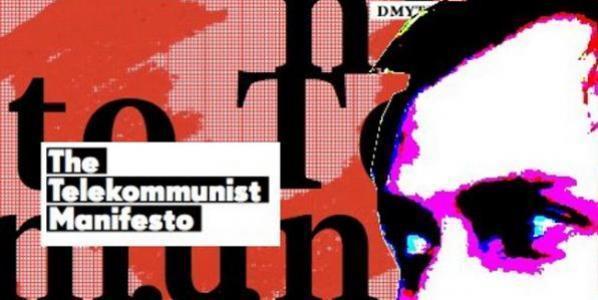 KMO, from the C-Realm Podcast, interviews Dmytri Kleiner
This interview with Dmytri Kleiner, conducted by KMO for his C-Realm Podcast, was transcripted by Guerrilla Translation at KMO’s request. The audio was, unfortunately, unusable for the podcast because of background noise, but the resulting interview was too good to not to share. The following is re-posted from the C-Realm blog.
KMO: You are listening to the C-Realm Podcast, I am your host, KMO, and I’m speaking with Dmytri Kleiner, venture capitalist and miscommunications technologist. Dmytri, welcome to the C-Realm Podcast.
Dmytri: Thank you, but that’s “venture communist.”
KMO: Did I say “capitalist?”
Dmytri: [chuckles] It’s an easy mistake.
KMO: You know, I’ve read the phrase “venture communist” several times in the past few hours in preparing for this interview, and yeah… it just rolled out “venture capitalist,” didn’t it?
Dmytri: [chuckles]
KMO: So, Dmytri Kleiner, “Venture Communist” – what does that mean?
Dmytri: Well, it’s sort of the name of a research project I started awhile ago. My background comes from the social justice movement of the 90s. I was part of some of the kinds of hacker groups that eventually became things like Indymedia, and stuff that we called technology affinity groups. At that time there was something going on called the dotcom boom, that you probably remember. A lot of us who were part of these hacker affinity groups supporting activist projects were working for these dotcoms.

Dmytri Kleiner
As the social justice movement began to fade, along with the dotcom boom itself going into bust, it became very clear to me that this was very problematic. These truly liberating and revolutionary communication platforms were not going to be funded by capital. And so, if venture capital wasn’t going to fund them, then we needed some other way to fund them. This is where the term originates from. It originates from the simple aversion to venture capital. If venture capital won’t fund what we need to do, then we have to create venture communism. And so, venture communism itself began as a research project. And over time, there has been some development of the concept, but I usually mean the term in the very broad sense. I have my own proposals that you’ll find in the manifesto and other texts for what approaches to venture communism might look like, or what a venture communism may be like, but I also use the term in a very broad sense that could include other ways of collectively forming the communication capital that we need.
KMO: I’ll just tell you a little bit about my relationship to capitalism and the dotcom period. I worked in customer service for Amazon.com from 1996 to 1998 and got some pretty decent stock options. When I sold them, I made more money with one phone call than I did in all the rest of my life selling my labor by the hour. I made that one call to the brokerage and said, “Exercise all of my options and sell the shares,” and I got about $660,000 with that call.
Dmytri: Wow…
KMO: Had I waited and made the call six weeks later, I would have made about $3 million.
Dmytri: Oh, wow.
KMO: And in hindsight, I’m so glad I didn’t wait. The money let me do what I wanted to do for many years, but then it ran out. By then I had moved to Arkansas where I was trying to start a homestead farm. That’s where I was living when I ran out of money and had to go back to work in my mid-30s, with a nearly decade-sized gap in my resume. There was not a lot of opportunity, really, in Berryville, Arkansas, in the early aughts. Well, I had a big change of heart, because, before that, I had been very much libertarian, politically. I had been a techno-utopian, a trans-humanist, and a Singularitarian. Those are meme complexes that tend to attract one another.
Dmytri: Sure.

KMO
KMO: Rarely are trans-humanists particularly critical of capitalism, or even cognizant that there might be something to criticize. And so, having to basically start again in my mid-30s, working really horrible jobs in sales – I started selling cell phones, and then I got into insurance, which is a really, really ugly business – my political views changed, and eventually my techno-utopian views gave way as well.
Now, I’m actively critical of capitalism. But I’m trying to articulate that criticism in such a way that it does not trigger an automatic ideological, reflexive rejection of what I have to say. Because, for so many people in this country, particularly in the middle of the country, the word “capitalism” just means “our side.” It represents everything that is right and good. Capitalism is synonymous with prosperity, and communism means totalitarian, evil dictatorship that brings austerity, and slavery. So, I’m trying to be very careful with my terms, but let me encourage you to say as much good as you can about the concepts of communism and peer to peer networks.
Dmytri: Well, I never imagined myself to be speaking to the masses or making an argument to the masses. From the beginning, I always considered myself to be an artist and to be somebody who had technological skills that could be of use to activist movements. So, I was never particularly concerned with the words that I used, and actually, I’ve always been rather attracted to strong or provocative language from “pirate” to “hacker” to “communist.” But, actually, now that I have, over the years, taken on a more “contributing to theory” kind of a role, I think that it’s quite important to continue using the word “communism”.
When I had my post-social justice, post-dotcom disillusionment, I started really engaging on a lot of forums where actual economists and political theorists participate. A little bit outside of the hacker community, in this sort of infoshop politics of “reclaim the streets,” and one thing that really frustrated the people that I was communicating with was that I wasn’t using any kind of language they recognized.
When you work in any kind of technical field, whether it’s computers, whether it’s politics, whether it’s economics, there is an established dialogue going on, and if you use the language that everybody else is using, that makes it a lot easier to communicate, to share ideas, and to really be very precise about what arguments you’re making. And so, I learned that I should understand the classical language, and that I should be able to use it.
A lot of people who like my work over the years that come from similar backgrounds as yourself, and they were reluctant to use the word “communism.” They would say, “Ah, this sounds really interesting, I like what you’re saying, but do we have to use that word? That word is so horrible and off-putting”. But, actually, that word connects you to hundreds of years of research and struggle and theory that goes far deeper and far broader than my own work does. So, by not just making up some random word – like what was it, “venture community-ism” was one of them, and other kinds of things – and by sticking to the word “communism,” it might connect you to that theory as well.
Another thing I think is really important is to understand that anything can go wrong. Anything can go badly. So even if we make up new words, it doesn’t mean that we will somehow protect ourselves from possible negative outcomes. By using the word “communism,” it is implicitly understood that negative outcomes are possible, because we have actually seen them. In using that word, we do it without naïveté. We use it with the understanding that it’s not necessarily problem-free.
KMO: I heard you say in a presentation, that when you use the word “communism,” you are talking about a theoretical society; one that has no historical example.
Dmytri: That’s true, but there are historical examples of people who tried to achieve it.
KMO: But there has never been a nation-state that embodied communism in the way that you’re describing it.
Dmytri: Well, there’s never been a nation-state that claimed to have achieved communism.
KMO: I think that’s an important point that American audiences in particular would find unfamiliar. Here, the Soviet Union is held up as the archetypal example of communism.
Dmytri: Right, but not a single leader of the Soviet Union would ever have claimed to have achieved communism.
KMO: I have been reading your “Telekommunist Manifesto,” and there’s one sentence from early in the manifesto that I think we could probably spend the rest of our time together just unpacking. So, let me read that, I’ll even read it twice, and then I’ll ask that you explain it piece by piece. You wrote, “The Internet started as a network that embodied the relations of peer-to-peer communism. However, it has been reshaped by capitalist finance into an inefficient and unfree client-server topology”.
So, let’s start with just the first part. “The Internet started as a network that embodied the relations of peer to peer communism”. Say more about that.
Dmytri: Well, for many of us in activist circles, in hacker circles in the 90s and some even before (that had access), the Internet didn’t just represent a new technology. It represented something that could have very broad social and political implications, in that, when you use the technology, especially the classic platforms of the Internet, – email, IRC, USENET, and the original classic platforms of the Internet – they didn’t mediate between users. All communication between users was based on mutual configurations. So therefore, if your computer and my computer agreed to exchange information with each other, we could do that without the mediation. Every intermediary node operated under the end-to-end principle, and just allowed us to communicate as if we were talking directly to each other. So this was very much a society of equals.
The “classic Internet” had this kind of ethos of sharing, like we really believed at that time that the Internet was uncensorable. We had this idea because of the topology, and because of the peer-to-peer nature of the communication tools we were using. But of course, what we didn’t fully realize back then, is that this Internet was very tiny.
The “classic Internet” had this kind of ethos of sharing, like we really believed at that time that the Internet was uncensorable. We had this idea because of the topology, and because of the peer-to-peer nature of the communication tools we were using. But of course, what we didn’t fully realize back then, is that this Internet was very tiny. It felt big to us, but it was really very tiny. It was mostly developed by universities, by NGOs, by the military, and other organizations, and the people developing it were developing it for use value, which is an important distinction in economics.
The people who were making things like email, make USENET, like IRC and Finger, were not making them so they could sell them for exchange. They were making them in order to use them. So it really embodied a communist ethic of “from each to each.” The people creating technology wanted to use and share it with everyone that needed it.
But of course, this can’t scale very much, in order for a communication system to be used by the billions of people on the planet, it can’t be entirely made by university students, NGOs and some military contractors. When the Internet became commercialized, it became commercialized by venture capital, and venture capital invests money not for use value but for exchange value. This means that when a venture capitalist provides money, he or she does so under the pretext that they will make more money in return. This is different from a use value Internet. It becomes an exchange value Internet. In order to capture exchange value, the network had to become less free. An internet that allows users to do whatever they want presents very limited opportunities for capitalists to earn profit.
In order to charge prices, communications could be centralized through areas where prices can be charged. And so, there you have the re-architecture of the Internet from what it was back then, based on peer-to-peer software like e-mail, IRC, USENET, Finger, and so forth, to what eventually became called social media, or, briefly, Web 2.0, which is where web applications were developed to mimic the kinds of interactions people were having on the real peer-topeer social media platforms of the early Internet, but in a client-server fashion reminiscent of the original capitalist online platforms like CompuServe, and the original AOL, where all users connected through a central point. Platforms like Facebook, Twitter, and other sorts of things used this same model, and by doing so, they were able to make a profit model based on the capture of user data and control of user interaction.

Dmytri Kleiner
KMO: This will be a little bit of an aside, but just for my own personal curiosity, when I first started using the Internet, I was a graduate student at the University of Missouri in the early 1990s, and I used IRC, email and USENET, and I also got into listserv discussion groups, but I’m not familiar with Finger, what is Finger?
Dmytri: Finger is like status updates, you have a text file in your home directory, two text files actually, .project and .plan, and you could put your status updates in there, like you might do on Twitter now and then people could check what you are doing.
KMO: Hm, I wonder how I missed it?
Dmytri: You probably had one. People could Finger you.
KMO: Would you say what you mean when you describe the current state of the Internet as being, “an unfree, client-server topology”?
 Dmytri: Yes. That is because the current state of the Internet is based on big, centralized services like Facebook, but that’s not all that’s possible. You can still use Finger on the modern Internet as long as you still have TCP/IP to the house, which is, of course, not guaranteed. For one of Telekommunisten’s artworks in 2010 we made a clone of Twitter. It was a microblog based on Finger to show that these ideas have been around since the beginning of the Internet and that the kinds of things being made by modern social media platforms aren’t new in the sense of what kind of use of media they are proposing. The only thing that’s new about them is how they want to capture profits. Finger has existed since the 70s in a distributed fashion that nobody could make a profit on because nobody could control it. Twitter is, of course, very central. It requires millions and millions of dollars in funding. Because it can capture lots of data it can make a business model around monetizing that data and selling it to advertisers and other parties.
KMO: And later in your manifesto, you wrote, “No social order, no matter how entrenched and ruthlessly imposed, can resist transformation when new ways of producing and sharing emerge”.
Dmytri: Right.
KMO: And yet, new ways of producing and sharing did emerge with the early Internet, tools which you described as being very peer-to-peer and communist in structure. And yet it was resisted. That transformation was seemingly hijacked and redirected toward things that are very favorable to the preservation of inequality, a class system and commoditized art, and all the distasteful aspects of the modern Internet.
Dmytri: Well, that’s because, as I elaborate more in the section that talks about peer production, Benkler and stuff like that, is that we haven’t actually achieved peer production on any kind of massive level. If you look at what happens with the early Internet and free software, you see that what was going on was not a new mode of production, but just a very unique kind of distribution of an existing form of production at its core. The problem with free software and free networks is that they can’t capture any exchange value as we discussed already. And so because they can’t capture any exchange value, they cannot finance their own material cost of the upkeep of the people that take care of them. The networks and the programmers and the engineers, and all the people that contribute to the development of free software and free networks need sustenance. And that sustenance, then and now, still comes from capitalism. That, I think, is the point. A true mode of production can’t be resisted, but we haven’t actually seen peer production emerge as a real, significant form of production. For that to happen, we have to have material assets in the commons as well as immaterial assets. So long as the composition of the commons is entirely immaterial, they will not be able to sustain its material upkeep.
The networks and the programmers and the engineers, and all the people that contribute to the development of free software and free networks need sustenance. And that sustenance, then and now, still comes from capitalism. That, I think, is the point. A true mode of production can’t be resisted, but we haven’t actually seen peer production emerge as a real, significant form of production.
KMO: Is there any point in trying to request that the state serve the ends of a peer-to-peer society, or is the state completely at odds with that by definition?
Dmytri: There are a number of threads in the overall strategy that I think are necessary. On one hand, we need venture communism, which means independent, federated entrepreneurship along communist principles. But on the other hand, the state does exist, and I believe that we can’t just imagine that we live in a future state-less society. We have to understand what the state provides now, and we have to struggle within the state as a theater of struggle as well, to get what we can out of it. So I would say yes, but that it really depends on where you are.
In principle, if you look at public funding for other kinds of media, like film, television, and movies, in many cases there’s been quite significant public involvement in the development of those media. So, do I think that there is the prospect for public involvement in funding of social media for a positive impact? Certainly, but, in an era where we’re still not out of the neoliberal phase of history, in an era where governments don’t even want to pay for schools and housing and education and roads, the idea that they will suddenly become interested in paying for social media seems unlikely. So, it doesn’t seem to be a prospect that I have a lot of confidence will actually come about, though it could come about, and if it did, it could be positive. Perhaps, especially in areas that are trying to assert their independence from global neoliberalism, like South and Central America for instance, perhaps they will understand the public need to finance social media in the same way that they finance their broadcast media and their film media.
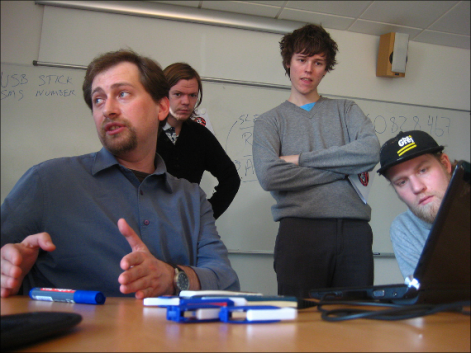
Sousveillance. The Art of Inverse Surveillance February 8th – 9th, 2009, Aarhus University, Denmark.
KMO: Just last night, I was reading an essay by David Byrne, of the Talking Heads, about Spotify, streaming music, and the emerging situation in which all the money changing hands for streaming music is basically going to record labels. Not only are they selling the songs of their artists to the streaming services, but they are also in exchange, for the listing the music companies catalogs, they are getting a stake in services like Spotify, but that artists get very little, even though it is the creativity and passion of the artists whih create value of the end users. The contribution of the artists is absolutely vital and integral, but they get very little of the proceeds.
For example, this past summer, Daft Punk had a song that was so popular that even people who don’t pay follow the music business or make any effort to seek out new music would recognize it – “Get Lucky” is the song – and their Spotify revenues for this, which had been downloaded or streamed hundreds of millions of times, was $13,000 each. They are the megastars of streaming media right now, and the amount of money that they received was less than one would make flipping burgers at McDonald’s. And so, we’ve got this emerging structure where the assumption is that the artists themselves are expected to work a day job somewhere, and then, in their spare time, struggle and produce art which enriches corporations. I’m just wondering what way forward you can envision, and what’s actually worth the time and effort trying to bring it about, because I’m largely of the opinion that trying to request that corporations and governments stop their current collusion and help artists is probably a silly way to invest one’s energy, and I’m wondering about a viable way forward.
Dmytri: I think, in most places, I would agree. Though, as I said, I think in some places it’s more viable than others, but here in the Western world, I think that it wouldn’t be the best use of energy. You had John McChesney on the program, and I’m sure that my view is not so different than his.
The answer, as it’s always been, has been the organization of workers towards ownership of the means of production. It’s no surprise to me that artists are being squeezed out of the profits made by Spotify and other online streaming corporations, because, you understand that artists are paid for their labor value, not the value of what they produce. The value of what is produced is captured by the people that own the means of production and distribution. They are the ones who are going to capture the value, so, unless artists own their own means of distribution and production, they can’t hope to capture the value that is so produced. So the only real way forward is to have not Spotify and iTunes, but organizations made up of the people who actually make the music involved in the production and distribution of media, and to have those owned by the workers themselves.
KMO: I understand that, but I find it an unsatisfying answer. (laughter)
Dmytri: Yeah, I know, it’s the same answer we’ve had for a couple of hundred years.
KMO: Yeah…
Dmytri: It’s not a sexy new answer, but, unfortunately the basic economics makes it so.
KMO: Well, the very central point of McChesney’s message is that we are approaching or perhaps in the midst of what he calls a “critical juncture,” which is a convergence of crises in which a disruptive new technology, a legitimacy crisis around current institutions and economic turmoil all come together. When that happens, we get a moment where there is a possibility to make institutional changes which are sweeping and long-lasting, and it seems that our side, so to speak, is not as focused on capturing the opportunity of that moment, that critical juncture, as the capitalists are. They seem quite poised to take advantage whenever these opportunities open up.
Dmytri: Of course. And, you know, that’s very difficult to combat, because they have the accumulated wealth to be able to weather the storms. So, in a way, crisis serves a role in capitalism as well. It allows the stronger capitalists to squeeze out the weaker capitalists, because capitalism is competition even among the capitalists. The capitalists aren’t only struggling against us, but also struggling against each other.
KMO: And so, it’s no good to try to become a sort of minor, beneficent capitalist, because the larger and sociopathic capitalists will just outcompete you and reduce you back to the worker who is paid not for the value of what he creates before his time, basically.
Dmytri: Absolutely, that’s right. And I think it’s important to understand that capitalism is not a choice for capitalists either, because if you’re capitalist and you invest your capital in such a way that it fails to create more capital, you cease to be a capitalist, right? So, capitalists are just as much trapped within the capitalist system as everybody else.
KMO: But it’s a much more well-appointed cage that they inhabit than most everybody else inhabits (laughter).
Dmytri: Certainly, but it’s not that even if any individual or bunch of individual capitalists suddenly had an epiphany and decided to abandon their exploitive ways, that that would be a threat to the system itself. That would only be the opportunity for other capitalists to squeeze them out.
KMO: Although it seems that the capitalists who had this emerging sense of consciousness and esprit de corps and identification with people and other classes of society, if they had this awakening moment, but they also realized what will happen if they act on it overtly, they might, if they were clever (and they must be clever to be where they are), continue to use the language which pacifies the other capitalists, while working subtly and behind the scenes to implement improvements and some movement toward social justice.
Dmytri: I don’t think language actually has much to do with it. I think the only people that are queasy about radical language are people who position themselves on the left, because they feel that being portrayed as a radical will weaken their position. I think that the people in power are not particularly concerned with language, and you can see that very often if you look at media campaigns. We’ve seen all kinds of revolutionary language, and even revolutionary figures from historical events used in advertising, used to promote and describe capitalist products. So, of course the film industry uses these themes and figures quite liberally, and it’s funded by capitalists.
I don’t think that the capitalist has to make a semantic argument to his peers, I think they have to be successful. I think, in the end, they have to capture profit. And it doesn’t matter how they capture the profit. If they do capture it, they become successful. And that’s also very interesting.
I don’t know if you’ve read any of the work that I’ve done on macroeconomics, which is much more recent than the manifesto. It still consists of just random blog articles rather than a more substantial text, but there are a couple of ideas that I’m fleshing out, and they don’t have names as catchy as “venture communism,” but I think that they’re interesting ideas. The great Polish economist, Michał Kalecki, created an equation to separate profit and consumption by class, which is to say, by workers profit and by capitalist profit. This equation allows you to see the relationship between capital and labor within the profit model. Using Kalecki’s equation as inspiration, I tried to take an approach where I look at modes.
 One major problem that I have with a lot of progressive theories that you hear casually within the anarchist community and the communist community is this idea that communism is something that happens in the future, that it suddenly happens as an epiphany, where societies are transformed magically from the old society to the new society, and everything is completely different. I don’t think that this is the case. I think we have communism right now, as well as capitalism right now. If you look at the kinds of relationships we have in our day-to-day lives, we have relationships that are ruled or dominated by exchange value, but we also have relationships that approach the communist relationships of “from each according to his ability, to each according to his need.” “From each, to each”, as I like to summarize it. And we experience these relationships among our friends, within our families, within intentional communities, and also within some of the emerging peer-production forms, like free software and information sharing, and things like that.
What we have is multimodal environment, and I think we need to look at the economy as having multiple modes of production happening at all given times. I don’t think it should be our objective to try to figure out how we can flip from one to the other, but how we can increase the kinds of producing and sharing that we think are beneficial and want more of and decrease the amount of producing and sharing that happens at ways that we think are destructive and not beneficial, and that we want less of. We need value to flow from one mode to another, this is what I’m thinking of, inter-modal value flows.
What we have is multimodal environment, and I think we need to look at the economy as having multiple modes of production happening at all given times. I don’t think it should be our objective to try to figure out how we can flip from one to the other, but how we can increase the kinds of producing and sharing that we think are beneficial and want more of and decrease the amount of producing and sharing that happens at ways that we think are destructive and not beneficial, and that we want less of.
One kind of these flows is something that I’m calling “substantiation”, which I’ve already been told is a horrible term. The idea of “substantiation” is that there are certain forms of investment that benefit individual members of a class, while hurting the class as a whole.
One example of substantiation is workers supporting capitalists when they buy capitalist securities in their pension funds. Individual workers that buy the securities could very well benefit, but the class doesn’t, because, overall, it cedes more power to capital. The capitalists take that investment and use it to expand capitalist control of the means of production and their own political strength. So, even though funds may benefit the individual workers who invested in them, they hurt workers as a class.
Now, I think that we can also find examples of things that are going the other way. I think free software for instance is a good example of that. If you are capitalist whose business depends on software as an input — in other words, you don’t sell software but you need software in order to produce whatever it is you produce — and you capture your profit elsewhere in the circulation of that final product, so capital is an input to your production, you therefore invest in free software, and by doing so you may yourself benefit, because you get help from the community and cheaper and better software to use in your own production. But, the capitalist class loses, because the sale of software licenses is broadly damaged, is lost as a way to make profit for the capitalist class. So, even though in both cases the individual members of the class are benefiting, this kind of value flow hurts the class in general. These are just a couple of examples of the kind of thinking we need to develop further. We need to figure out how value flows between the different modes that are existing at the same time within the contemporary economy, and what kinds of methods and institutions and practices can we introduce and promote that will cause value to flow from exploitive means to liberating means.
KMO: I think I follow you, but would you summarize your last line of reasoning?
Dmytri: I think that it’s helpful to think of the society that we live in as not being either capitalist or communist, in essence, that it’s helpful to think that within our society we have many modes of production going on at the same time. We have capitalism. We have communism. We have all kinds of hybrid and alternative forms going on. But we have a lot of different kinds of social relations. So, what we need to do is think about that in a compositional way. We need to think about what kinds of ways of producing and sharing are already going on right now, that we could develop more broadly, and how can we move and make value flow from the more exploitive modes to the more liberating modes.
This is what I was trying to get at with the idea of substantiation. These modes are coexisting and drawing off each other, and so just as much as we are benefiting the capitalists with our production, because everything that happens within commons-based production right now as being captured by capital, because the commons is still largely an immaterial commons. But likewise, by contributing to that immaterial commons, the capitalists are also helping us. So, value is flowing. We need to think strategically and ask how can we reduce the loss and maximize the gain. We need to conceptualize how to structure the kinds of productive forms which enable a sustained and positive long-term exchange away from capitalism.
KMO: Well, Dmytri Kleiner, it has been a pleasure talking to you, I look forward to future conversations, and thank you very much for participating on the C-Realm Podcast.
Dmytri: Very nice talking to you as well.
