Category: Leonidas Martín
Beautiful Fences
In this short piece, Leonidas Martín (of Colectivo Enmedio, among other things) talks about the paradoxically subliminal yet strong social control imposed by state-directed urban design and re-design, the possibly surprising causes and effects of that control, and some heartfelt speculation on art’s role in recovering the nature and purpose of our cities. If you like this piece, you’ll love 12 Inspired Actions to Outsmart Repressive Situations and Laws, co-written by Leonidas Martín and Amador Fernández-Savater. This piece originally appeared on the Enmedio blog.

Polideportivo Raval (where metal plates were installed in the windows to prevent anyone from sitting down)
Since the day it first opened, the windows of my neighborhood gym have been a gathering point for neighbors. They’re right at street level, and they’re big. Lots of us had sat on their deep windowsills for many years, most of all the Pakistanis who live in the surrounding area. Note that I said, “had sat”, because ever since Barcelona’s City Hall installed some giant metal plates, no one sits there anymore. The gatherings and chit-chats are over. “Keep it moving!”
Saying “metal plates” might make you think of something like those iron gates which restrict access to someplace, or the spools of barbed wire you often see along the borders. They’re nothing like that. The metal plates they’ve installed at my gym are lovely. They’re designed by a young architect, one of the many young architects that work for City Hall, and they’re perfectly integrated with the structure of the building. The window glass, the ledges and the plates complement each other like parts of a Franz Joseph Haydn symphony. In fact, I’m sure that if anyone passed by there today – anyone who didn’t already know what these windows had been, and what they were used for – they wouldn’t notice anything strange. And that’s what’s so interesting.
It’s a given that movement within city spaces has never been free; architecture and urban design have always directed it. But unlike the fences, bars, and walls that once were used to restrict and channel our mobility, this contemporary urban furniture is all but invisible. Before, regulating the behavior of bodies in space and directing what to do and how to do it required very visible elements. Today, however, it seems that this kind of indoctrination calls for something altogether different – going unnoticed, or only minimally. And with hardly a change to the landscape, it serves its repressive purpose – or does it one better.
It isn’t always like this; there are still places where these urban elements controlling bodies in space are crystal clear. You only need to have a look at the southern border of Europe to get the idea. In Ceuta, for example, the walls and the barbed wire aren’t hidden under any pretense whatsoever; in fact, it’s just the opposite. In these places, the urban elements are clearly visible. They have to be. Their effectiveness depends in large part upon their visibility. An undocumented immigrant who wants to enter Europe must plainly see the material obstacles he’ll run up against, the things blocking his entrance. Presumably, one would think twice after seeing things like that.

Floral spikes
But this piece of mine isn’t set in any of those locations. What I’m talking about here is other places, where the immigrants who already crossed those borders end up. I’m referring to those cities where they come to seek their fortune: particularly, those cities which profit from advertising themselves almost like commercial brands. Cities like Barcelona, Paris or London. In these places, the devices dictating behavior go virtually unnoticed. They’re integrated into the visual matrix of the city itself, hardly perceptible, serving to uphold the aesthetic values and morals associated with that city, while hiding their primary function – directing the mobility of the people.
The plates installed outside the windows of my gym are far from the only example of this kind of urban installation designed to prevent unwanted situations and social behaviors. The city-brands are full of these elements; low hedges and bushes, strategically located to prevent people from making themselves at home in public places; magnificent wrought iron fences blocking access to restricted areas; exquisite spikes preventing people from laying down where they shouldn’t; geometric forms in noble materials placed in corners to dissuade people from getting cozy where they oughtn’t…endless urban designs which, as in the E.A. Poe story “The Purloined Letter”, are right in front of everyone, yet pass unnoticed. We come across these things a thousand times, but we never see them, or, at least, we never see their true, hidden purpose.

Elegant spikes
At first glance, these elements could seem irrelevant, just little urban bits not worth considering. But as I see it, these fragments represent – although slyly – the spirit of the economic and political model which created them: the spirit of the market. A spirit which sets everything in motion (people, cities, countries, works of art…) under the criteria of the one and only law: extract the most profit possible from any human activity. This spirit is everywhere; it affects us all and all that surrounds us. The immigrants themselves, as mentioned earlier, were driven here by this spirit. It’s what set them in motion, the power that has pushed them over the walls, dodging barbed wire. “Motion” here doesn’t imply freedom, far from it. All movement prompted by the spirit of the market must always be conducted and occur under the law it imposes. Otherwise, this mobility could deviate, resulting in a non-consumer-economy objective – and that’s a risk the market can’t take. In this sense, the metal plates at my gym, or other similar urban elements, are the grease which helps to run the indoctrination imposed by the spirit of the market.
The behavior of the citizens, as with the identity of a city, is not something to be taken for granted. Instead, it’s one’s own actions, and the changes these acts make to the social fabric, are what create behavior. These actions and behaviors could be, a priori, infinite. To limit them, to make them respond to a certain spirit, takes a lot of creativity. Right here is where the role of an artist comes into play – or has this not always been the artist’s task, to bring a touch of common sense to something that has neither pre-existing logic nor order (as Oscar Wilde said, “…to teach Nature her proper place”)? It comes as no surprise, then, that it’s the artists, the architects, and the designers who are in charge of translating into form (urban furniture, in this case) the one commercial law and its objectives. They do it because it’s what they know how to do, it’s how they make their money. But they also do it because they’re more concerned with form, with those aspects that lie at the heart of art itself, than with the end-uses derived from their work. And they do it for one more reason.

Cactus
In the world we live in, each of us goes it alone in society. No intermediaries. A stranger among strangers. This emboldens a “me” full of pride, ready to believe he’s almighty. But it also encourages a “me” ready to fall at the feet of any effigy that crosses his path. A “me” ready to take on the world, but beaten by fear and loneliness. So this young architect designs the metal plates which later get installed by City Hall in the windows of my gym, because he feels lost in some incomprehensible hieroglyphs. This young architect looks at life as characters in Kafka’s novels do. He knows not who decides things, nor to whom he may turn in search of justice or help. For him, to live is to be dragged along by a mysterious force whose sheer power and great size reveals his own utter helplessness. This is the starting point from where our young architect designs the metal plates which serve to prevent immigrants from gathering in the street.
Each time I go for a swim at the gym, I wonder – what would it be like, an art that could break this damned aesthetic statute that prevents gathering? An art open to a dynamic concept of life, where our surroundings are created in direct relation to constantly changing behaviors? What would it be like, an art that stood up to established forms of behavior, and able to adapt to new ways of life, ones we’ve been seeking for a long time? And what about a form of urban design which, instead of concealing repression, organized our shared world? Because this, and nothing else, is a city: the organization of our shared world.
Article translated by Jane Loes Lipton and Stacco Troncoso – Guerrilla Translation!
This article has also been published in:
A call for the World Record of people shouting, “You’ll never own a house in your whole fucking life”

Ah, the joys of homeownership and mortgage payments. We at Guerrilla Translation take these issues very seriously, so we’ve brought in an expert to tackle this ever pressing concern.
Artivitist Leónidas Martin is the co-author of our recent translation “12 Inspired Actions to Outsmart Repressive Situations and Laws”. In the following lines (and videos), Leo reminisces about an illustrious career characterised by smashing world records, and interviews some of his buddies addressing the housing crisis in their own peculiar way.
First up, we have the TV ad leading up to the world record…
“A call for the World Record we set for the most people shouting, “You’ll never own a house in your whole fucking life” (sadly, Guinness wouldn’t recognize our feat). An event that gathered hundreds and hundreds of people in cities all over Spain to shout, collectively and publicly, what had been experienced until that moment as a personal problem.”
How did this illustrious event come into being?
The baby says “The mortgage is KILLING ME!”
An anonymous email started making the rounds on the net, summoning thousands of people to protest against rising home prices and speculation on May 14th 2006, at the same hour, all across Spain. The protest was repeated during many a subsequent Sunday and, lo and behold, something like a social movement had sprung up, with a regular assembly organising a bevy of activities (marches, press conferences, actions, media appearances, etc). Within this context, it didn’t take us long to realise that we were a varied bunch: graphic designers, teachers, activists, hairdressers, actors… the lot. This held a potential, a cornucopia of riches that we immediately exploited; this is the origin of all the design and creative elements that made Vdevivienda 1 such a visible phenomenon (graphic campaigns, videos, action staging, etc). Every production made within this open, creative, diverse and cooperative framework was an example of collaborative creation. It was delightful.

And to wrap it up, this thrilling Ramones-song-length documentary on the making-of the World Record. Here’s what Leo has to say on the subject:
The “Fuck-o-meter”. You saw it here first.
On October 6th, 2007, we beat a new world record. Thousands of people in cities all across Spain simultaneously shouted: “You won’t own a house IN YOUR WHOLE FUCKING LIFE!” The decibels radiating from this collective cry were registered by an interactive meter, baptised “The Fuck-o-meter” for the occasion. The sheer intensity and volume of this vociferation was reflected in real time and projected on a massive screen by a stage, whereupon a group of actors, showmen and activists hosted the proceedings for this grand public intervention. That was a day we made ourselves heard; man, did we ever make ourselves heard…

Bonus! We didn’t translate this one, because Leo is possessed of full English-speaking Ninjahood. See him here, waxing lyrical on the joys of the Spanish revolution….
1. [Or “H is for Housing” a wordplay on V for Vendetta.]↩
12 Inspired Actions to Outsmart Repressive Situations and Laws
 Amador Fernández-Savater & Leónidas Martín
- Translated by Stacco Troncoso, edited by Jane Loes Lipton– Guerrilla Translation!
- Main Image by Colectivo Enmedio
- Original article at eldiario.es
The Spanish government’s latest round of anti-protest laws are as worrying as they are laughably predictable. On top of criminalizing passive resistance, the new regulation considers actions such as uploading images of police violence to YouTube, or even Tweeting about a protest, to be punishable by fines as high a 600,000€, if you decide to protest in front of any so-called “Democratic Institutions”. As George Orwell argued, “A society becomes totalitarian when its structure becomes flagrantly artificial”.
Given that this trend is growing internationally, and rather than play a cat and mouse game where normal people have the losing hand, we can turn the tables and ridicule these sorts of reactionary, short sighted, desperate measures with our greatest assets: imagination, humor and the fact that we’re the good guys. The following article, written by Spanish art-ivists Amador Fernández-Savater and Leónidas Martín, offers 12 examples drawn from the last five decades poised to inspire and provoke. And check this out: so many people are eager to learn more about the how-to and history of this approach, that this has been the single most widely Facebook-shared article in eldiario.es’s history! We’ve also included some English hyperlinks to follow up on some of these leads and subtitled the one video in Spanish. Although written in reaction to the passage of the new law in Spain, we believe that their application and appeal is universal. Read on…
The objective of Spain’s new Citizen Security Law is very simple: to proscribe politics by criminalizing it, and withdrawing anything other than politics by politicians from circulation. This stunted, meager concept of democracy declares that decision-making is the exclusive right of political parties, public opinion the monopoly of experts, and that the sole role of the citizenry is to vote every four years.
The law was immediately dubbed the “Anti 15-M” law in social networks. In effect, these measures don’t hold up to the general and abstract character of a proper “law”. Instead, they’re very specifically directed against the new forms of on-the-ground citizen politics we’ve seen emerge in these last two and a half years: 15-M, Mareas (Citizen’s Tides), PAH, for example 1. While critics of the 15-M movement dismissed it as something meek and inoffensive, it’s now evident that its open, creative, and inclusive modes of action have posed a challenge to the powers that be.
It is certainly not the first time in the history of politics – and by this we mean, the surging increase of debate and decision-making by the people on issues of common life – that politics have come under threat: dictatorships, authoritative regimes and repressive laws, police management of public space, and so on. What then can we do when open, frontal confrontation is neither possible, nor the best of all options (because it’s useless, because it makes us feel despondent and crushes our voices, because it only leads to a trail of wounded, imprisoned protesters, etc.)?
In other, infinitely harsher situations than ours, the people managed to come up with subtle, intelligent and imaginative strategies to bypass repressive situations and laws. Below we present 12 stories of actions that can inspire us today to disobey the new law with humor, beauty, mobility, and a bit of camouflage.
Humour (or How to say it without saying it)
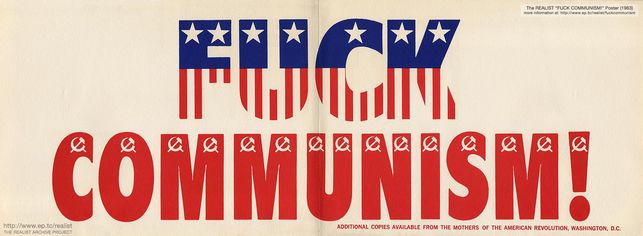
1: Fuck Communism in the USA
In the United States in the 60s, two words were absolutely forbidden. One, literally, was the word “fuck”. Writing it or saying it aloud could carry fines, or even prison sentences. The other was, both culturally and symbolically, “communism”. It was the great taboo, the evil spirit which the House Committee on Un-American Activities had decided to eradicate (and magnify, in considering anyone and everyone to be a suspect).
The Yippies, which was the creative activist group led by Abbie Hoffman and Jerry Rubin, decided to take matters into their own hands by organizing a citywide sticker and billboard campaign with the following slogan: “fuck communism”. There was a poster designed by Paul Krassner.
They were saying the forbidden (sometimes as a feint or while saying it without saying it), dodging censorship and criminalization, seeking complicity with intelligent observers able read between the lines and appreciate the genius of this operation.
For further investigation: Read Kurt Vonnegut’s thoughts on this poster.
2: The Orange Alternative in Poland
In the 80s, you needed guts and killer smarts if you wanted to go up against the Communist regime of Poland. Without them, you’d almost surely end up in prison for the rest of your life – or worse. Members of Pomaranczowa Alternatywa (Orange Alternative) stood out for their whimsical approach to protest and their creative use of the absurd.
They kicked off their career by painting dwarves over the regime’s attempts to whitewash all antigovernment graffiti away. These omnipresent dwarves soon took on lives of their own as symbols of Polish dissent. Hundreds of people dressed up as orange dwarves started to protest in the streets, demanding things such as the overthrow of Gargamel (!)
By using metaphor and allegory, saying without saying, they carried out dozens of protests without running the risk of being arrested – that is, without those arrests making the authorities look pretty ridiculous in the process. Really, how can anyone take a police officer seriously after seeing him arrest a protester for “participating in an illegal gathering of dwarves”?
For further investigation: Join “The Orange Alternative Revolution of Dwarves”
3: The Tighty-whitey Block in New York City
A few days before the protests against the World Economic Forum in February 2002, the Major of New York City digs up an old law (drafted in 1847, no less!) prohibiting the use of masks in the course of any public event. The restoration of the law has a very clear objective: to allow the police to compile a thorough photo archive of protesters.
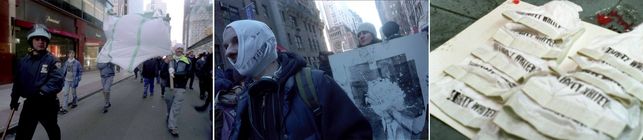
The New Kids on the Black Block, a group of anti-globalization activists wise in the ways of guerrilla communication, scrutinize the law with the utmost attention. What the law literally says is that the “use of any kind of mask” is strictly prohibited. But, with a bit of creativity, many things can be pressed into service…and thus, the Tighty-whitey Block is born.
“Tighty-whities” is US slang for old school underpants. In a matter of hours, the New Kids acquired a truckload of more than a thousand of these underpants, had them printed with subversive messages and distributed among the protesters. What’s more, they produced a gigantic underpants-shaped banner as a rallying point for all who wanted – or needed – to protest in anonymity, even if it was with a pair of underpants covering their mugs.
Tighty-whities: underpants though they may be, masks they most definitely are not. So, the police are left impotent as hundreds of protesters march by with underpants over their faces. They can’t make arrests, much less build that photo archive – certainly not the kind of mugshots they were expecting!
Camouflage (or, how to break the rules of the game from inside)
4: Argentina’s 501 Movement
Voting is compulsory in Argentina, but the National Electoral Code exempts anyone who’s 500 kilometers or more away from their home. On election day 1999 a group of young people invited anyone feeling dissatisfied with the electoral routine to make their way to a location 501 km away from their place of residence, as a way of expressing that the true meaning of democracy can’t be reduced to choosing from among what are, essentially, identical options every four years.
All the participants certified before police that, on election day, they would be 501 km away from their place of residence. Free, collective travel arrangements were provided from Buenos Aires to Sierra de la Ventana, where a festival was held. Unsurprisingly, they were accused of being “anti-political”, “anti-democratic”, and blah, blah, blah. But they countered, in their “Open Letter to Voters”, that right there at kilometer 501 they had reclaimed the true meaning of democracy, not as a perfunctory formality of the Necessary and Inevitable, but rather as a transformation of the extant, by everyone and for everyone.
For further investigation: “El movimiento 501, la “Carta a los votantes” y la spanish revolution” (in Spanish).
 5: The Sex Pistols on the Thames
It’s mid-1977, Queen Elizabeth’s Jubilee is drawing near and the Government and the Royal House are desperate to avoid any critical actions. Following this logic, the Sex Pistols, authors of the song “God Save the Queen”, are expressly forbidden from playing on the British mainland.
The Pistols’ reaction to the ban is legendary. Instead of throwing in the towel, the band rent a boat for the occasion (aptly named the “Queen Elizabeth”), and on the 7th of June, the same day as the Royal March, they play a gig smack in the middle of the River Thames. Lest we forget, while the official order expressly prohibits them from playing on British mainland, it doesn’t say anything about rivers and waterways.
The stunt was so successful that it sent shockwaves through the media. That same week, their single “God Save the Queen” reached number one in the British charts. But, given that the song was banned, their chart-topping success could neither be announced on television, nor played on the radio. It was the only time in history that there has been no number one song.
6: Belarus’ Revolution Through Social Networks
Belarus, July 2011. Frustration over the economic crisis reaches its peak. President Alezander Lukashenko’s authoritative regime forbids all types of protest, while police repress all dissent. In response, the “Revolution Through Social Networks” appeared, a public call to gather in the streets to applaud, or to synch all mobile phones and make them ring at the same time. In this (apparently inoffensive) manner, thousands of people managed to turn a handful of everyday gestures into powerful expressions of dissent.
Mobility (or how to not become a target for your adversaries)
7. Lavapiés 15, Madrid
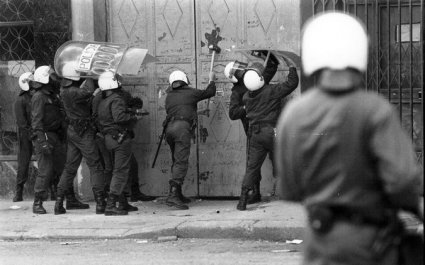
Located at its namesake address in the Lavapies district of Madrid, Lavapies 15 was a squat back in 1996. An official eviction order was drawn up within six months of its existence. The dwellers of Lavapies 15 sealed the door and pretended to hole up inside, the standard procedure for squats at that time (very heroic perhaps, but both useless and frustrating in the end).
So, as a hundred police agents and a helicopter searched the house, the squatters made their escape over rooftops, making obvious the disproportionate, unjustified and repressive deployment. It’s even rumored that some squatters actually stood by the door, mingling with the rest of the onlookers, to witness their own eviction.
“Resistance doesn’t have to equal suffering, taking the piss is another form of struggle”, they explained in regards to their action.
For further investigation: Read a short excerpt from “The Exteriority Crisis: From the City Limits and Beyond” on “The Ghosts” of Lavapies 15.
8: Chile’s National day of Protest
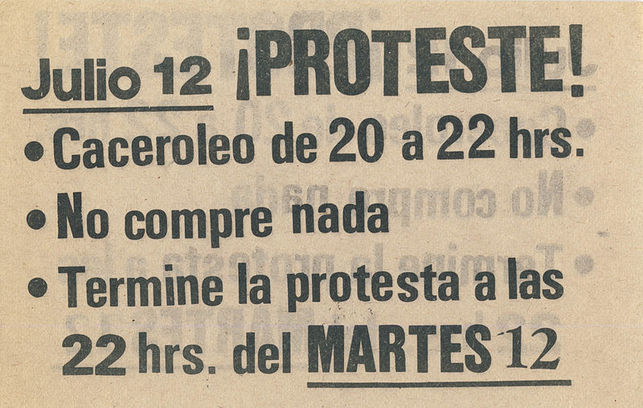
Chile, July 1983. Pinochet’s dictatorship is 10 years old, and the copper mine workers celebrate the anniversary by holding a national strike. The copper mines were the backbone of the country’s economy at the time, so the dictator’s response was swift. Hundreds of troops and various police forces surround the mines, with orders to shoot anyone supporting the strike. Bloodshed seems inevitable. However, it didn’t turn out that way.
Barely a day before the beginning of the strike, the leaders and spokespersons of the worker’s movement decide to change strategies. Rather than having the miners work stoppage be the only means of protest, they called for the first National Day of Protest, with many decentralized actions throughout the country. For example, people were encouraged to drive their cars at a snail´s pace through the main highways and thoroughfares of Chile, creating epic traffic jams all over the country; or to turn the lights on and off in their houses; or to incessantly bang pans and pots at nightfall. This was the birth of the cacerolazo, a mode of protest still very much in use nowadays.
9: The (non) Battle of Puerta del Sol, Madrid
Tuesday, August 2nd 2011, the police unceremoniously clear out the remains of the recent occupation of Puerta del Sol, Madrid’s famous main square. Specifically, the info booth left there by the 15-M Movement. They tear down the beautiful plaque that read “We slept, we awoke. The square is taken”, and dump it in the trashbin. Thousands of citizens, feeling suddenly erased from the map, spontaneously gather to reconquer the square.
Lines of police blocked all entry points, while armored police vans stood guard over an empty square. Suddenly someone shouts, “Ciao, ciao, ciao, nos vamos a Callao” (“Ciao, ciao, we’re moving to Callao” – one of the neighboring squares). The slogan is quickly picked up. Rather than confront the police, protesters decide to turn their backs on them. Change of perspective, change of scenery, change in the dialogue, change of interlocutors, and change of emotions. Instead of uselessly screaming in the face of impassive policemen, 15-M decides to branch out all over the city. A seemingly helpless situation turns into one of empowerment. A joyous evasion.
The police garrison at Sol remains entrenched in position, protecting nothing. A day goes by, then two, three…such a level of police presence is unwarranted, and on the fourth day, they are told to stand down. Then, on the night of August 5th, the people happily re-enter the now liberated square in a great march.
For further investigation: a text Amador wrote describing the events (translation not ours)
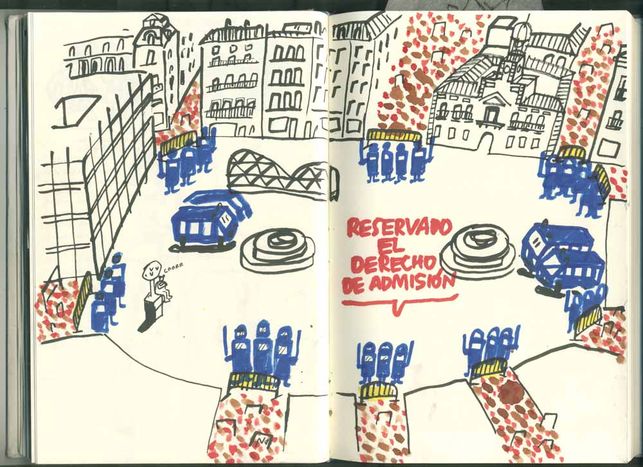
The (Non) Battle of Sol as seen by Enrique Flores. The bubble reads “We Reserve the Right to Refuse Admission”
Beauty (or how art disarms brute force)
10: The pianist at Gezi Park (Istanbul)
During the June 2013 protests and prior to the final eviction of Gezi Park in Istanbul, president Erdogan had given an ultimatum to the demonstrators.
7 P.M. on the 12th of June was the chosen hour. Everything was primed for a police charge: emergency crews, gas masks, media, barricades…but just as the clashes began and the teargas exploded, there came a sound – neither war cry nor firearms, but music: The Beatles’ “Let It Be”. A piano had appeared from nowhere, and a hooked-nosed skinny kid with a hat was playing “Imagine” by John Lennon and “Bella Ciao”. Just then, everyone stopped what they were doing and gathered: they sat, applauded and sang together.
The pianist was a German of Italian origin, who’d been travelling throughout Europe carrying a message of peace. He had made the piano himself, asserting that his music calmed the police and, somehow, protected the demonstrators. Erdogan didn’t dare crush this community sprung around music. It would have been too brutal an image to expose to the world.
(Here you can see the Solfónica, Madrid’s own protest-march classical ensemble and choir, producing the same effect during the Spanish general strike of November 14, 2012)
What you have just read is a fragment of a chronicle of those days in Istanbul written by our friend José Fernández-Layos. You can read the full account here in Spanish
11: “Standing Man” in Istanbul
When Erdogan finally – without warning – attacked Gezi Park and evicted the occupiers, he issued a threat: anyone trying to enter Taksim Square (adjacent to the park) would be accused of terrorism. Thousands of people tried to enter forcibly or via the barricades, but it was all in vain. Until one man waltzed through, posing as any other tourist, with no gasmask or bandanna covering his face, and simply stood in front of the Atatürk building, just standing there quietly for hours. It soon became a trending topic on Twitter and the police arrested him, but it was too late: many other “standing men” or “still persons” like him replicated the action in an incessant dribble on squares throughout the country. Bit by bit, Taksim was reclaimed. It was practically impossible to steer public opinion that these people were terrorists, when it was plain to see that they were simply people standing there…although, in fact, everyone knew that they were defying the government.
What you have just read is a fragment of another chronicle written by our friend José Fernández-Layos about those days in Istanbul. You can read the full account here in Spanish
12: The Reflectors in Barcelona
Around the time of the first anniversary of the 15-M protests, the powers that be had flipped the switch on their repressive countermeasures to criminalize street protest. Playing into this dynamic robs the streets of plurality, “de-democratizing” protest and reducing it to small groups, very homogenous and easy to identify and codify. Enter The Reflectors with the slogan, “We won’t play that game, let’s break the codes”.
The Reflectors look like superheroes out of a Marvel comic book, but they are in fact normal people with two or three very un-normal characteristics: their brilliant costumes made out of aluminum foil, the Reflecto-Ray and the Reflecto-Cube.
Used correctly, the Reflecto-Ray reflects sunlight over police cameras recording protesters. The Reflecto-Cube can be used in two different ways: as a festive prop when any protest starts getting boring, and as an antidote to police charges.
This second application of the Reflecto-Cube was put to the test for the first time in Barcelona, during the last general strike on November 14th, 2012. The populist protests of the morning had finished, and police entered the Plaza de Cataluña square in full force, striking everyone in their path with their batons. People panicked. Terrified protesters started running towards neighboring Paseo de Gracia and, at that exact moment, the Reflecto-Cube erupted onto the scene. After a good while trying to get to grips with it, the riot police decided to dispose of it by pushing it back towards The Reflectors, who proceeded to send it back to the police, starting a game of absurd beach volleyball that radically transformed the atmosphere in the square from sheer panic to all-out party in less than a minute.
For further investigation: Find out more about The Reflectors’ adventures here.
Do you know of any other similar actions? Tell us your story in the comments, and we will try and update this article with them.
This first compilation was written by Leónidas Martín Saura (Enmedio Collective) and Amador Fernández-Savater, with the indispensable help of Sabino Ormazábal and his horseflies, Juan Gutiérrez, Frauke Schultz, Lawrence of Arabia, Nuria Campabadal, Beautiful Trouble, José Fernández-Layos, Margarita Padilla and Franco Ingrassia.
The principles of the Guerrilla Movement are, ultimately, two: mobility as the best defensive weapon; and thought, as the best kind of attack. Neutralizing the enemy’s targets and the conversion of each individual into a sympathizer and friend are the keys to victory.
BONUS! Here’s a coda of sorts to this compilation, written by the co-author Leónidas Martín and published in our Metablog: A call for the World Record of people shouting, “You’ll never own a house in your whole fucking life”
Guerrilla Translation/Related: Overcoming the Shock Doctrine/Soy Pública
 Strength and Power: Reimagining Revolution/ Amador Fernández-Savater
 The Interruption of the Dominant Narrative, an interview with Colectivo Enmedio/ Amador Fernández-Savater interviews colectivo Enmedio
1. [These are all groups and collectives enmeshed within the 15 -M network. Briefly]:
- Las Mareas or “Citizen Tides” are Spain’s post-syndical defense network for Education, Public Health, Feminism, Labour rights and more.
- PAH (Plataformas de los Afectados por la Hipoteca) is Spain’s anti-foreclosure network.
To read about these, and many other, initiatives taking place in Spain right now, read our translation of Bernardo Guitérrez’s “Spain’s Micro-Utopias: The 15M Movement and its Prototypes”]↩
